Get Full Government Meeting Transcripts, Videos, & Alerts Forever!
Get email alerts on the Elections Legislation topic
No spam. Unsubscribe anytime.
Committee begins review of a package of election bills: hand audits, recount rules, poll‑watcher rights and photo‑ID changes
Summary
The committee reviewed working drafts of multiple election bills including a proposal for random precinct hand audits, new recount thresholds and deposit rules, expanded poll‑watcher access, independent‑candidate signature and timing changes, voting‑machine test rules, and tightening acceptable photo ID for in‑person voting.
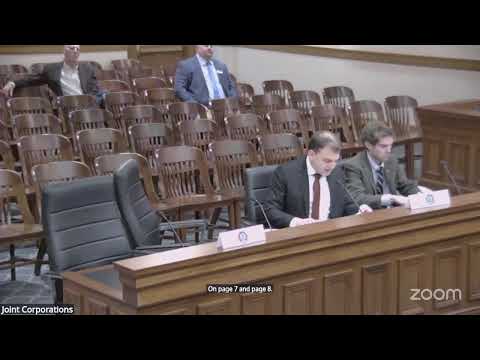
The Joint Corporations, Elections & Political Subdivisions interim committee heard a detailed briefing on several election bill drafts covering post‑election audits, recounts, poll‑watcher authority, independent candidate nominations, voting‑machine testing and acceptable identification.
Josh Anderson (committee staff) walked members through working drafts (26LSO‑43 through 26LSO‑49). Key changes discussed included a precinct‑level random hand‑count audit after each primary and general election (secretary of state to select one precinct per county and county clerks to complete a hand count within seven days), revised recount thresholds that would trigger mandatory hand recounts (for example, automatic hand recounts for statewide or legislative offices if margins fall below 1% or 2% thresholds specified in the draft), and the creation of an election recount account to reimburse counties when recount costs exceed statutory deposits.
Secretary of State Chuck Gray said the hand‑count precinct audit measure was identical to a bill the office supported in the Legislature and recommended rule‑adoption timing be moved earlier (Secretary recommends rules by July 1, 2026) and urged immediate effect for clarity. On automatic recounts, he and staff proposed several technical amendments and flagged concerns that the engrossed version assigned some automatic recount costs to the state; they recommended restoring the status‑quo allocation in which counties bear costs for certain automatic recounts unless statutory thresholds for state reimbursement are met.
On poll watchers (26LSO‑45), the draft would expand watchers’ access to observe early in‑person and absentee processes, allow a designated replacement process if a watcher is removed or does not appear, specify identification badges and seating, and clarify that watchers may observe set‑up and shutdown procedures. The office described the measure as bringing Wyoming into alignment with many other states’ poll‑watcher statutes.
The independent‑candidate draft (26LSO‑46) would tighten nominee qualifying requirements: require independents to be unaffiliated at the time of nomination, move nomination paperwork into the same filing window used by partisan candidates (starting 81 days before the primary with 14 more days to file petitions), and raise signature thresholds (for example, raising legislative district thresholds from 2% to 5% of the prior vote). Sponsors and staff said the goal is to put independent and partisan candidates on a more consistent timeline and to limit last‑minute entrants who file after seeing primary results.
Voting‑machine and electronic ballot marking device test rules (26LSO‑47) would require public notice, individual machine testing (not just per type), retention of test certificates with the secretary of state, and a clear retest process; the secretary proposed three technical amendments to ensure every county that uses ballot‑marking devices follows the same test protocol and to require archive of results in their original form.
Voter‑identification changes (26LSO‑48) would remove Medicare/Medicaid insurance cards and student IDs as acceptable photo‑less identification and require that any remaining acceptable forms include a photograph; the Secretary proposed an enactment date of June 1, 2026 and suggested an additional amendment to make clear expired IDs are not acceptable and to require presentation of the original ID rather than a photocopy in some circumstances.
Committee members raised implementation questions: how often automatic recount thresholds would be triggered; potential county budget impacts if counties remain responsible for recount costs; whether hand audits would select precincts appropriately and how a transparent randomization process would be run; and the timing of any enactment so clerks can adapt procedures. The committee did not vote on the bills at this session and recessed for lunch with public comment scheduled for the afternoon.