Get Full Government Meeting Transcripts, Videos, & Alerts Forever!
Get email alerts on the Emergency Services 911 topic
No spam. Unsubscribe anytime.
Panel backs study and limited emergency grants to shore up Wyoming 9-1-1 services
Summary
The committee amended 26LSO183 to require a third-party study of a potential statewide migration to next-generation 9-1-1 and to authorize a single appropriation (study plus emergency gap funding) to help underfunded public-safety answering points; stakeholders urged inventory, interoperability and equitable grant rules.
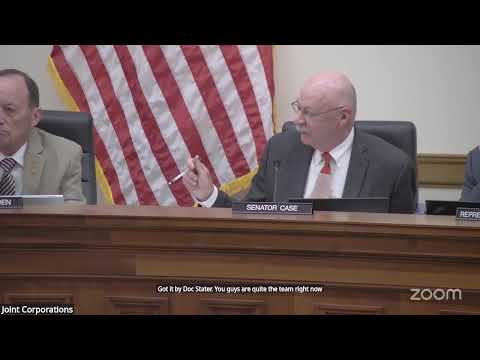
The Corporations, Elections & Political Subdivisions Committee on Feb. 20 voted to sponsor an amended 26LSO183 that directs a formal study of Wyoming’s 9-1-1 systems and authorizes a limited appropriation to fund the study and provide emergency gap grants to struggling Public Safety Answering Points (PSAPs).
Nate Smolinski, the state’s 9-1-1 coordinator and chief technology officer, told the panel the state should contract a third party to examine governance roles, expenses for migration to next-generation 9-1-1 (NG9-1-1), operational models, technologies, efficiencies and funding options. He proposed the Public Safety Communications Commission oversee an RFP-led study and estimated a study cost of up to $750,000.
Local officials, sheriff and police associations, county commissioners and city managers supported a study and asked that limited bridge grants be available while the state conducts a full inventory and migration plan. Alan Thompson (Wyoming Association of Sheriffs and Chiefs of Police), Nick Agopian (County Commissioners Association) and Craig Haslam (former Fremont County dispatch chair) emphasized that PSAPs are locally run, vary widely in capacity and face an estimated statewide funding shortfall of roughly $3 million for current operations.
Telecom providers and vendors (Verizon, Charter, Lumen, Range) backed a study and urged equitable, interoperable solutions and cautioned against relying solely on assessments on customer phone bills; the hospitality industry opposed tapping lodging-tax revenue. The committee debated whether to make the bill purely a study or to include grant authority; members combined both approaches by amending the draft to fund a study and provide emergency gap funding through a single appropriation and to allow flexibility about which state agency administers the program.
The committee adopted the amendment directing immediate study work and a single appropriation and voted to sponsor the bill as amended. Members asked staff to refine language, determine an appropriation source and set reporting steps.