
Residents oppose ICE partnerships as Sullivan County Commission approves consent calendar, opioid‑fund appropriation and vehicle bond
Get AI-powered insights, summaries, and transcripts
Subscribe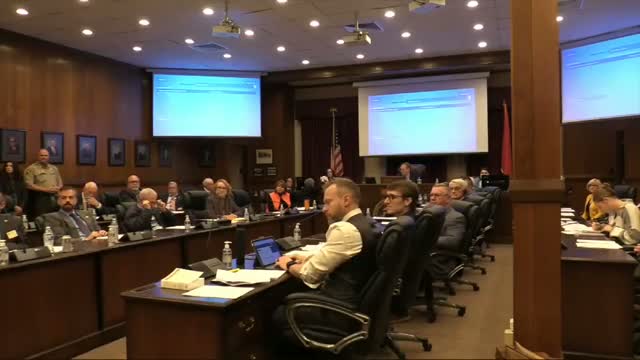
Summary
Large public comment turnout urged commissioners to reject ICE/Homeland Security partnerships and grant money; the commission nevertheless approved the consent calendar and adopted resolutions including an opioid‑settlement appropriation to Families Free and a capital outlay note to buy sheriff vehicles.
Hundreds of residents, many representing local faith groups, health advocates and concerned neighbors, used the Sullivan County Commission's Feb. 19 public‑comment period to oppose the county accepting Homeland Security or ICE‑linked funds and partnerships. Commissioners then moved through a consent calendar and approved several resolutions, including opioid‑settlement funding for a women's recovery home and authorization of a bond for sheriff vehicles.
Speakers during the public comment period described fears that ICE task‑force activity and related grants could lead to racial profiling, civil‑rights harms and local disruption. One speaker urged the commission to "vote no on probably your items 2 and 3," decrying cooperation with ICE operations. Gail Health, who identified herself as a Sullivan County resident, told the commission: "Please do not accept ICE funding and the obligations that come with it." (Public comments are recorded in the meeting transcript.)
Several commentators referenced recent national incidents and urged the county to avoid adopting the same approaches; others argued the small dollar value of a federal grant would not be worth the social and legal risks. Stephanie Rosen Wing said the county should reject a reported $145,000 Homeland Security award that could support ICE activities and pressed the commission for details about which local officers completed federal task‑force training and who would pay overtime or potential civil‑liability costs.
Sheriff Jeff Cassidy addressed the crowd and commissioners in defense of task‑force partnerships, characterizing task‑force activity as an evolved practice since 9/11 and arguing the sheriff's office seeks to maintain oversight when working with federal partners.
Votes and key actions later in the meeting:
- Consent calendar: passed by unanimous consent (clerk recorded 21 yes, 3 absent). - Item 10 (establish ACH advance payments for property taxes; waiver of rules): recorded as passing with 21 yes, 3 absent (moved to first read status). - Item 13 (appropriation from the opioid settlement fund to Families Free for operating costs of a women's recovery home): the commission adopted the resolution (clerk recorded 21 yes, 3 absent). The packet language read "513,700" (see clarifying details); the commission recorded adoption on the floor. - Item 17 (authorizing issuance of a capital outlay note not to exceed $1,522,000 to acquire sheriff and corrections vehicles): adopted (clerk recorded 19 yes, 2 abstain, 3 absent). Commissioner discussion asked for a five‑year replacement plan for fleet purchases.
Why this matters: public opposition to ICE partnerships and Homeland Security funding was a dominant theme of the meeting and prompted extended comment from residents; the commission nonetheless proceeded to approve multiple measures, including funding that commissioners said must be used for treatment (opioid settlement funds) and a bond to acquire vehicles for law enforcement operations. The votes recorded in the clerk's tally establish the adopted items and will be reflected in county fiscal and program implementation.