Get Full Government Meeting Transcripts, Videos, & Alerts Forever!
Get email alerts on the Healthcare Credentialing topic
No spam. Unsubscribe anytime.
DOH credits 'Project Pathway' pilot and new HELMS system with speeding health‑care credentialing in Washington
Summary
Department of Health officials told Governor Inslee they have reduced psychology licensing backlogs, are redesigning credentialing teams and will roll out a new HELMS licensing system; a psychologist who waited months for licensure described the human effects of delays and recent improvements.
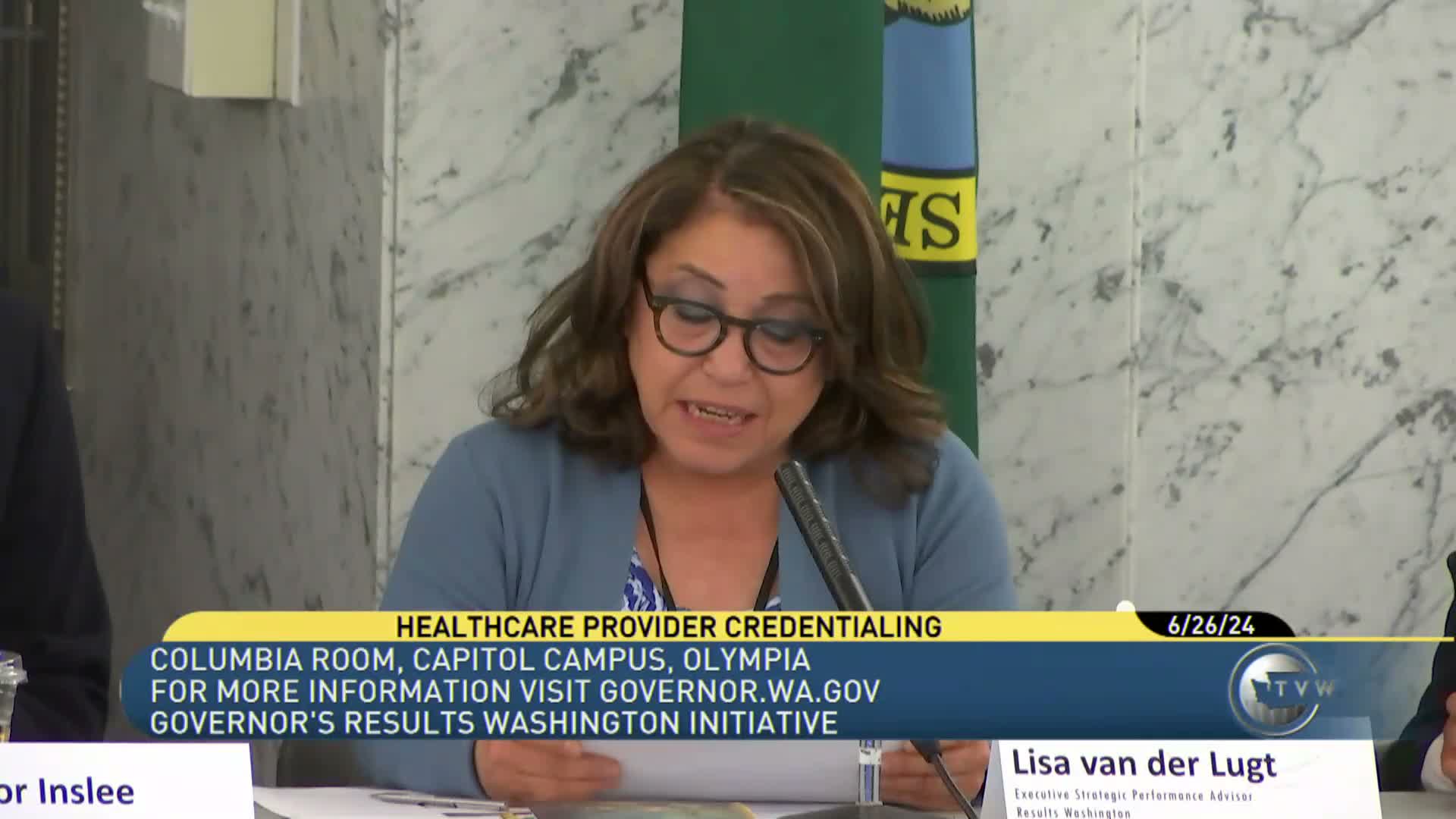
Sasha De Leon, deputy director in the Health Systems Quality Assurance division at the Washington State Department of Health, told Governor Inslee’s June public performance review that a focused pilot called Project Pathway slashed a backlog of complex psychology credentialing cases and helped the department bring timelines closer to its goals.
Project Pathway, which moved subject‑matter experts closer to credentialing staff and instituted daily case huddles, “eliminated that backlog” of about 55 complex psychology applications within three months and produced sustained improvements, De Leon said. The department said renewals are processed in about three days, while more complex initial licenses typically take around 90 days in the best‑case scenarios.
The pilot also produced measurable back‑office changes across behavioral health, De Leon said: applications pending in the behavioral health team dropped by 46% and pending emails declined by 26% after the reorganization. DOH reported it receives as many as 400 applications per day and processes roughly 73,000 applications a year, issuing more than 59,000 credentials annually; the division supports roughly 365,000 credentialed professionals across about 81 regulated professions.
Dr. Joe (Joseph) Barone, a behavioral health consultant who appears via video testimony, described months of frustration before changes reached him: he said initial communications from the department felt “curt and short and in personable,” but after renewed staff engagement last year he received different, more helpful messages and was fully licensed in May 2023.
"It was no longer this in‑personable shadow in the back…someone was actively trying to figure something new out," Barone said of the later interactions that led to his licensure.
Officials credited a mix of process, staffing and technology changes for the gains. Sasha De Leon and other DOH leaders described reorganizing credentialing teams under executive directors, adding pro tem board reviewers, implementing new scorecards for staff and updating application materials and FAQs to reduce confusion. The department acknowledged limits imposed by an aging information system and has been working on a replacement.
DOH is building a new registry platform called HELMS, the Healthcare Enforcement and Licensing Management System, which the department said will replace multiple legacy systems, allow mobile application submission, and provide applicants with real‑time status updates. De Leon said HELMS will roll out in three phases and be fully live "by next fall." Governor Inslee and others welcomed the system, though Inslee quipped that the HELMS name reminded him of former senator Jesse Helms and said he appreciated that the system acronym is not tied to that person.
Panelists also pointed to recent legislative changes cited by DOH staff that support credential portability and data collection. De Leon referenced ‘‘second substitute House Bill 17 24’’ (2023) and an ‘‘engrossed second substitute house bill 22 47’’ (earlier this year) as statutes that implemented recommendations to reduce credentialing barriers; she also cited an ‘‘engrossed substitute house bill 15 o 3’’ (2023) requiring demographic data collection from health‑care providers. (These bill identifiers are reported as spoken during the review.)
Dr. London Breedlove, director of professional affairs for the Washington State Psychological Association, said the association has seen “incredibly collaborative and forthcoming” DOH leadership and called improved communication and translation of complex licensing pathways helpful to members who were experiencing emotional stress and livelihood impacts from delays.
DOH emphasized ongoing priorities: build predictive staffing models to match workload, expand process redesign across professions, continue stakeholder engagement, and complete HELMS implementation. Secretary of Health Dr. Shaw told the governor the department is focusing on three investment buckets — staffing, data/process redesign and technology — and said artificial intelligence could play a future role in automating routine reviews and improving communications.
The public performance review closed with thanks to staff and partner organizations and reminders about a survey for attendees; organizers announced the next public performance review in July on poverty reduction and the working families tax credit.
Provenance: Reporting in this article is based on Department of Health presentations, panel discussion and video testimony during the June public performance review convened by the Governor’s Office.