Get Full Government Meeting Transcripts, Videos, & Alerts Forever!
Get email alerts on the Tribal Climate Funding topic
No spam. Unsubscribe anytime.
Inslee Announces $52 Million in Climate Commitment Act Funding for Tribal Climate Resilience During Quinault Visit
Summary
Governor Jay Inslee and Washington Commerce Director Fong visited the Quinault Indian Nation to announce new Climate Commitment Act investments and to highlight tribal-led relocation and habitat-restoration projects; Quinault leaders described specific local funding priorities, including school and museum relocation planning.
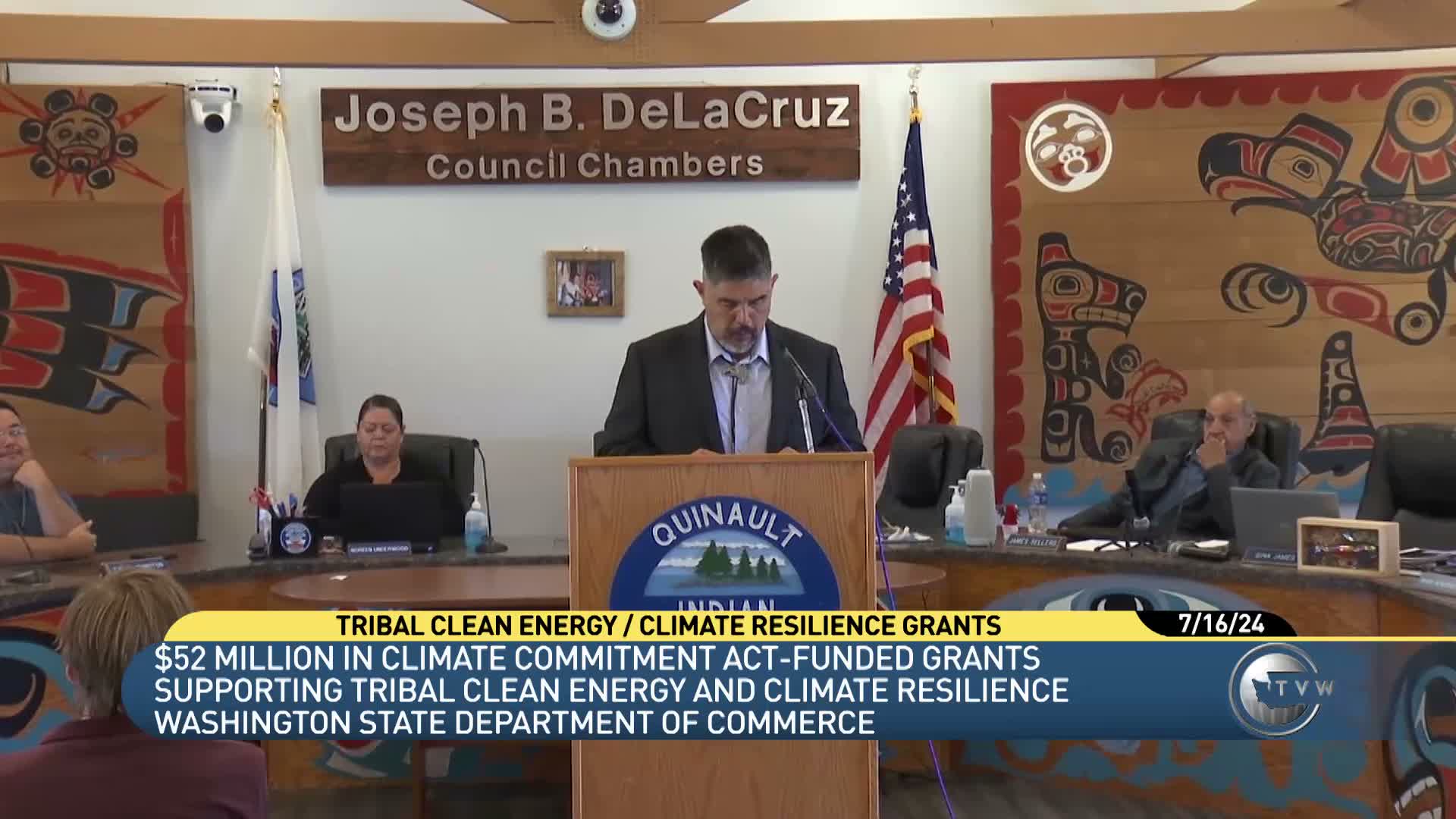
Governor Jay Inslee announced an additional $52 million in Climate Commitment Act funding for tribal climate-resilience projects on Monday during a visit to the Quinault Indian Nation, saying the state has already distributed nearly $140 million to tribal communities and that the new allocation will support planning and projects to respond to sea-level rise and other climate threats.
"An additional allocation of $52,000,000" was announced by Inslee, who told the Quinault community and guests that tribes will direct how the investments are used. "The best thing we're doing about it is have the tribes direct these investments," Inslee said.
The governor framed the announcement in the context of threats facing the Quinault and other coastal and river communities—sea-level rise, floods and wildfires—and praised tribal leadership for planning relocations and habitat restoration as both protective and morally necessary.
Quinault leadership described several projects already underway or planned that aim to move facilities and infrastructure to higher ground and to restore fish habitat. President Capone said the nation has secured or sought funding for an $8.7 million "Qu'itch generations" building, $1 million for a master plan, $2.6 million for a Taholah water reservoir to serve new construction on higher ground, $300,000 for a fisheries climate adaptation plan and $150,000 for architectural drawings to relocate the tribal museum that holds cultural archives.
"You can have the idea, you can have the dream, but to be able to carry it out until the end and move some dirt, move some money to ensure that that stuff happens, that is what I call success," President Capone said, describing both short-term construction and longer-term planning needs.
Inslee listed examples of tribal projects supported by Climate Commitment Act dollars statewide, including community warming-center solar arrays and battery backups, microgrids and upland relocation planning, and said tribal governments—not the state—are directing these investments. He noted the Climate Commitment Act has already funded tribal projects across Washington and said the newly announced allocation will add to that work.
Commerce Director Fong said the Department of Commerce is announcing $52 million in investments for tribal climate resiliency across the state and that Commerce had allocated nearly $80 million in Climate Commitment Act funding to tribal projects in the past year. She thanked staff members who led program work, naming Mary Miller and Tribal Relations Director Michelle Gladstone Wade, and said the agency aims to support both planning and physical infrastructure.
The event also included updates on salmon-recovery work in the upper watershed, where Quinault leaders reported progress but emphasized decades-long timelines for full restoration; on school safety and relocation planning for Taholah School District under a state seismic-safety grant; and on continued needs for state resources to carry projects into construction.
No formal votes or legislative actions were recorded at the event; the announcements described were funding allocations and program commitments by the governor's office and the Department of Commerce. The program concluded with an invitation for photos and a reception featuring locally prepared salmon.
Next steps identified in the remarks include tribal-led planning using Climate Commitment Act resources and continued coordination with Commerce and state agencies to move site planning and construction forward.