Get Full Government Meeting Transcripts, Videos, & Alerts Forever!
Get email alerts on the Workplace Harassment And Remedies topic
No spam. Unsubscribe anytime.
Attorney General’s civil‑rights adviser tells commission sexual harassment is underreported and outlines reporting routes and remedies
Summary
An Assistant Attorney General reviewed legal definitions, vulnerable workforces (farmworkers, construction, nursing), remedies and reporting pathways (AG Civil Rights Division, Human Rights Commission, EEOC), and urged reporting and safety planning. The AG office said state enforcement prioritizes pattern‑or‑practice matters but can provide referrals.
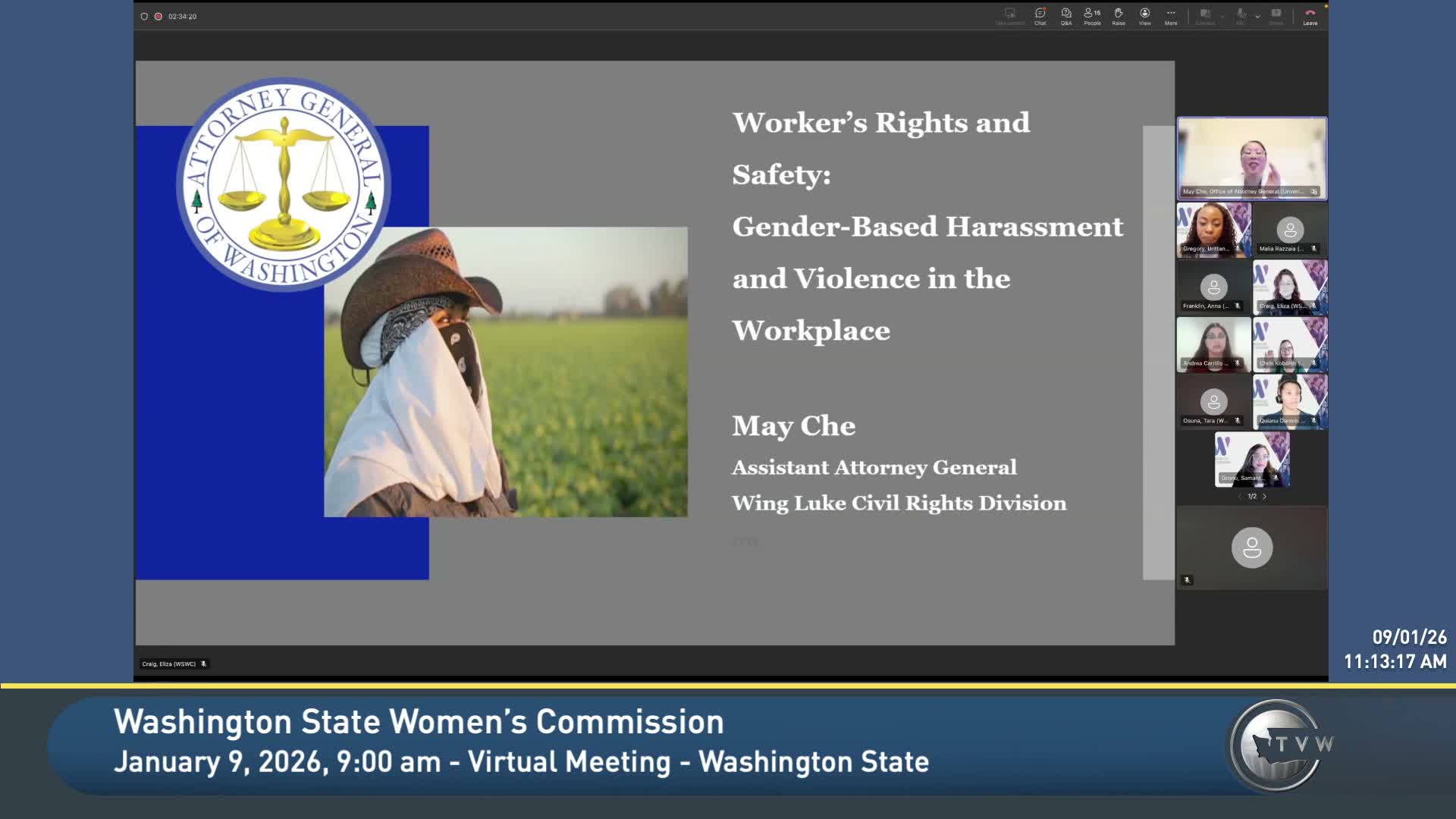
Mei Chi, an Assistant Attorney General in the Civil Rights Division, told the Washington Women’s Commission that gender‑based harassment and assault in the workplace are vastly underreported and that certain worker populations are especially vulnerable.
Citing federal task force findings and academic studies, Mei Chi said survey responses can vary widely depending on question wording: when respondents are asked generally, one in four women reported experiencing workplace harassment; when given definitions and examples, reported rates rise substantially. She identified high‑risk sectors — low‑wage female‑dominated industries, some agricultural work, construction and certain healthcare settings — and said BIPOC and immigrant women report higher rates of harassment.
Mei Chi walked commissioners through legal categories of unlawful conduct under Washington law and federal Title VII: quid pro quo and hostile‑work‑environment harassment. She reviewed remedies available through administrative and civil processes, including compensatory damages, injunctive relief (training, monitoring, supervisory reassignments), and, under federal law, punitive damages in some cases. Under Washington law, punitive damages are not permitted. She described time limits for filing: six months for HRC employment complaints and a 300‑day EEOC filing window in Washington when the HRC exists.
Mei Chi said the Attorney General’s Civil Rights Division typically prioritizes matters that implicate a pattern or practice affecting a class of people, but the office will speak with individuals, provide resources, and refer cases to the HRC or EEOC when appropriate. She illustrated enforcement remedies with summaries of past state cases and explained that administrative investigators have subpoena power and can seek temporary restraining orders or preliminary injunctions in urgent circumstances.
In a Q&A, commissioners raised concerns about immigrant communities’ fear of exposure, EEOC/HRC processing capacity and practical steps employers and workers can take to reduce risk; Mei Chi recommended reporting incidents, safety planning and pursuing legal remedies when appropriate.