Get Full Government Meeting Transcripts, Videos, & Alerts Forever!
Get email alerts on the Legislative Positions topic
No spam. Unsubscribe anytime.
Sentencing commission weighs in on several bills; recommends changes and conditional support
Summary
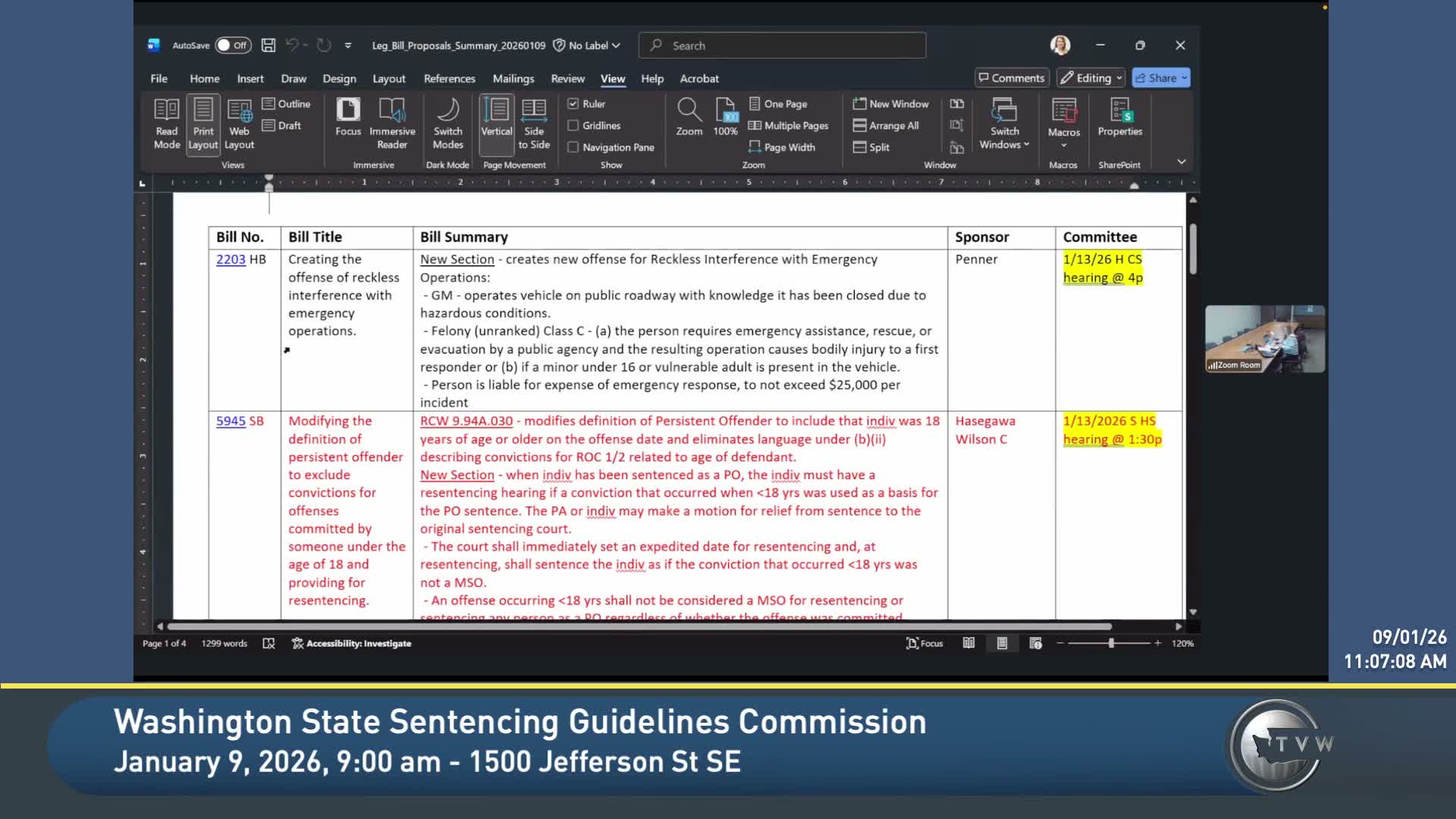
The Sentencing Guideline Commission reviewed multiple bills Jan. 9 and issued recommendations: it asked the legislature to lower penalty levels in bill 2203, supported SB 5945 (persistent‑offender retroactivity) and voted to support HB 2102 on LFOs limited to indigent defendants, each with caveats noted by commissioners.
At its Jan. 9 session the Sentencing Guideline Commission reviewed a slate of legislative bills and recorded formal positions it will convey to the legislature.
On bill 2203 (reckless interference with emergency operations), commissioners questioned whether proposed felony placement was proportional to comparable unranked class C felonies. Judge Swan moved that the legislature reduce the gross‑misdemeanor level to an infraction and the felony exposure to an unranked gross misdemeanor; the motion passed with a majority and multiple abstentions. The commission’s recommendation will be summarized for bill sponsors and committees.
The commission supported SB 5945, a proposal to exclude offenses committed when a person was under 18 from persistent‑offender (three‑strikes) calculations and to make that change retroactive for some cases. Members discussed the bill’s reach — staff and legislators noted approximately 24 people could be affected by retroactivity — and debated implications for victims and for those who were declined into adult court. The commission adopted a pro position to inform testimony.
On HB 2102 (revising legal financial obligations), commissioners debated scope and fiscal impacts. After discussion the commission voted to support the bill "as it relates to costs and fees" while expressly taking no position on the bill’s definitional components (for example the specific statutory definition of indigency), which it deemed outside the SGC’s scope. The motion passed with amendments and a recorded majority vote; staff will present the commission’s support and caveats when testifying.
What’s next: staff will prepare written testimony and present the commission’s positions at hearings. The commission also scheduled special legislative meetings to triage bills with imminent hearings.