Get Full Government Meeting Transcripts, Videos, & Alerts Forever!
Get email alerts on the Federal Funding And State Response topic
No spam. Unsubscribe anytime.
Washington governor vows to fight federal funding freezes, protect civil-rights and back clean-energy jobs
Summary
Governor Ferguson said Washington will use litigation and state resources to fight recent federal funding freezes—citing about $162 million currently affected—and pledged to defend reproductive and transgender health care, preserve DEI programs and accelerate state clean-energy investments.
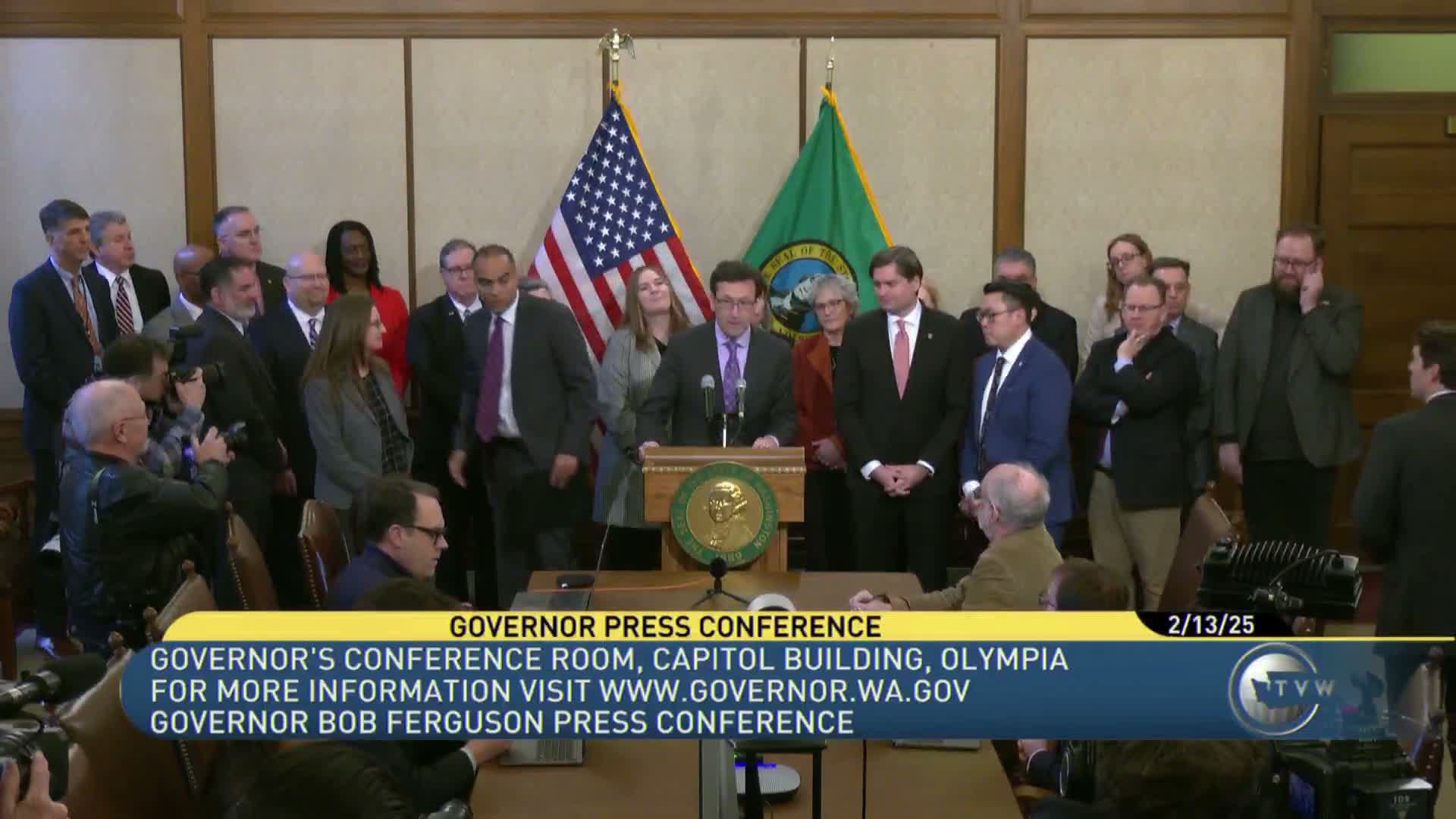
Governor Ferguson used a statewide press conference to lay out Washington’s legal and policy response to early actions by the Trump administration, saying the state will both defend its laws in court and invest state resources to protect residents and jobs.
Ferguson said Washington received roughly $27,000,000,000 in federal funding last fiscal year—about one-third of the state budget—and that “currently, as of this morning… 162,000,000 in federal funds are frozen that we’re aware of.” He listed affected programs including a large award tied to a “solar for all” program (about $156,000,000), a $3,000,000 climate pollution planning grant, and roughly $3,300,000 intended for Department of Natural Resources wildlife preparedness. “Things are literally changing daily, if not hourly,” he said.
The governor credited Attorney General Nick Brown’s office for pursuing court protections and said Washington will continue to litigate where federal actions exceed lawful authority. “Follow the law,” Brown said during his remarks, adding that the AG’s office has participated in four separate lawsuits and is leading two that address transgender health care and birthright-citizenship issues.
Ferguson framed the measures as part of a broader defense of state values. He pledged to protect reproductive freedom and health-care access for transgender Washingtonians, saying health-care decisions “will be guided by doctors and other health care providers, not politicians in Washington, DC.” The governor also vowed to keep state-funded diversity, equity and inclusion programs, arguing they make government more responsive.
On energy and economic risk, a Commerce official noted two primary threats: a legal freeze on federal energy funds and the possibility of a trade war. The official said Washington has some state resources and programs (including protections under the Climate Commitment Act) that can augment federal dollars, but warned that long pauses in federal funding would threaten clean-energy jobs and grid modernization.
Ferguson signaled forthcoming state investment decisions: “You can expect announcements from me in the coming weeks about investments that we are making in exciting companies in Washington state that will create good paying jobs in the clean energy economy.” He also said the state is monitoring budget impacts and preparing agency reduction proposals to meet a 6% target for many departments.
Reporters pressed officials on what would happen if the federal administration refused to obey court orders. Ferguson described such a refusal as “nothing short of a constitutional crisis.” Brown outlined standard enforcement steps, including contempt proceedings and judicial enforcement, and said courts have so far issued temporary restraining orders in cases brought by state attorneys general.
Ferguson closed by emphasizing the twin priorities of defending Washingtonians from unconstitutional federal actions and continuing to advance state priorities such as affordability, education and public safety. The administration said it will keep pursuing frozen funds in court while exploring state-level actions to support affected programs.