Get Full Government Meeting Transcripts, Videos, & Alerts Forever!
Get email alerts on the Budget Methodology topic
No spam. Unsubscribe anytime.
Forecast council directs staff on reversions, revenue floor, juvenile facility costs and Medicaid eligibility savings
Summary
The Economic and Revenue Forecast Council gave staff guidance on methodology for the governor's 2026 supplemental budget outlook, settling on a compromise reversion assumption (1% in FY26, 0.9% thereafter), excluding a statutory 4.5% revenue-growth floor, and including the governor’s proposed juvenile facility operating costs and functional‑eligibility savings in the outlook.
The Economic and Revenue Forecast Council on Jan. (meeting date) voted on a set of methodological choices staff will use to prepare an outlook for the governor’s 2026 supplemental operating budget, deciding on assumptions about unspent appropriations, a statutory revenue-growth floor, a proposed juvenile rehabilitation facility, and changes to Medicaid functional eligibility.
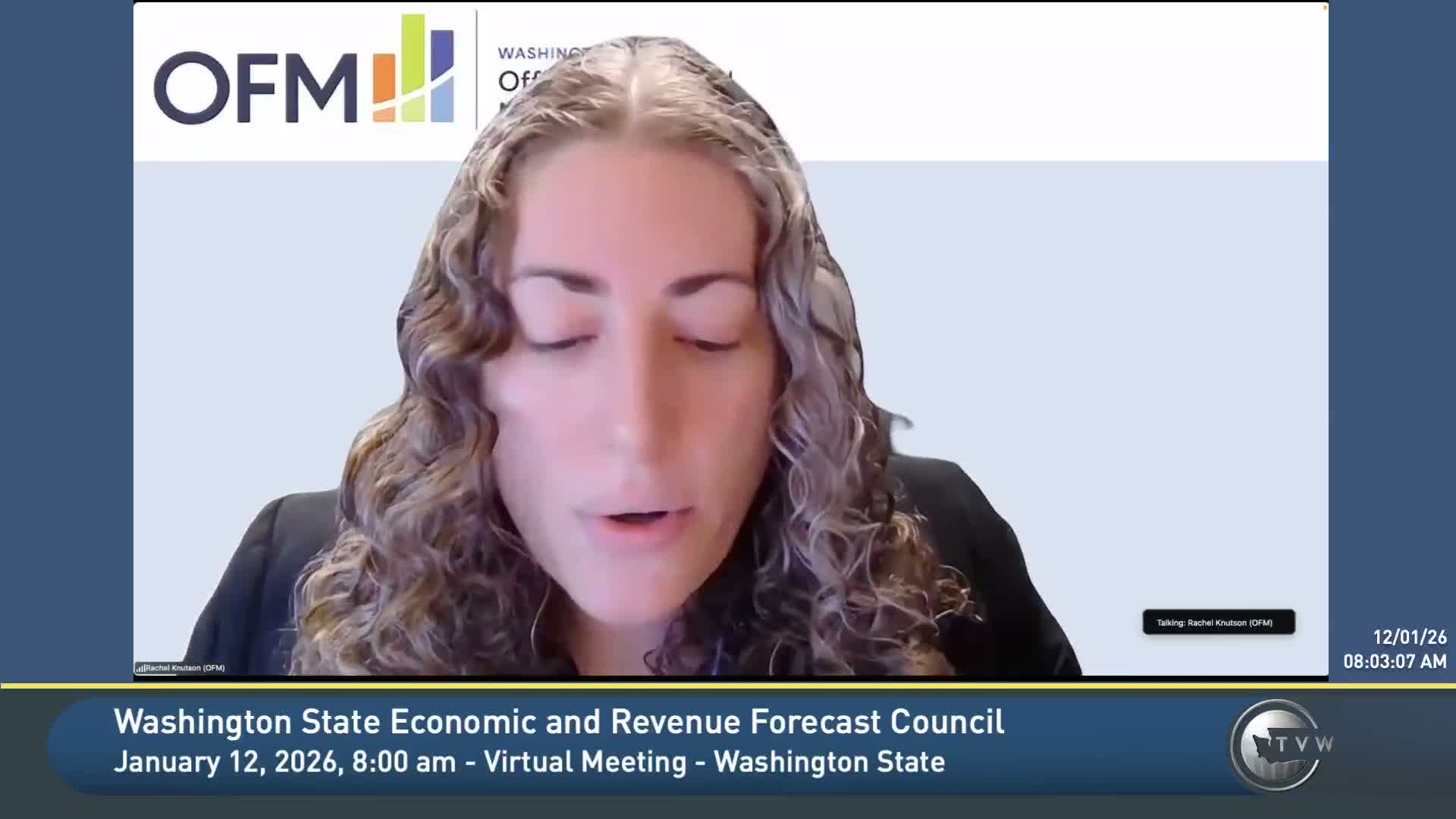
The council adopted a compromise reversion assumption instructing staff to use 1% of general‑fund appropriations in fiscal year 2026 and 0.9% in the out years for the outlook, after a series of failed motions and discussion about conservatism versus reflecting the governor’s proposal. Rachel Knudson, senior budget advisor at the Office of Financial Management, told the council that the governor’s 1% assumption reduces projected expenditures by about $1,496,000,000 over the outlook period and that the long‑term average reversion rate is roughly 1.1%.
"Actual reversion levels in recent years have been larger than typical," Knudson said, noting the workgroup’s historical analysis. Director Chapman of OFM said the administration felt "much more comfortable at a number that's still below that long term average," arguing the governor’s assumption was data‑informed.
Some legislators pushed for a more conservative baseline. "I would prefer...that we stick to the point 75%," Representative Couture said, calling it "a little bit more conservative." Representative Orcutt argued for consistency with the enacted budget, urging use of the previously adopted option to aid public clarity.
On statutory revenue growth, the council instructed staff not to assume the additional 4.5% per‑year growth factor described in RCW 43.88.055 for the ensuing biennium in the outlook, following a motion by Representative Couture that the council follow the governor’s approach. Knudson told the council excluding the 4.5% adjustment reduces projected ending fund balances by about $2,168,000,000 compared with the statutory floor.
The council also considered the governor’s proposed additional juvenile rehabilitation capacity. The governor’s capital request includes $15,000,000 for design and construction and the outlook assumed $43,100,000 in operating costs in the 2027–29 biennium. After debate about whether anticipated operating costs are a policy decision that should be excluded from an outlook, the council voted to include the governor’s $43.1 million operating‑cost assumption in the outlook.
Finally, the council voted to include the governor’s assumed savings from proposed increases in Medicaid functional eligibility thresholds in the outlook. The governor’s proposal assumed $170,600,000 in savings in the 2027–29 biennium (about $71,800,000 in FY28 and $98,800,000 in FY29) if policy changes proceed; OFM staff noted those savings would require policy actions and, in some cases, a Medicaid state plan amendment before they would materialize.
Votes at a glance
- Reversion assumptions: After initial motions failed, the council instructed staff to use 1.0% in FY26 and 0.9% in subsequent outlook years (motion carried by the required majority).
- 4.5% statutory revenue floor (RCW 43.88.055): Council instructed staff not to apply the additional 4.5% revenue assumption in the outlook (motion passed).
- Juvenile rehabilitation operating costs: Council instructed staff to include the governor’s assumed $43.1 million in out‑biennium operating costs for a proposed juvenile rehabilitation facility in the outlook (motion passed).
- Functional eligibility for Medicaid: Council instructed staff to include the governor’s assumed $170.6 million in savings from proposed functional‑eligibility changes in the outlook (motion passed).
What happens next
Staff will prepare the governor’s supplemental budget outlook using the council’s guidance and return materials to the council as the budgeting process continues. Chair and members emphasized this guidance is for producing an outlook of the governor’s proposal and does not itself enact policy.
(Procedural note: Acting Department of Revenue Director John Reiser was introduced near adjournment; the council then adjourned.)