Get Full Government Meeting Transcripts, Videos, & Alerts Forever!
Get email alerts on the Bill Signings topic
No spam. Unsubscribe anytime.
Governor signs package of bills on first day of signings; vetoes one emergency clause
Summary
An unnamed governor who identified themself as newly inaugurated signed a series of bills affecting health-care licensing, WIC screening access, primary care reporting, antitrust filings, broadcasting tax code, ATV VIN rules and juvenile Medicaid policy; the governor vetoed one bill’s emergency clause while signing it into law.
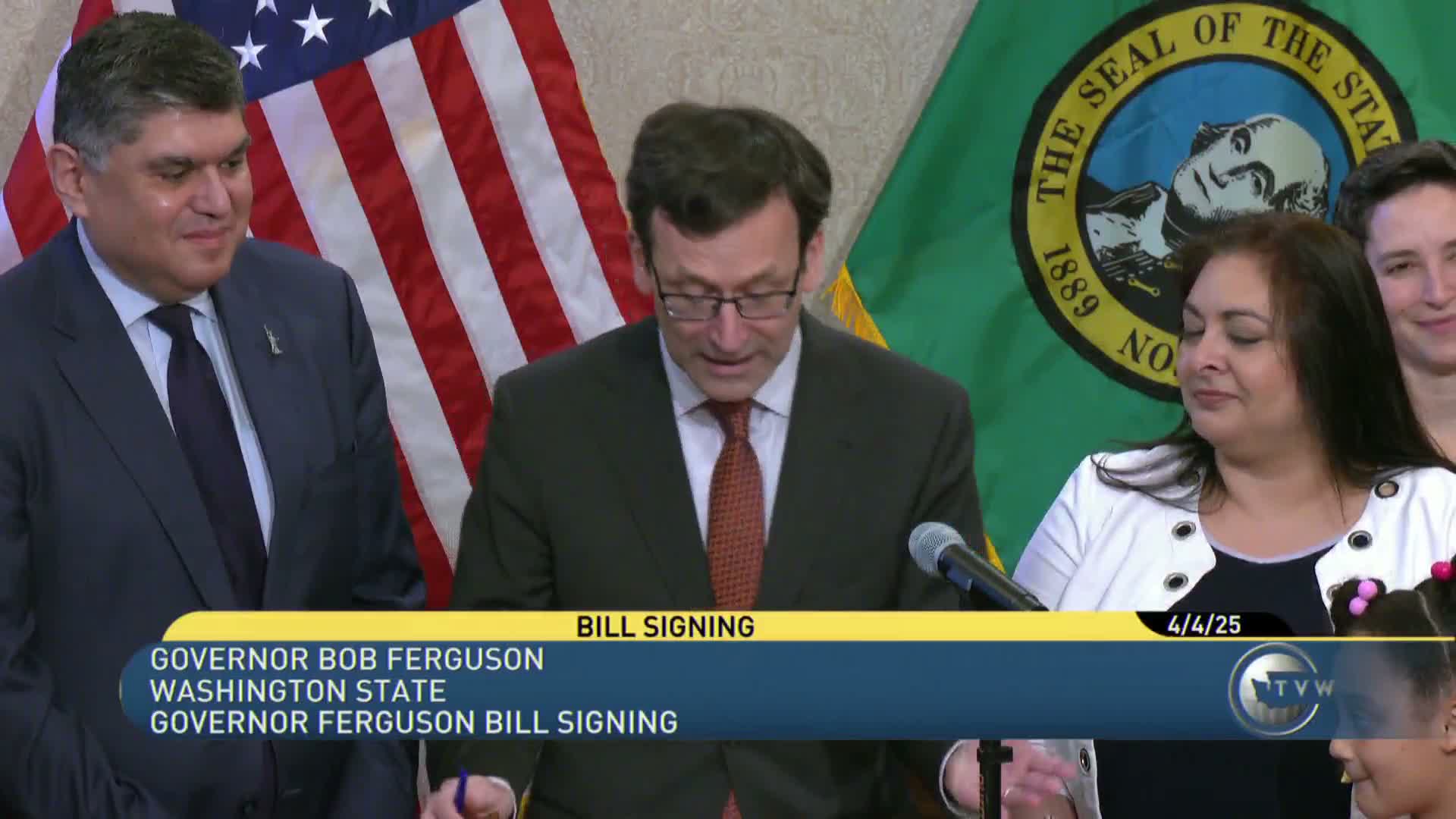
The governor (speaker did not give a personal name in the transcript) signed a package of state bills at a public event, describing the occasion as their first day of signing laws and thanking lawmakers and advocates who worked on the measures.
The package included measures the governor said aim to expand health-care access, streamline professional licensing and update technical areas of state law. "Senate bill 5118 directly addresses that shortage by streamlining the licensing procedure for international medical graduates and reduces barriers for them to practice here in Washington state," the governor said, reading the bill description and thanking prime sponsor Javier Valdez. The governor repeatedly paused between signings for photographs and sponsor introductions.
Why it matters: The measures cover a range of state functions that affect everyday services—from who can provide care in underserved areas to administrative steps for broadcasters and vehicle inspections—so the signings together change both health delivery and several technical regulatory rules.
Votes at a glance (action outcomes): - Senate Bill 5118 — streamlines licensing for international medical graduates; signed into law. - Senate Bill 5006 — makes it easier for individual board-appointed directors to make recommendations to corporate boards (sponsor: Jamie Peterson); signed into law. - Senate Bill 5051 — places all nursing professions under the Washington State Board of Nursing and adds two certified nursing assistant members to that board; signed into law. - Senate Bill 5084 — establishes a standard for reporting primary care expenditures to track compliance with the 2022 target; signed into law. - Senate Bill 5122 — requires entities filing federal pre-merger notifications to also notify the Washington attorney general's office; signed into law. - Senate Bill 5244 — exempts WIC staff from a state requirement to register as medical assistants for hemoglobin screening sampling, which the governor said "will increase access for about 45,000 WIC participants"; signed into law. - Senate Bill 5457 — technical cleanup moving radio and TV broadcasting B&O tax language to a new section; signed into law. - Senate Bill 5462 — exempts ATVs and similar off-road vehicles from most VIN inspection requirements; signed into law. - Senate Bill 5577 — ensures Washington's Medicaid program continues to cover HIV antiviral drugs; signed into law but the governor vetoed the bill’s emergency clause as "unnecessary" because the change codifies current practice and is already funded in the Health Care Authority's base expenditures. - Senate Bill 5128 — codifies practice for juvenile correctional facilities that use Medicaid to serve incarcerated juveniles and directs the Health Care Authority to collaborate with providers and correctional facilities; signed into law.
Details and notable points: The governor emphasized speed and customer service in government operations when introducing bills such as SB 5051 (nursing professions) and SB 5084 (primary care reporting). For the WIC-related bill (SB 5244), the governor cited federal WIC regulations and framed the state exemption as a way to reduce barriers to testing and follow-up care. On SB 5577 (HIV antivirals), the governor signed the bill but vetoed only the emergency clause, saying the underlying policy is already funded and in practice.
Quotes from the event are drawn from the public remarks delivered by the event’s primary speaker; direct quotes are attributed to that speaker as recorded in the transcript. The event included repeated photo opportunities and brief introductions of prime sponsors and staff between signings. The session closed with the governor thanking attendees and noting it was their first day signing bills.
What comes next: Each bill takes effect according to the law’s effective dates (not specified in the transcript). The governor did not announce further administrative steps at the event beyond thanking sponsors and staff.