Lifetime Citizen Portal Access — AI Briefings, Alerts & Unlimited Follows
Board denies petitions seeking moratorium on alkaline hydrolysis; rules already require prion inactivation validation
Loading...
Summary
Three similar petitions asked the Board to halt alkaline hydrolysis and prevent effluent from entering wastewater systems due to prion concerns; the board denied the requests after staff explained WAC 246‑500‑53 requires autoclave‑equivalent treatment or third‑party validation demonstrating prion destruction.
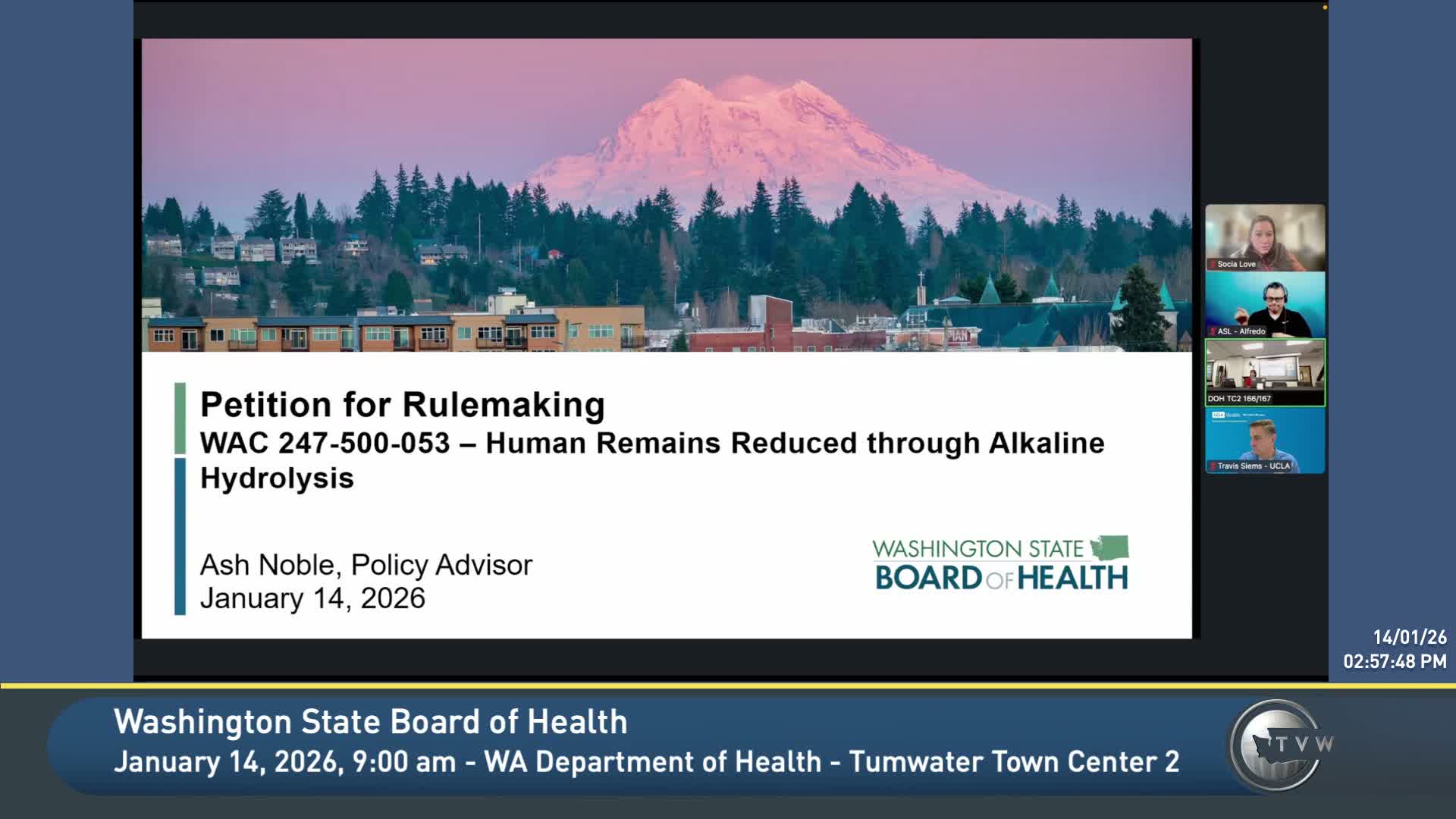
The Washington State Board of Health on Jan. 13 declined petitions that sought a temporary moratorium on alkaline hydrolysis, restrictions on discharge of process effluent to wastewater systems, and limitations on application of biosolids derived from treated effluent, citing existing board rules that require validation that reduction processes achieve sterilization and prion destruction.
Board staff explained how alkaline hydrolysis works and reviewed WAC 246‑500‑053, which requires either high‑temperature systems that meet autoclave standards (250°F / 121.1°C for at least 30 minutes) or low‑temperature systems supported by third‑party validation demonstrating prion destruction and sterilization. Ashley Noble, a policy adviser, explained the process: "The effluent then makes its way to the municipal wastewater treatment facility where it is treated with all other liquid and sewage wastes."
Experts and board members discussed the technical literature and validation standards. Board member Steve Kutz and other members emphasized that the board’s earlier rulemaking included temperature/time standards intended to inactivate prions; Kutz stated, "250 degrees for 30 minutes kills the prions," referencing autoclave‑equivalent conditions required in rule. The board concluded the standards are adequate and denied the petitions, while noting resource limitations that make independent bioassay programs infeasible for the board.
What happens next: Staff will notify petitioners of the denial. The board reiterated that the existing rule requires either the autoclave standard or third‑party testing for systems not meeting the high‑temperature specification.
Sources: Petitions and DOH/Board staff briefing at Jan. 13, 2026 meeting.