Get Full Government Meeting Transcripts, Videos, & Alerts Forever!
Get email alerts on the Newborn Screening topic
No spam. Unsubscribe anytime.
Board decides not to add 3‑MCC deficiency to Washington newborn screening panel
Summary
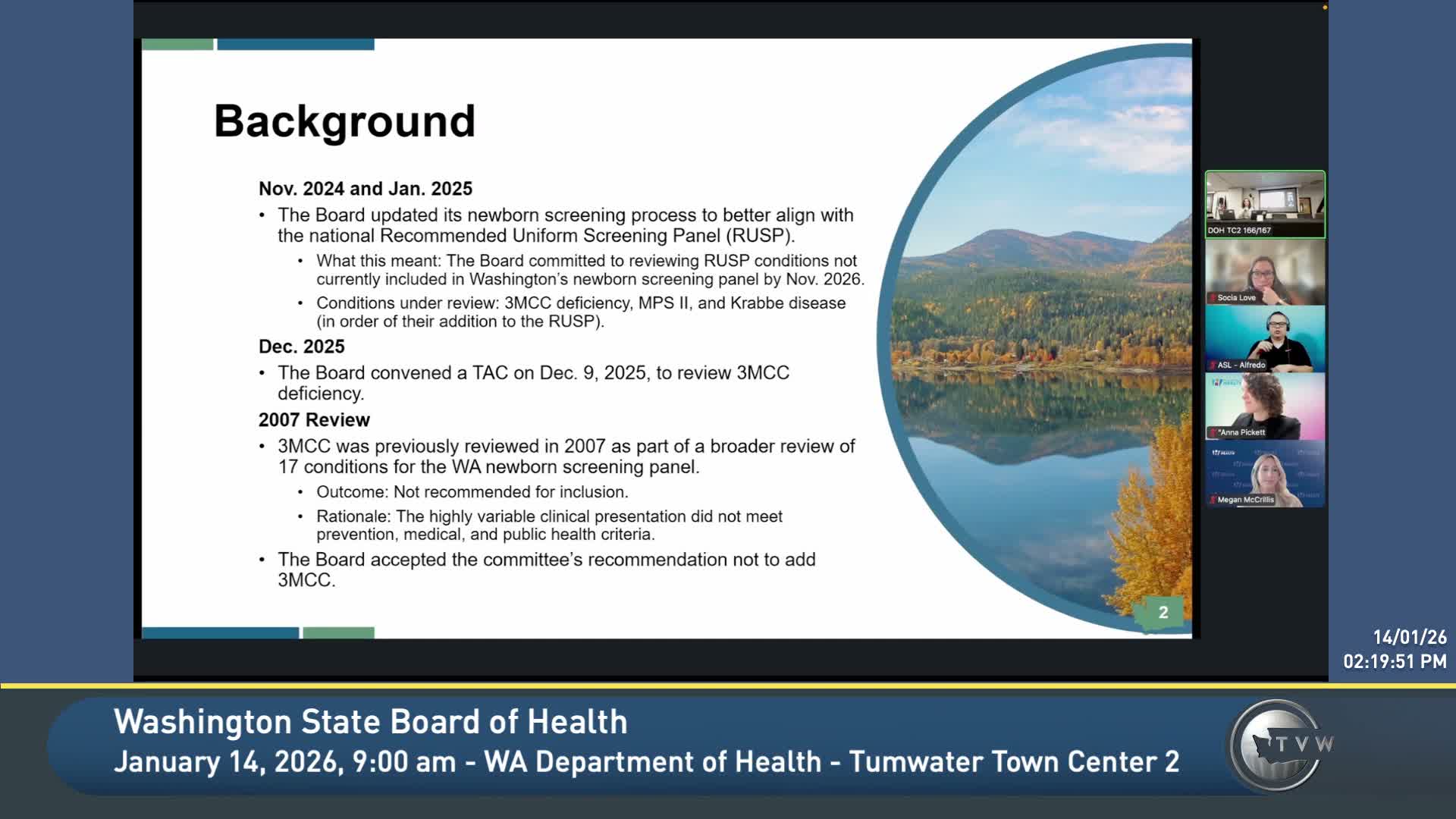
After technical advisory committee review and cost‑benefit analysis, the State Board of Health voted not to add 3‑methylcrotonyl‑CoA carboxylase (3‑MCC) deficiency to the statewide newborn screening panel, citing limited expected public health benefit and uncertain long‑term infrastructure and cost implications.
The Washington State Board of Health determined on Jan. 13 not to add 3‑MCC deficiency to the state newborn screening panel following a technical advisory committee review and department analysis.
Board staff and the advisory technical committee presented the condition’s characteristics — an estimated prevalence of about 1 in 40,000, a majority of cases that are asymptomatic, and a small subset (estimated ~15%) that might require clinical follow‑up. The state laboratory already measures the C5‑OH analyte for other conditions, so implementation would largely need a cutoff refinement rather than new assays. The department estimated testing costs at roughly $0.30 per newborn and modeled limited net societal benefit; the TAC majority concluded 3‑MCC did not meet the board’s six criteria for addition.
Board member discussion emphasized the uncertain lifetime risk, the rarity of severe metabolic crises that screening would prevent, and Medicaid and programmatic readiness to follow up and fund treatment. After discussion, board member Paj Nandi moved that 3‑MCC deficiency should not be considered for addition to the newborn screening panel; the board approved the motion.
What happens next: Staff will document the TAC recommendation and the board determination. Petitioners and stakeholders will be notified; the board signaled interest in reviewing its process for petition handling, criteria application and how fiscal and clinical follow‑up capacity are evaluated earlier in the review timeline.
Sources: Newborn screening technical advisory committee and Department of Health presentations at Jan. 13, 2026 board meeting.