Get AI Briefings, Transcripts & Alerts on Local & National Government Meetings — Forever.
DCYF presents workload model that would add roughly 400 staff; governor’s budget begins phased funding
Loading...
Summary
Agency officials told the oversight board a new workload model—reducing 'usable' casework hours, adding case‑weighting for complexity and accounting for tenure—identifies roughly 360 direct‑program FTEs plus ~66 back‑office FTEs; the governor’s budget proposes phased hires toward that goal.
Deputy Chief Financial Officer Brianne Boggs and DCYF officials outlined a new child‑welfare workload model that, if fully implemented, would significantly increase staffing across the department.
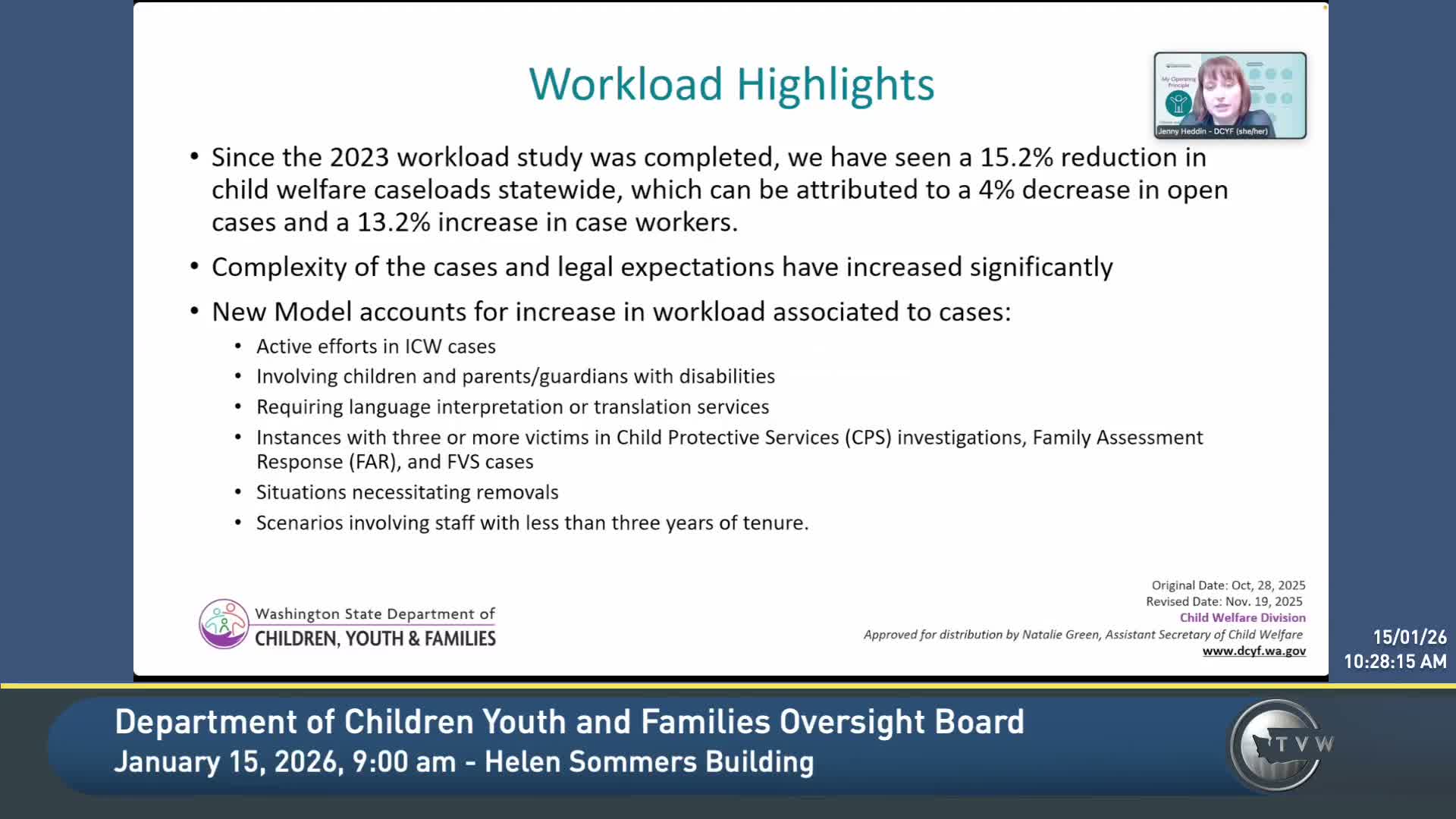
Jenny Hedden described the methodology: a time study by an outside contractor (PCG) was augmented by 2024 regional workgroups to adjust for policy shifts and uncounted tasks. The model lowers the agency’s assumed "usable hours" per worker (from 174 to roughly 124 hours a month) to account for holidays, sick and family leave, training and non‑case activities. It also introduces case weighting to reflect additional effort for Indian Child Welfare Act cases, parents/children with disabilities, translation needs and households with multiple children.
The result, Hedden said, was a substantial change in the agency’s assumptions about what a single worker can sustainably handle. "That 174 hours that we assumed previously didn't allow for any of [training], so it's no surprise that staff feel stressed," she said.
Using the revised assumptions, Hedden said the model indicates a need for nearly 360 additional direct‑program FTEs and roughly 66.3 additional back‑office FTEs (human resources, IT, finance). Hedden and Boggs proposed phased implementation to match hiring and training capacity; Boggs said the governor’s proposed budget step substantially funds DCYF’s FY26–27 request and would begin hiring incrementally (1.3 FTE in FY26, 23.6 in FY27, ramping to 46 in FY28 at full-year pace).
Board members asked whether the model accounts for vacancy rates, regional variation and qualitative factors. Hedden said the agency is currently expending all funded FTEs statewide but that local vacancy and leave patterns can make offices feel understaffed. She said the department will pursue IT upgrades (a system she identified as ProFam) and procedural changes to reduce clerical load, and that some savings could emerge from improved technology and targeted clerical/discovery staff.
Members asked for more regionally disaggregated analysis and for a plan to monitor outcomes as hires are phased in. Hedden said the model will be adjusted over time to reflect new data, policy changes and the implementation of a modern IT system.
If approved as requested, the staffing increases would be phased over several years rather than delivered in a single budget cycle. DCYF officials said they will return with more detailed regional projections and additional documentation for the board and the legislature.