Get Full Government Meeting Transcripts, Videos, & Alerts Forever!
Get email alerts on the Industrial Infrastructure topic
No spam. Unsubscribe anytime.
Port of Pasco wins board support for Ryman water trunk to spur cold‑storage and rail-served industrial development
Summary
The board approved a staff-recommended financing package to help fund a 16‑inch water trunk at the Ryman Industrial Center, supporting Cold Summit’s planned cold-storage campus and rail-served industrial development expected to bring private investment and jobs.
The Community Economic Revitalization Board voted to support a financing package to extend industrial water infrastructure at the Ryman Industrial Center in Pasco, a project presented by the Port of Pasco and private partner Cold Summit.
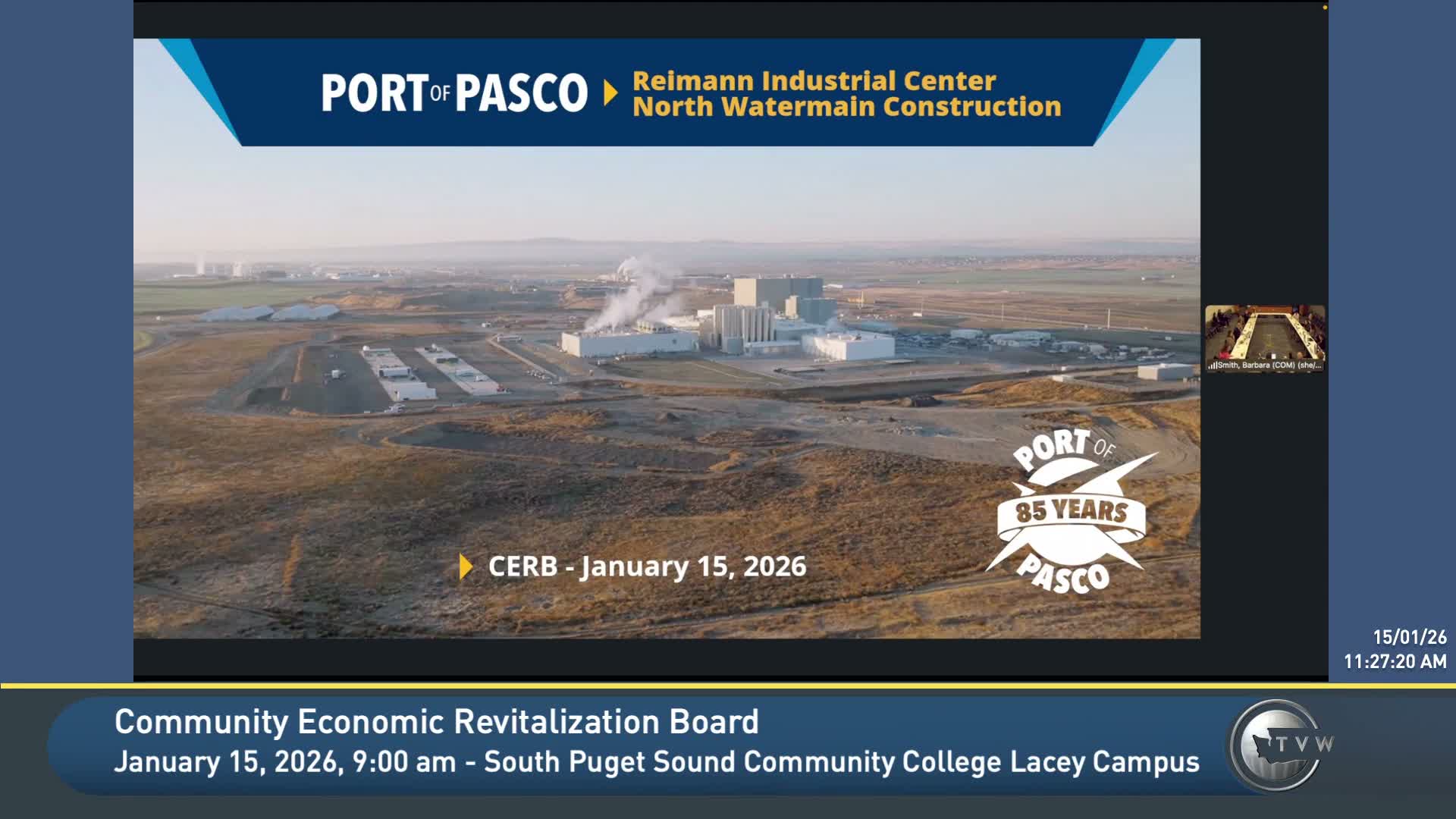
Port and developer representatives described a 164‑acre industrial site that has been engineered for rail access and industrial utilities. Port of Pasco deputy Steven McFadden said staff recommended a $4.25 million general obligation loan at 1.7% over 20 years (first payment deferred to Jan. 31, 2029) combined with a $750,000 grant to help construct about 20,000 lineal feet of 16‑inch ductile iron water main and internal trunk piping. “This project is 100% designed and 100% approved by the city of Pasco,” McFadden said, noting the water main is ready to go to bid once funding is secured.
Cold Summit’s representative said the company plans rail‑served cold storage buildings at the Ryman site and has national experience delivering temperature‑controlled facilities; Cold Summit told the board that the buildings could generate hundreds of jobs once operational. Board members asked about power availability, water capacity and site readiness; the port said it had secured a substation and transmission capacity scalable to multiple megawatts at the Ryman site and that the city had agreed to the needed water allocation.
Board staff framed CURB’s involvement as catalytic for attracting large private investment and enabling rail‑served industrial sites. The board approved the staff recommendation to fund the package, with standard pre‑contract requirements (final scope, budget, NEPA/SEPA, permits and evidence of match and private investment). The board’s action aims to unlock private investment and support new industrial employment in the Tri‑Cities region.