Get Full Government Meeting Transcripts, Videos, & Alerts Forever!
Get email alerts on the Advisory Opinion Attorney Legislators topic
No spam. Unsubscribe anytime.
Legislative Ethics Board declines blanket opinion on lawyer‑legislators representing clients against state agencies
Summary
After extended debate the Legislative Ethics Board concluded it will not issue a new blanket advisory opinion on whether attorney‑legislators may represent clients against state agencies, saying the question is fact‑specific and education and cautionary guidance are preferable.
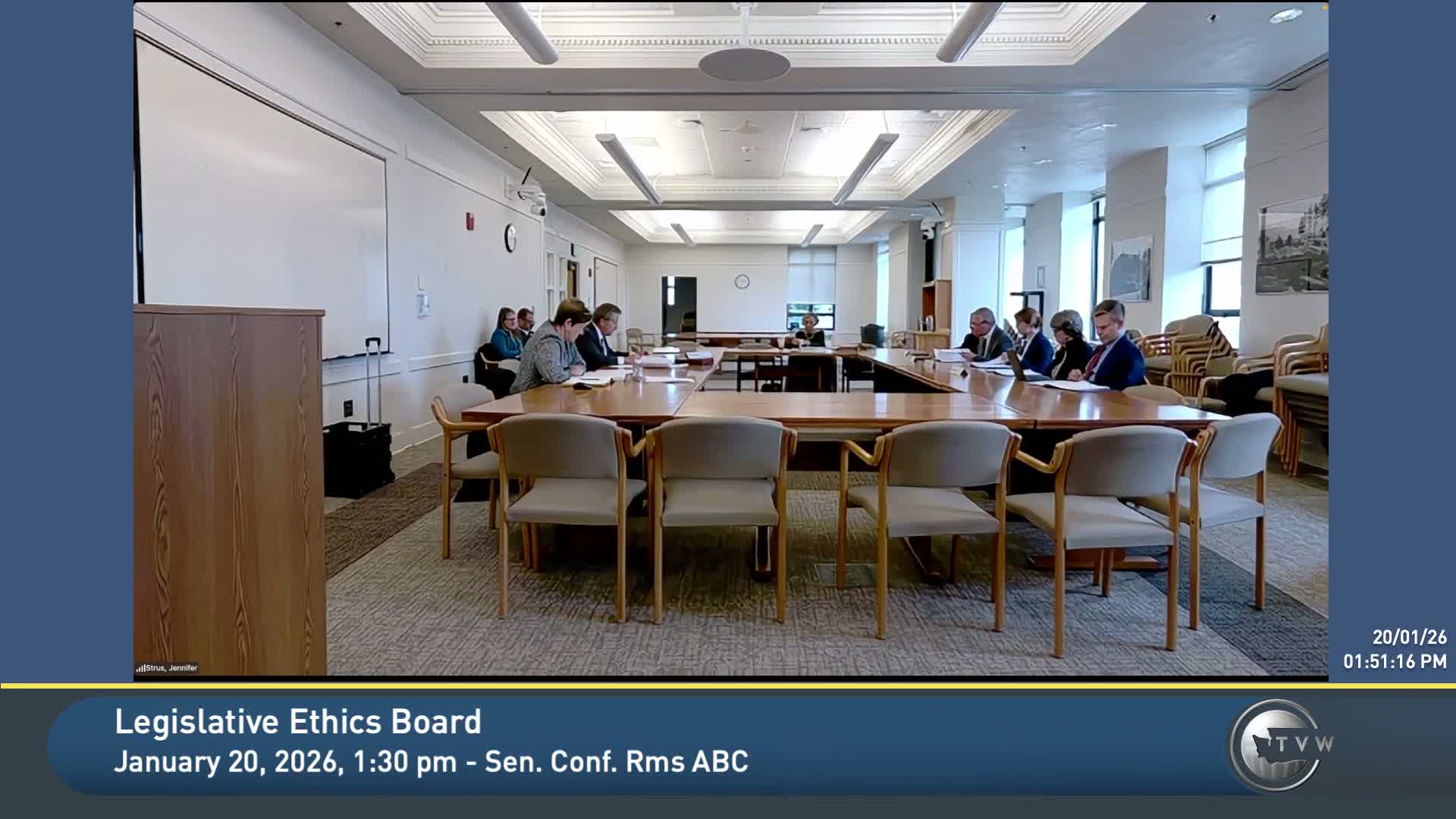
The Legislative Ethics Board on Thursday discussed a proposed advisory opinion addressing whether legislators who practice law may represent clients in matters involving state agencies and decided not to issue a blanket rule.
Jennifer, the board’s staff attorney, presented a draft that concluded “the opinion is no. It’s not automatically an ethics violation,” while emphasizing several cautions: attorney‑legislators must keep their private legal work clearly separate from their legislative duties, avoid using legislative status to obtain special treatment, and be alert to appearances of special privileges (SEG 415–423). The draft also proposed that an administrative law judge (ALJ) could prepare an initial order for board review and that discovery limits follow the Administrative Procedures Act.
Members debated the scope and framing of any new guidance. Unidentified Speaker 6 urged the board to start from the constitutional premise that the legislature is part‑time and members must be able to pursue livelihoods while receiving practical cautions about role separation (SEG 482–490). Unidentified Speaker 4 warned the draft could conflict with earlier opinions restricting certain outside employment, arguing that a legislator’s inside knowledge of an agency or industry could create undue influence if that legislator later represented a private client (SEG 524–536).
Representative Hackney said the body should avoid sweeping prohibitions but clearly prohibit using the legislative role to extract favors: “Given that we are a part time legislature, there shouldn't be a prohibition,” and members must be able to identify and investigate clear conflicts, such as leveraging votes or budgets for private advantage (SEG 577–586; 587–595).
Board members also discussed hypotheticals — whether running legislation that incidentally benefits many people (for example, broad business tax relief) differs from taking private, narrow actions that confer direct financial gain to the legislator. The staff memo noted that if an action benefits a broad class it is less likely to be an ethics violation than a situation where the legislator is the sole or primary beneficiary (SEG 612–615; 552–558).
After extended discussion the chair summarized the views and asked whether members preferred issuing a formal opinion. The board concluded it would not adopt a new, blanket advisory opinion at this time, preferring to emphasize education and to continue addressing contested cases on their facts. Chair wording captured the outcome: unless members objected, the board would not issue the proposed opinion (SEG 1038–1041).
The board directed staff to continue outreach and to provide practical guidance and examples to help legislators avoid conflicts of interest, and to rely on complaint‑driven adjudication where facts require formal review. The meeting recessed briefly before moving into an executive session.
What the board did not do: the board did not adopt a new formal rule or change the statute; it declined to set a single categorical prohibition and will continue to evaluate individual complaints under existing ethics rules and the Administrative Procedures Act.