Get Full Government Meeting Transcripts, Videos, & Alerts Forever!
Get email alerts on the State Legislation topic
No spam. Unsubscribe anytime.
Governor signs package of bills on housing, health care, tribal revenue sharing and more
Summary
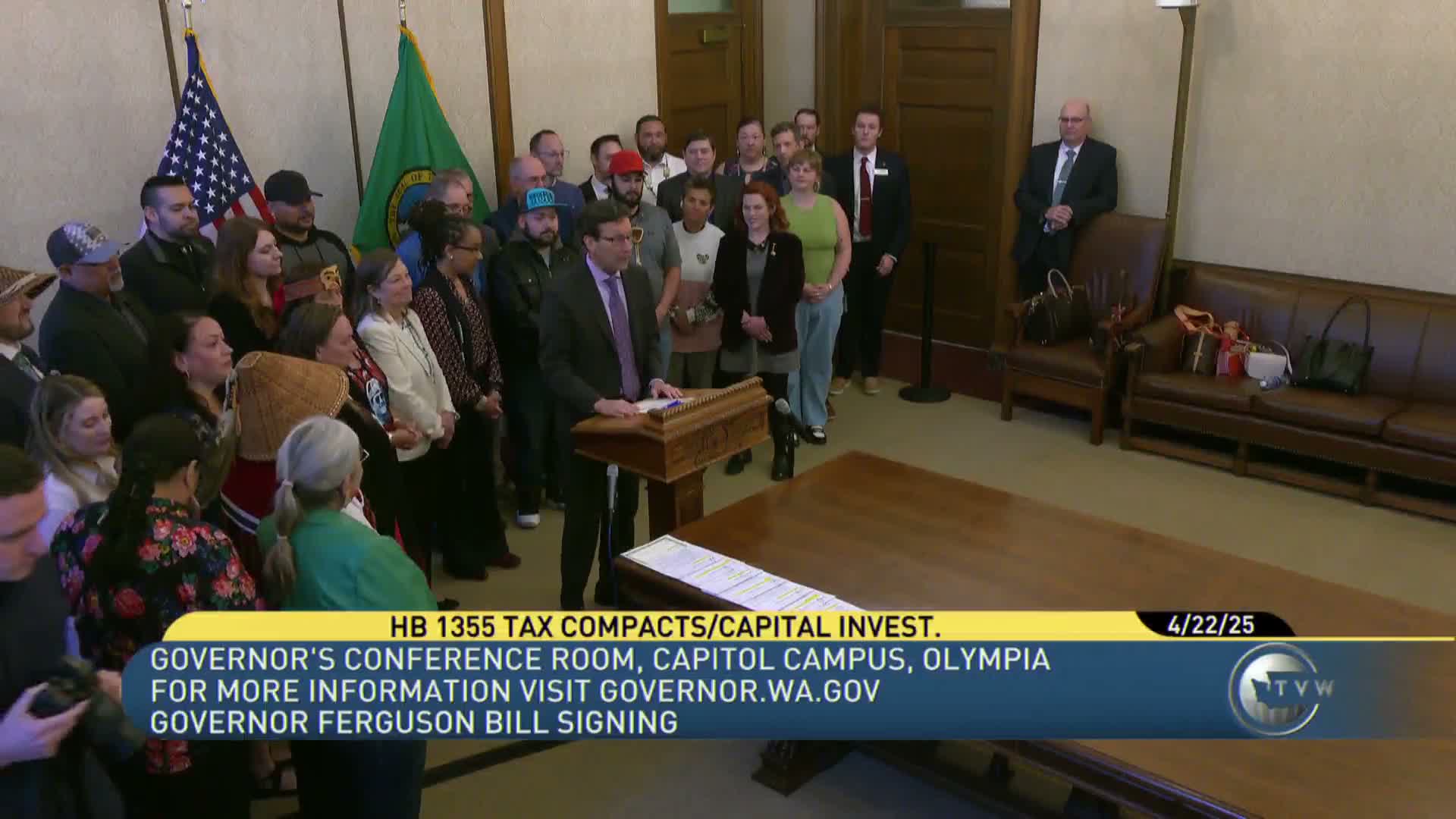
At a bill-signing ceremony, the governor signed a multi-bill package into law that includes measures on tribal revenue sharing, medical-debt reporting, birth-control supply coverage, affordable housing code changes, and local flexibility for mental-health funds.
At a public bill-signing event, the governor signed a package of measures into law covering tribal revenue sharing, parking rules, farming tax treatment, housing, juvenile diversion, health-care data sharing, medical-debt reporting and other matters.
The ceremony brought together legislative sponsors, stakeholders and community representatives for brief remarks and photos. The bills the governor signed ranged from technical changes to state programs to new consumer-protection requirements intended to increase access and reduce burden for Washington residents.
Among the measures the governor described as particularly important were a law to increase revenue-sharing for certain federally recognized tribes that completed qualified capital investments, and a provision that prohibits reporting medical debt to credit reporting agencies. "This bill does not erase medical debt, but it removes barriers caused by that debt by lessening the impact to Washingtonians' credit scores," Speaker 2 said during the ceremony.
Other bills signed included legislation that gives local governments the option to allow parking in front of private driveways, clarifies farm property-tax valuation rules so working farms can diversify without jeopardizing current use status, and changes the building code to make it easier to rehabilitate existing structures for affordable housing. The governor also signed a measure creating a state registry for health-care providers and facilities to improve data sharing among agencies, and a bill expanding access to diversion agreements for youth who commit minor offenses.
The package also contains several public-health and consumer-protection items: a requirement that health plans cover a 12-month supply of contraceptives beginning Jan. 1, 2026; a law requiring hospitals to report price data consistent with federal transparency rules; and a bill encouraging school instruction on blood and bone-marrow donations as part of at least one health class required for graduation in the 2025–26 school year.
Several measures change technical or administrative deadlines and formulas: one extends Growth Management Act planning deadlines for certain counties to Dec. 31, 2026; another ties inflation adjustments for aquatic land leases to the Seattle-area Consumer Price Index; and legislation grants local flexibility to use mental-health and chemical-dependency sales-tax revenue for new construction of treatment facilities.
The governor occasionally paused for photos and invited a child, Ezra, to assist during one signing. "Ezra has told me I should sign it right here," Speaker 2 said while handing the child a pen.
The bills were presented with sponsor acknowledgments and brief remarks; the ceremony did not record legislative roll-call votes because these were enactments following the legislature's passage and the governor's signature. Additional implementation steps — for example, coordination between the governor's office and the Department of Health to build the provider registry — were described but not detailed at the event.
The administration said it will work with affected agencies and stakeholders on implementation timelines and program details. Photographs and short remarks concluded the event.