Lifetime Citizen Portal Access — AI Briefings, Alerts & Unlimited Follows
DNR staff recommend net present value objective and 1.7% default discount rate for East Side harvest model
Loading...
Summary
At a Jan. 20 study session, Department of Natural Resources staff recommended using net present value as the default objective for the East Side sustainable-harvest calculation, adjusting appraisal prices to reflect auction outcomes and counting actual management costs; staff proposed a default discount rate equal to the forest growth rate (about 1.7%) and will return with formal recommendations Feb. 3.
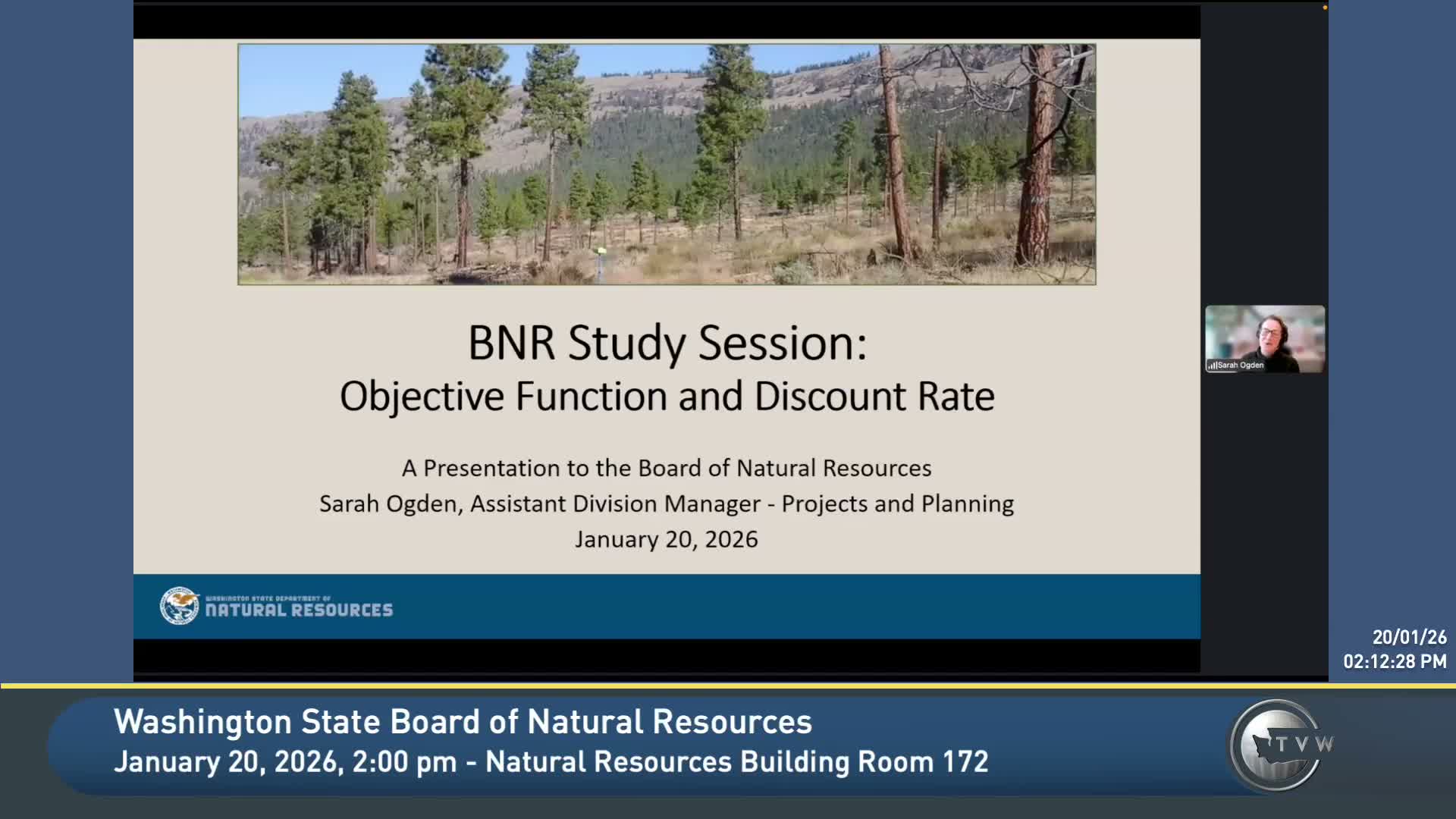
At a Jan. 20 Board of Natural Resources study session, Department of Natural Resources (DNR) staff recommended that the East Side sustainable-harvest calculation use net present value (NPV) as the base objective, that model prices be set by adjusting appraisal prices to reflect auction results, and that costs be counted as actual management expenses. Staff also proposed setting the base-model discount rate to the East Side forest growth rate—about 1.7%—and running sensitivity analyses at other rates as part of alternatives testing.
Sarah Ogden, assistant division manager for projects and planning, said the sustainable-harvest framework is grounded in statute and board policy and quoted the policy definition of a harvest target: "a sustainable harvest level is a volume of timber scheduled for sale from state-owned lands during a planning decade as calculated by the department and approved by the board." She told the board the no-action (base) alternative will model current conditions and that staff will present recommendations for the board’s Feb. 3 meeting.
Dale Yee, one of DNR’s economists, framed the objective function as the model’s way of ranking feasible management actions. "We're saying we should count the monetary returns from timber sales here in this objective function," he said, describing NPV as the default financial metric because it measures the magnitude of profitability over time. "Net present value is kind of the gold standard," Yee said, while acknowledging other metrics (benefit-cost ratio or IRR) might be appropriate for special cases.
On pricing, staff recommended species-specific, market-based prices derived from appraisals but adjusted to reflect observed auction outcomes. Yee described a pragmatic approach: when auction results exceed appraisals, the average difference would be split across species and used to raise model prices rather than attempting complex allocations between species.
On costs, staff recommended counting actual management costs (accounting expenses DNR would incur) rather than applying trust-account distribution percentages that can distort the economic signal. Yee illustrated the distinction with a thinning example, explaining that trust-account mechanics could make a management action appear beneficial to the trust while actual accounting costs would not. He also said fixed overhead costs (office utilities, etc.) need not be included in the model because they do not change the model’s optimal solution.
The discount-rate discussion centered on how to trade off near-term versus long-term revenue. Yee used a simple example to show how different real discount rates shift the model’s preference for harvesting now versus waiting. He said market borrowing or alternative-investment rates are imperfect guides for the DNR because the agency is unlikely to borrow for a decade-long horizon or to invest timber receipts in the same way as private portfolios. Instead, staff recommended using asset- and policy-informed bounds: the East Side forest growth rate is about 1.7%, and a data-derived ceiling on forest-driven financial return is roughly 2.7%.
"Every graduate student should spend a fair amount of time immersed in the discount rate literature," Yee said, noting the choice is uncomfortable and requires tradeoffs. Given long time horizons and intergenerational responsibilities, staff proposed a default discount rate at the current growth rate (~1.7%) for the base model while committing to sensitivity analysis across a range of rates, and to examining alternative specifications in future study sessions.
Board members pressed staff on two recurring themes: how environmental or social objectives are captured and how tactical, price-responsive operational decisions would interact with a decadal target. Several members noted the policy lists multiple objectives, including environmental protection and intergenerational equity, and asked whether those should be embedded in the objective function rather than as model constraints. Staff responded that the base model must start with a defensible baseline (money-focused NPV with constraints reflecting protected areas and other non-harvest rules) and that multi-objective formulations and alternatives (including environmental-protection options) will be presented in later sessions.
Sarah Ogden summarized next steps: staff will bring two formal recommendations to the Feb. 3 Board meeting—one on the objective function (to continue maximizing NPV, use adjusted appraisal prices, and use actual management costs for the base model) and one on the base-model discount rate (default equal to current East Side growth, ~1.7%). The staff also plans additional study sessions in March (environmental impact statement and multi-objective discussion) and April (financial analysis and metrics) and will run sensitivity analyses on discount rates and alternative formulations.
No formal board action or vote was taken at the study session. The session was administrative and informational; staff will return with formal recommendations and supporting staff reports on Feb. 3.