Get Full Government Meeting Transcripts, Videos, & Alerts Forever!
Get email alerts on the Legislation Signings topic
No spam. Unsubscribe anytime.
Governor signs multiple bills expanding retirement enrollment, timber reporting, wildfire mitigation and housing tools
Summary
The governor held a bill-signing ceremony to sign several House bills into law, including measures to auto-enroll local government workers in retirement plans, extend timber-reporting requirements, strengthen utility wildfire-mitigation authority, update higher-education accreditation rules, commission a JLARC study on clean-building costs, expand local REET flexibility, and allow Commerce more flexible homeless-counting methods.
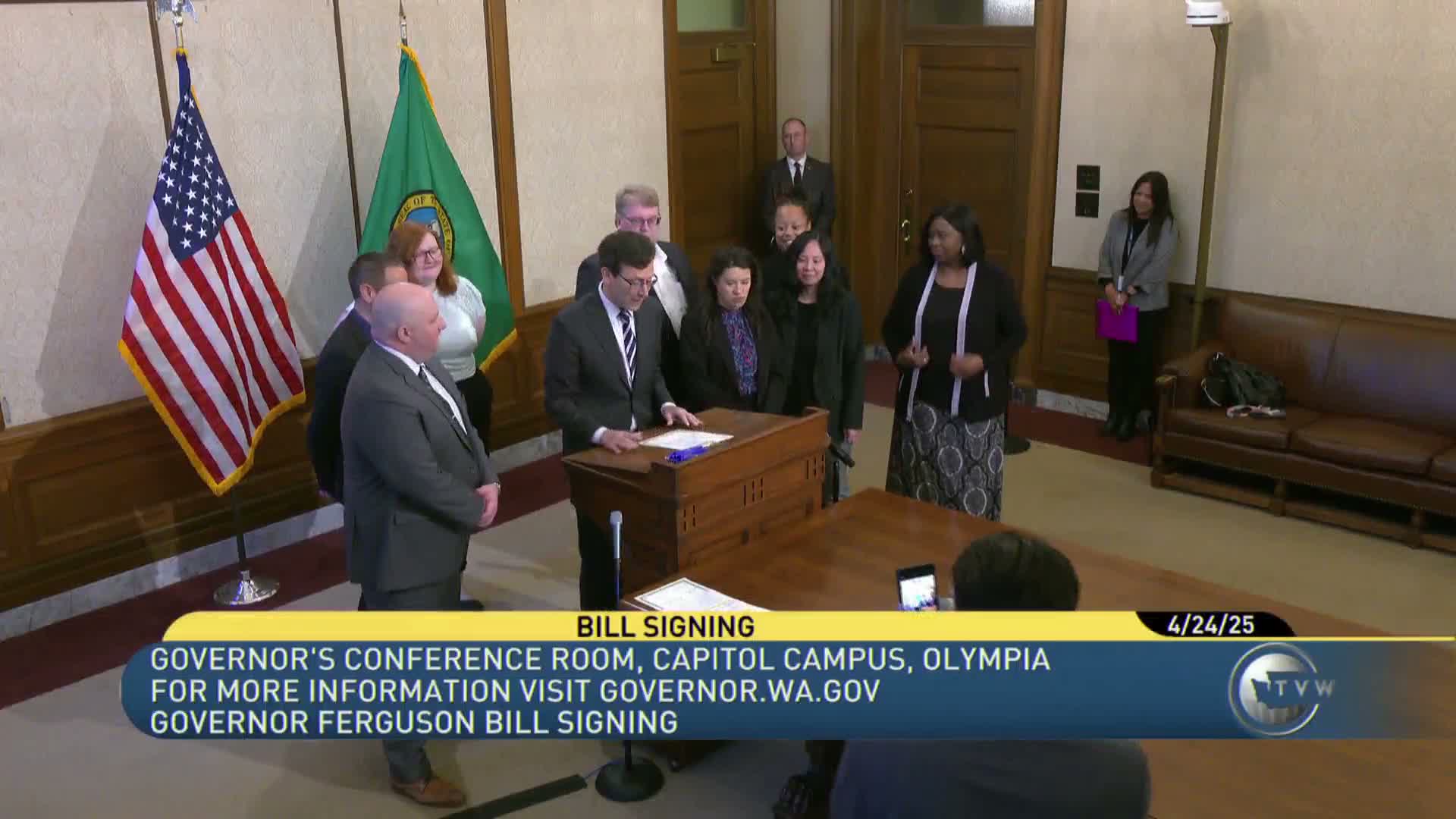
The governor on Tuesday signed a package of House bills that touch retirement savings, timber-tax reporting, wildfire mitigation, higher-education accreditation, state building planning and homelessness counting methods, saying the measures reflect bipartisan work and local needs.
"This bill makes it easier for them to access their employer's retirement plan without additional steps or paperwork," the governor said when introducing House Bill 1270, which the office described as authorizing counties, cities and other local governments to automatically enroll new employees in their retirement-savings plans. The governor thanked Rep. Dan Bernoski as the bill's prime sponsor and signed the measure into law.
The governor said House Bill 1389 extends through September 2029 a requirement for buyers to report large purchases of privately owned timber; the Department of Revenue uses market-based information from those reports to assess timber tax, and the governor said the change promotes fairness for timber harvesters. Rep. Adam Birnbaum was identified in remarks as the bill's prime sponsor.
On wildfire risk, the governor described House Bill 1522 as increasing authority for the utilities and transportation commission to work with utilities on wildfire-mitigation plans. "Wildfires are a growing concern here in Washington state," the governor said, and credited Rep. Tom Dent and Sen. Mike Chapman for their roles on the legislation before signing it.
House Bill 1572 updates state accreditation standards for higher-education institutions, the governor said, to account for institutions offering degrees and for branch campuses. The governor thanked Rep. Jerry Pollet for sponsorship and signed the bill.
The governor also signed House Bill 1715, which directs the Joint Legislative Audit and Review Committee (JLARC) to study the anticipated state cost of complying with the clean-buildings performance standard and to outline financial planning for state-owned buildings to meet greenhouse-gas reductions. The governor noted bipartisan support for the study and thanked Rep. Mary Dye.
House Bill 1791 was signed to give local governments more flexibility in how they use real-estate excise tax (REET) revenues, including the option to direct funds toward affordable housing, public safety and facilities for people experiencing homelessness. Rep. Dave Paul was cited as the bill's prime sponsor.
Finally, the governor signed the bill recorded in the transcript as 'House bridal 18 99' (filed as House Bill 1899 in the remarks), which the governor said gives the Department of Commerce flexibility to use a variety of information sources rather than an annual single-day point-in-time count to estimate the state's homeless population. The governor said current point-in-time methods likely undercount total homelessness and that removing the annual requirement frees Commerce to pursue more accurate approaches; Rep. Janice Zahn was identified as sponsor.
Each bill was introduced with brief remarks and followed by a ceremonial photo with sponsors and attendees. The signing event included short acknowledgements of visiting officials, including Mayor Wright of Oak Harbor, and concluded with attendees moving on to subsequent events.
What happens next: the bills take effect according to their statutory effective dates as provided by state law (not specified during the ceremony). The event was primarily ceremonial; no floor votes or additional debate occurred at the signing.