Get Full Government Meeting Transcripts, Videos, & Alerts Forever!
Get email alerts on the Usmca Review topic
No spam. Unsubscribe anytime.
Pacific Northwest roundtable urges renewal and improvement of USMCA as federal review proceeds
Summary
State and regional leaders, consuls and business groups at a Penware roundtable urged renewal of the USMCA ahead of a July 1 joint‑review deadline, announced plans for state resolutions and called on congressional delegations to press for a trilateral outcome that protects jobs and affordability.
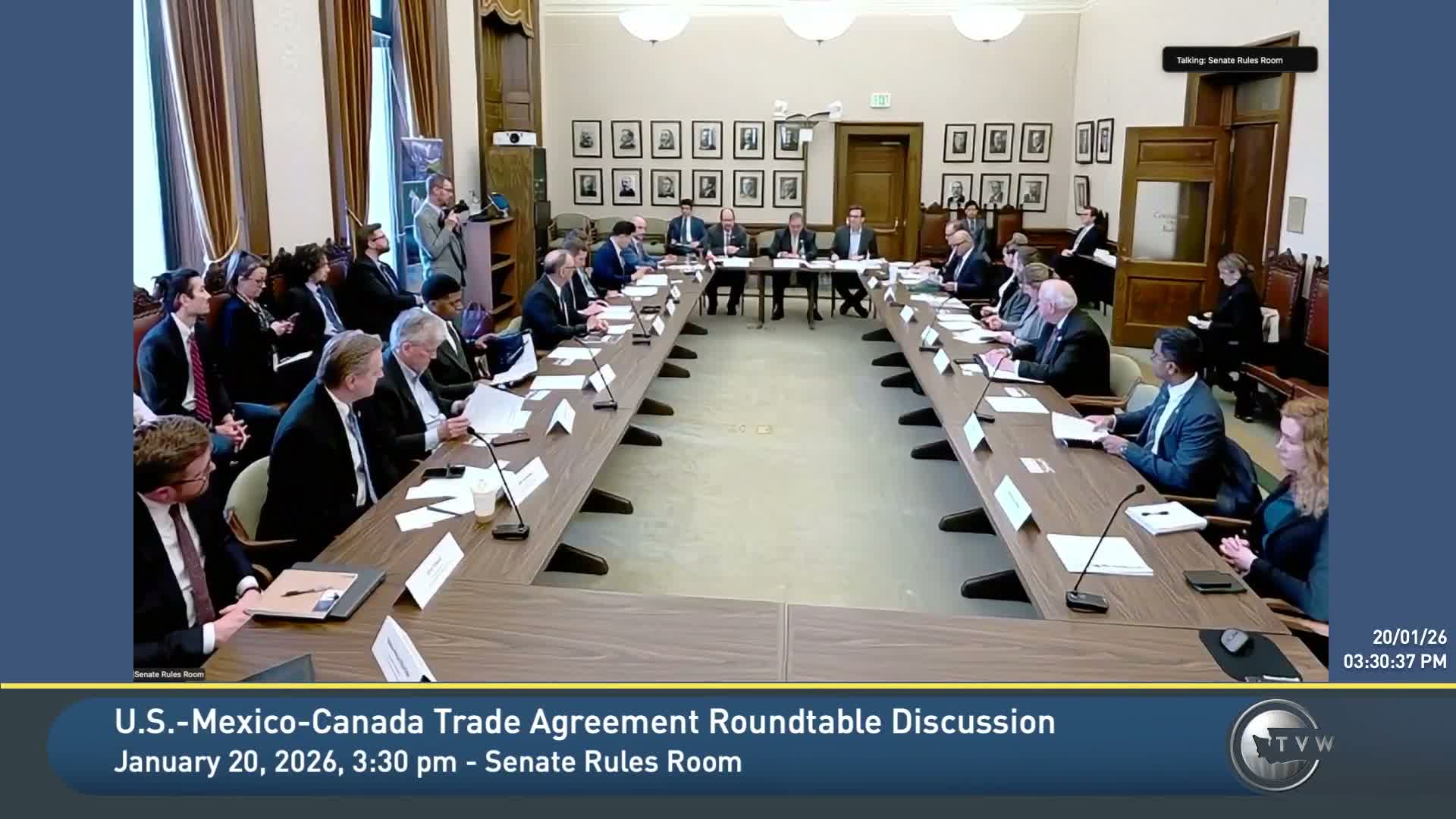
Lieutenant Governor Denny Heck convened a Penware‑organized roundtable of U.S., Canadian and Mexican officials, state lawmakers, consuls and business leaders to press for renewal of the United States–Mexico–Canada Agreement and to outline regional steps to influence the federal review process.
The roundtable came as the USMCA enters a six‑year review window that could result in a 16‑year renewal, an annual review regime for 10 years if parties do not agree, or an early withdrawal by a party. Speakers said the review creates a narrow window for public input and congressional engagement before the July 1 joint‑review deadline.
Why it matters: Participants tied the agreement to regional jobs and affordability. Congressman Rick Larsen (WA-2) said cross‑border trade supports roughly 10,000 jobs in his district and urged Congress to curb executive tariffs by limiting administration use of the International Emergency Economic Powers Act. "Trade good, tariffs bad," Larsen said. Governor Bob Ferguson described a state‑filed friend‑of‑the‑court brief opposing recent tariffs and said Washington will continue to press for stable trade relationships. "We filed a brief ... expressing our deep dissatisfaction with that," Ferguson said.
Leaders from Canada and Mexico urged continued trilateral cooperation. Craig Weichel, Canada’s Consul General in Seattle, said USMCA has helped grow North American trade and called for recommitment to trilateral free trade. Mexico’s Consul General Victor Hugo Lopez Ortega said USMCA is "an instrument of strategic stability" and described Mexico as a partner in aerospace, automotive and medical sectors.
Business and sector impact: Representatives from the Washington State Chamber of Commerce, state agriculture officials and provincial agricultural leaders described specific sector risks from tariff uncertainty. Chris Johnson of the chamber cited $6.7 billion in exports to Canada and Mexico in 2025; agriculture and building‑supply speakers said tariffs have already shifted sourcing and increased construction costs. Washington’s Department of Agriculture and provincial delegates highlighted the agreement’s dispute‑resolution mechanisms as important to keeping market access stable.
Planned state actions and outreach: Several participants endorsed a draft joint memorial (a legislative letter) supporting renewal. Representative Michelle Ryu said she and Senator Benke will introduce companion resolutions in each chamber to create bipartisan, bicameral state support and to circulate the language through the National Conference of State Legislatures and provincial partners. Brandon Hardenbrook (Penware) said the organization will share the resolution with partners at upcoming roundtables in Boise, Juneau and Salem.
Process questions and messaging: Multiple speakers urged congressional delegations to seek assurances from the administration that negotiations will be conducted in good faith and not result in unilateral withdrawal. Attendees also discussed coordinated messaging and limited advertising campaigns, with U.S. Consul General Sean Crowley advising study of Ontario’s prior campaigns before foreign governments advertise in the U.S. The USTR’s public comments were noted as listing priorities for Canada and Mexico that will be key in successful negotiations.
No formal federal decision occurred at the roundtable. Instead, participants emphasized advocacy steps—state resolutions, outreach to congressional delegations, and regional coordination—to influence the federal review and preserve tariff‑free trade that officials say supports jobs and price stability.
Next steps: Penware and allied legislators plan additional regional roundtables and state resolutions to amplify the Pacific Northwest message to the USTR and congressional delegations ahead of the July 1 joint‑review deadline.