Get Full Government Meeting Transcripts, Videos, & Alerts Forever!
Get email alerts on the Cascadia Planning topic
No spam. Unsubscribe anytime.
WSDOT brief: Cascadia planning, I‑5 master plan and high‑speed rail moving into public phases
Summary
WSDOT assistant secretary John White said Western Washington planning efforts — the I‑5 master plan, Cascadia high‑speed rail corridor identification and Amtrak Cascades service development — are aligning for public engagement in 2026 and aim to coordinate multimodal capacity for projected population growth through 2050.
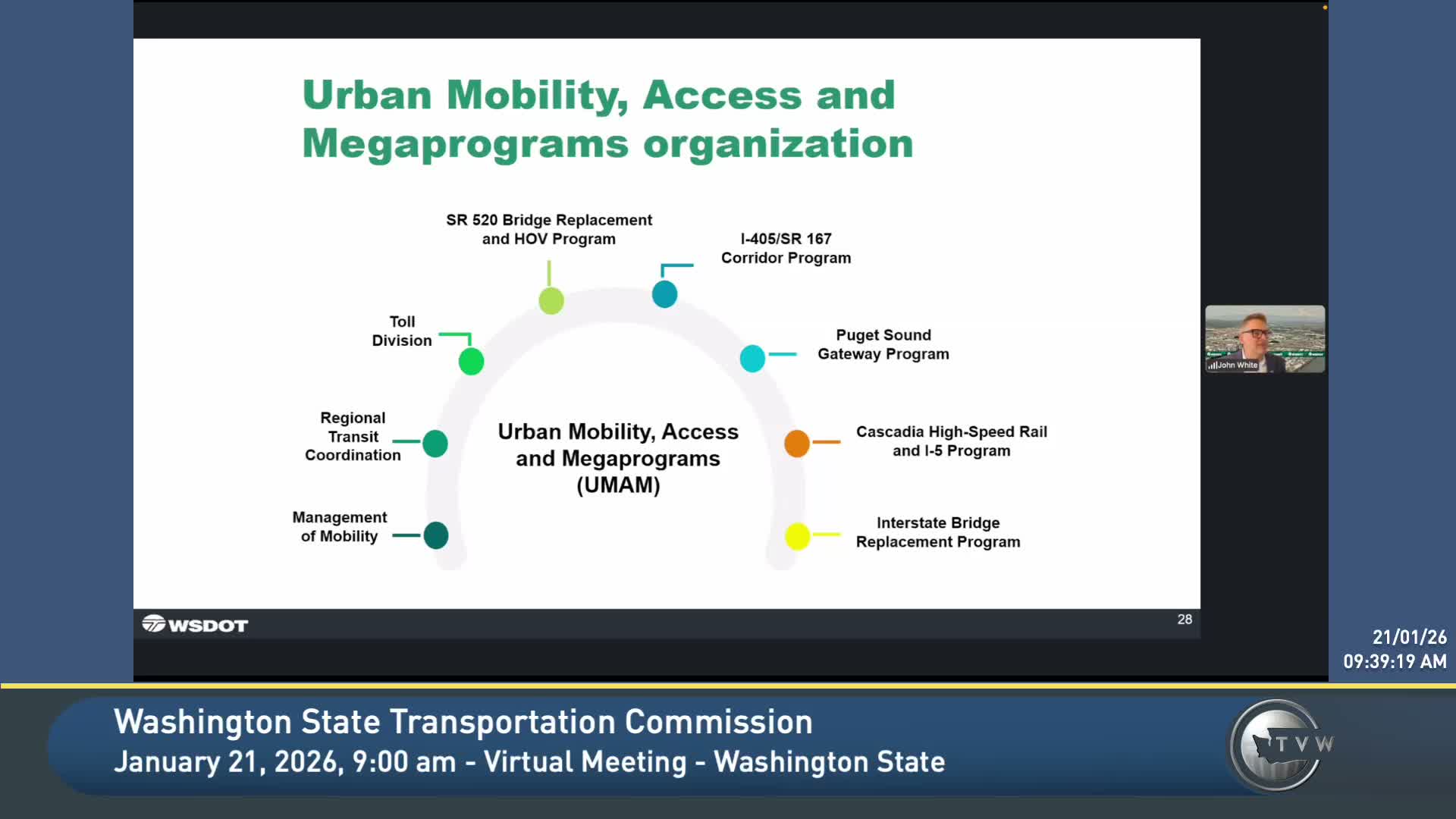
John White, assistant secretary for Urban Mobility and Mega Programs at WSDOT, briefed the commission on coordination among three Western Washington planning efforts: the I‑5 master plan, the Cascadia high‑speed rail corridor identification program, and Amtrak Cascades service development.
White said teams compiled more than 300 data sources and 600 datasets to assess existing conditions, constraints and future demand across freight, passenger rail and air. He described population forecasts of several million additional residents in the Cascadia mega‑region by 2050 and noted the I‑5 master plan received $11.7 million in the 2025–27 biennium to advance planning. "The Cascadia program was established to help integrate and align the I‑5 corridor master plan effort with potential for high speed rail," he said.
White said the Cascadia Corridor Identification development grant from the Federal Rail Administration totaled approximately $49.7 million with a state matching contribution from Climate Commitment Act funds, and that high‑speed rail planning is entering an early service‑development planning phase in partnership with the FRA. He emphasized the need to evaluate business cases, project phasing and environmental planning to align investments across modes.
Commissioners discussed regional coordination and coalition building; White said building supportive leadership and clear vision among partners is key to advancing large, multijurisdictional programs.