Get Full Government Meeting Transcripts, Videos, & Alerts Forever!
Get email alerts on the Wildlife Mitigation topic
No spam. Unsubscribe anytime.
FSEC approves Horse Heaven Wind Farm ferruginous‑hawk mitigation plan with edits and conditions
Summary
The Energy Facility Site Evaluation Council approved the Horse Heaven Wind Farm’s ferruginous‑hawk mitigation and management plan on Jan. 21, 2026, asking staff to add editorial changes and stronger language on artificial‑nest platforms and adaptive management. Two council members recused from the vote.
The Energy Facility Site Evaluation Council approved a species‑specific mitigation plan for the Horse Heaven Wind Farm on Jan. 21, directing staff to incorporate editorial revisions and to strengthen language around implementation of artificial nesting platforms and adaptive management measures.
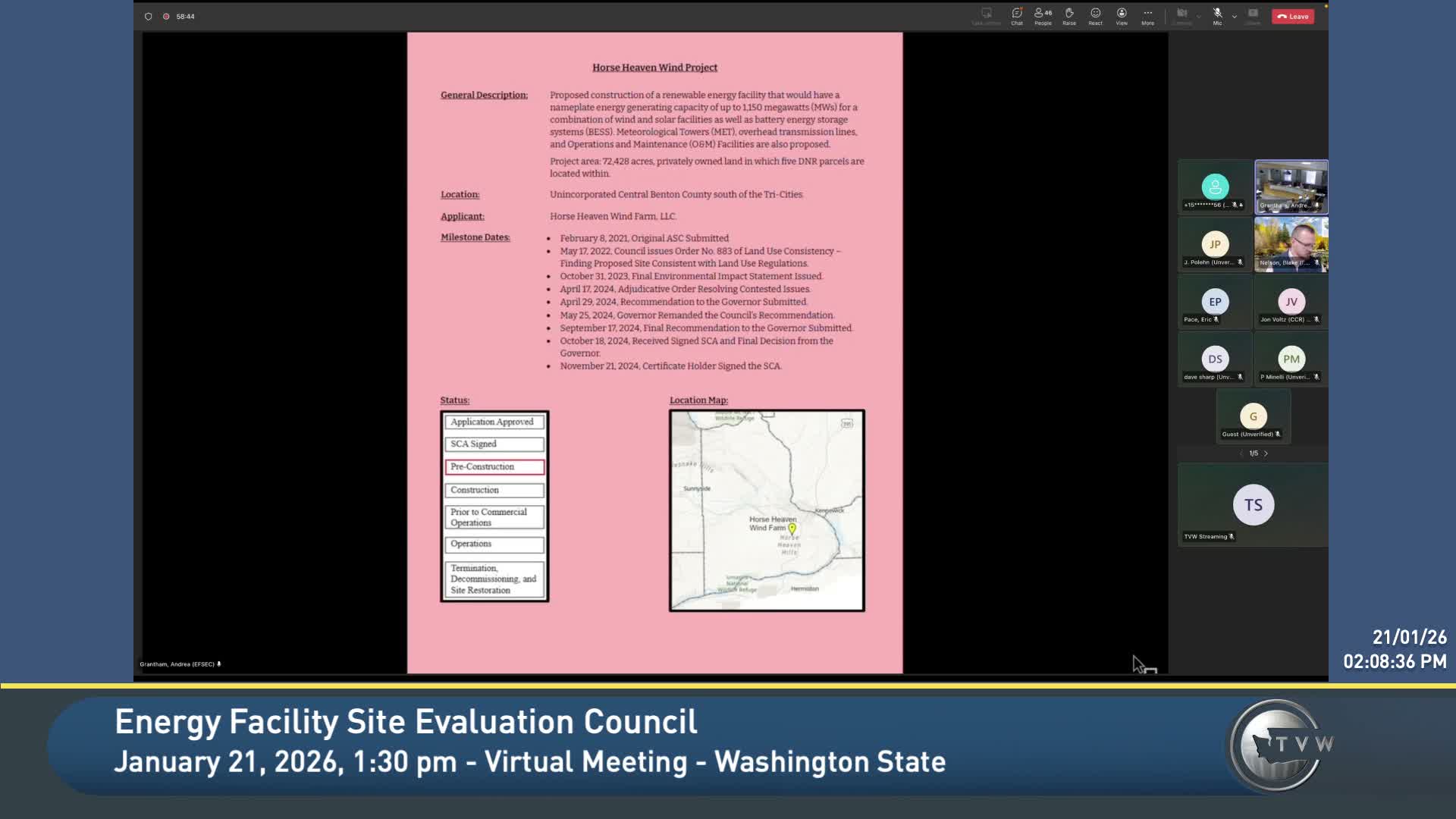
Staff presented the plan as required by Spec 5 of the site certification agreement and said the project‑specific mitigation was reviewed and reached consensus with the preoperational technical advisory group (PTAG) before public posting. Sean Green, FSEC SEPA specialist, summarized 32 public comments and outlined six substantive themes staff considered during the 14‑day comment period. "Staff is not recommending that this change be incorporated," Green said repeatedly while describing staff responses to requests that ranged from fines for wildlife take to mandatory platform installation.
Key decisions and staff recommendations
- Financial penalties for hawk injury or mortality: staff declined to make fines part of the mitigation plan, citing legal limits and confidence in exclusion areas, monitoring and adaptive management strategies. - Artificial nesting platforms: commenters urged mandatory installation; staff recommended keeping platforms as an option and suggested clarifying authority that would allow FSEC to direct installation if WDFW (Washington Department of Fish and Wildlife) recommends it. Council asked staff to clarify this chain of authority in the plan. - Monitoring duration: the plan proposes nest and mortality surveys for three of the first five years of operation. Staff and WDFW supported that approach; council members asked staff to provide cost estimates and said the adaptive‑management plan could expand monitoring if early data warrant additional years. - Automated detection systems and black‑painted blades: staff said current automated systems lack species‑specific reliability and that blade‑painting remains experimental and could introduce other impacts; staff therefore did not recommend mandatory requirements for those measures.
During deliberations councilors pressed for clearer text that would allow WDFW to flag circumstances where artificial platforms are appropriate and FSEC to impose that requirement on the certificate holder. Amy Moon, FSEC staff, said the compensatory mitigation package and the applicant's final proposal will be reviewed by PTAG and returned to FSEC for approval if additional measures are proposed.
Council action and next steps
Councilor Pamplin moved to approve the Horse Heaven ferruginous‑hawk mitigation plan as submitted by Horse Heaven Wind Farm LLC, with staff directed to incorporate listed editorial corrections and strengthened language regarding artificial‑nest platforms and WDFW consultation; the motion was seconded and passed by voice vote. Chair Kurt Beckett and Councilor Maverick Ryan noted recusals for this agenda item. Staff said it will bring follow‑up information and any final edits to the council if needed.
Why it matters
The plan is central to balancing siting and operational decisions with protections for the rare ferruginous hawk. It formalizes monitoring, exclusion zones and adaptive responses intended to reduce collision and mortality risk while preserving regulatory flexibility to adopt additional measures if monitoring shows them to be necessary.