Get Full Government Meeting Transcripts, Videos, & Alerts Forever!
Get email alerts on the Puyallup Watershed topic
No spam. Unsubscribe anytime.
Pierce County details landscape-scale projects across Puyallup, White and Chambers watersheds
Summary
Pierce County lead-entity coordinator Lisa Spurrier described recent and planned floodplain reconnections, barrier removals and estuary projects across the Puyallup/White/Chambers watersheds, citing examples where restored floodplains reduced flood impacts and improved salmon habitat.
Pierce County’s lead-entity team told the Salmon Recovery Council that coordinated, long-term landscape efforts are producing measurable benefits for salmon and flood resilience in the Puyallup, White and Chambers watersheds.
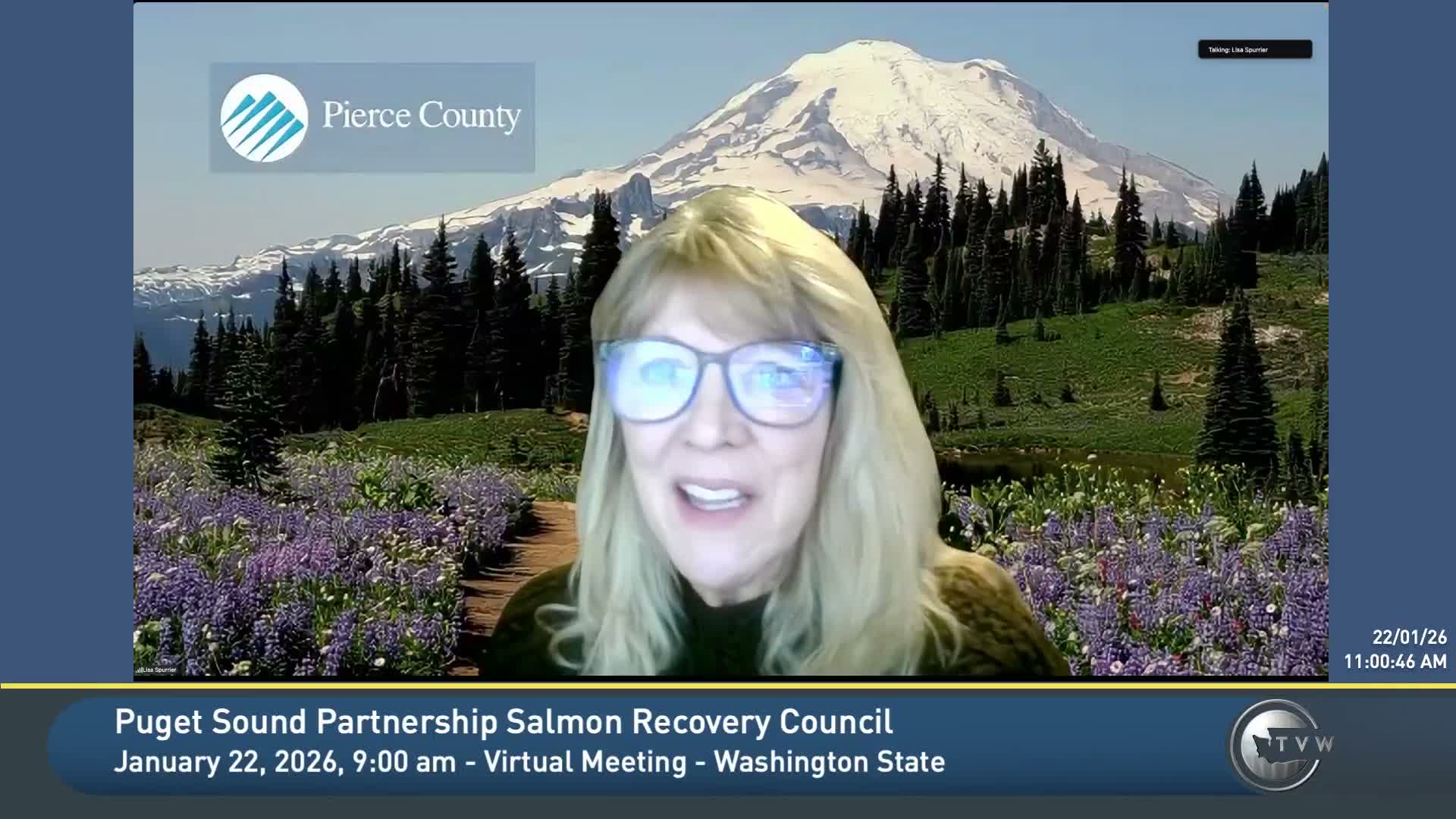
Lisa Spurrier, surface-water manager and lead-entity coordinator for the Puyallup/White/Chambers watersheds, reviewed a portfolio of projects, from headwaters road removals to large levee setbacks and estuary restoration. ‘‘High priority actions include reconnecting rivers with their floodplains, correcting fish barriers, protection of main stem and tributary areas, restoring hydrologic regime, and restoring estuaries and near shore areas,’’ Lisa said.
She highlighted notable accomplishments: King County’s 6,000 linear-foot setback (reconnecting roughly 120 acres of floodplain), Pierce County’s early 1998 forward levee setback reconnecting 122 acres, and recent projects on South Prairie Creek and Boise Creek that have demonstrably activated floodplain function during December floods.
Lisa also described substantial investments in upstream fish passage: the U.S. Army Corps’ $130 million investment to modernize Mud Mountain Dam’s trap-and-haul operations, intended to improve safe transport of adult fish to spawning grounds. She noted work on Clear Creek estuary opportunities, recent acquisitions (including a 16-acre mitigation parcel by WSDOT) and several local projects with federal, state and tribal collaboration.
Council members pressed on monitoring and life-history questions; Lisa said monitoring resources remain limited but that telemetry, otoliths and other studies are improving understanding of how fish use restored habitats.
Lisa urged the council to continue investing at the scale needed to maintain both habitat restoration and flood-risk benefits, saying monitoring shows fish quickly use restored sites and that multi-benefit projects reduce downstream flood risk as well as improve habitat.