Get Full Government Meeting Transcripts, Videos, & Alerts Forever!
Get email alerts on the Duckabush Project topic
No spam. Unsubscribe anytime.
Duckabush estuary restoration hits 100% design; project seeks federal funding to start construction
Summary
After 25 years of planning, the Duckabush (Decca Bush) estuary restoration reached 100% design and moved into preconstruction. Project partners say the Army Corps must secure full federal funding before the Corps will advertise contracts; the state has met its cost-share obligations but a large federal request remains for FY27.
After more than two decades of planning and design work, state and federal partners announced this month that the Duckabush estuary restoration has completed 100% design and moved into preconstruction.
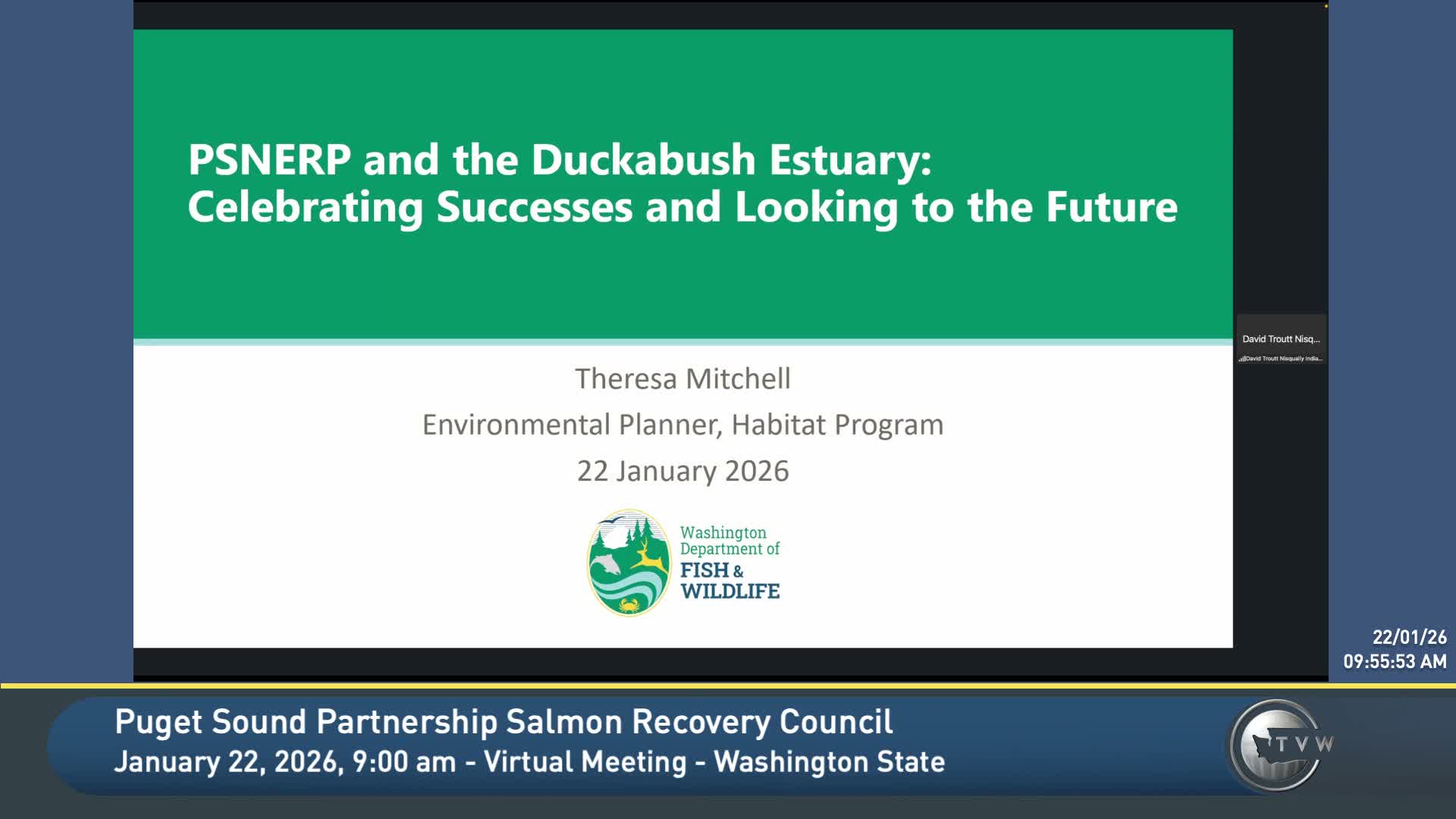
Teresa, lead project manager for the Puget Sound Nearshore Ecosystem Restoration Project at the Washington Department of Fish and Wildlife, said the milestone clears the way to seek federal construction dollars. “We are a 100% design. The Army Corps has moved us into preconstruction,” Teresa said, describing a final design package that merges Army Corps and WSDOT work and runs to hundreds of pages of plans and specifications.
The restoration would remove the historic US 101 causeway and reconnect four historic channels in the Duckabush estuary on Hood Canal. WSDOT will build a new estuary-spanning bridge approximately 1,613 feet long, with a maximum span of about 228 feet and substantially fewer piers than earlier designs. Project elements include removal of roughly 3 acres of fill, replacement of culverts, reconfiguration of the Decca Bush Road intersection and parking-area improvements to maintain public access.
Teresa and other partners emphasized the project’s dependence on federal funding and Corps timelines. The Army Corps has secured about $6 million to date for Duckabush and plans to request roughly $84 million more in fiscal year 2027, partners said. “The Corps will not put a project out for bid until they have all of the funding in hand,” Teresa said.
Jason, who introduced the briefing to the council, noted the significance of a 2022 change in Water Resources Development Act language that treated certain bridge and relocation costs as cost-shareable by the Corps—shifting the relative burden between federal and nonfederal partners for this project. Partners said that change was a major reason the project has become viable at this scale.
Agency staff outlined immediate near-term tasks: completing remaining real-estate acquisitions, finishing outstanding permit needs (including Marine Mammal Protection Act reviews), and finalizing the Corps’ cost estimate based on 100% design documents. Partners said the Corps asked for about six months to secure necessary real-estate interests to demonstrate readiness for a FY27 funding request; presenters warned that securing properties in that timeframe is challenging.
Council members and staff pledged to support the funding push. Ted and others asked how the Salmon Recovery Council could help; project staff requested assistance with coordinated outreach to congressional delegations once the Corps’ federal funding request is finalized.
If full federal funding is obtained on the Corps’ FY27 schedule, project partners said they expect a contract award and construction start in 2027. If the Corps does not receive the requested federal appropriation in that cycle, partners warned construction will be delayed because the bulk of the project cost is the bridge work and the Corps will not proceed without full funding.