Get Full Government Meeting Transcripts, Videos, & Alerts Forever!
Get email alerts on the Sentencing Policy topic
No spam. Unsubscribe anytime.
Sentencing Guidelines Commission pushes board recommendations forward; PSPRC produces two-page SOTA handout
Summary
The Sentencing Guidelines Commission reviewed and moved forward several of the board’s unanimous recommendations, and staff presented a two-page handout condensing the board’s 2021 report for use by legislators and practitioners; the board decided to remove partial 2024 data from the handout pending full-year figures.
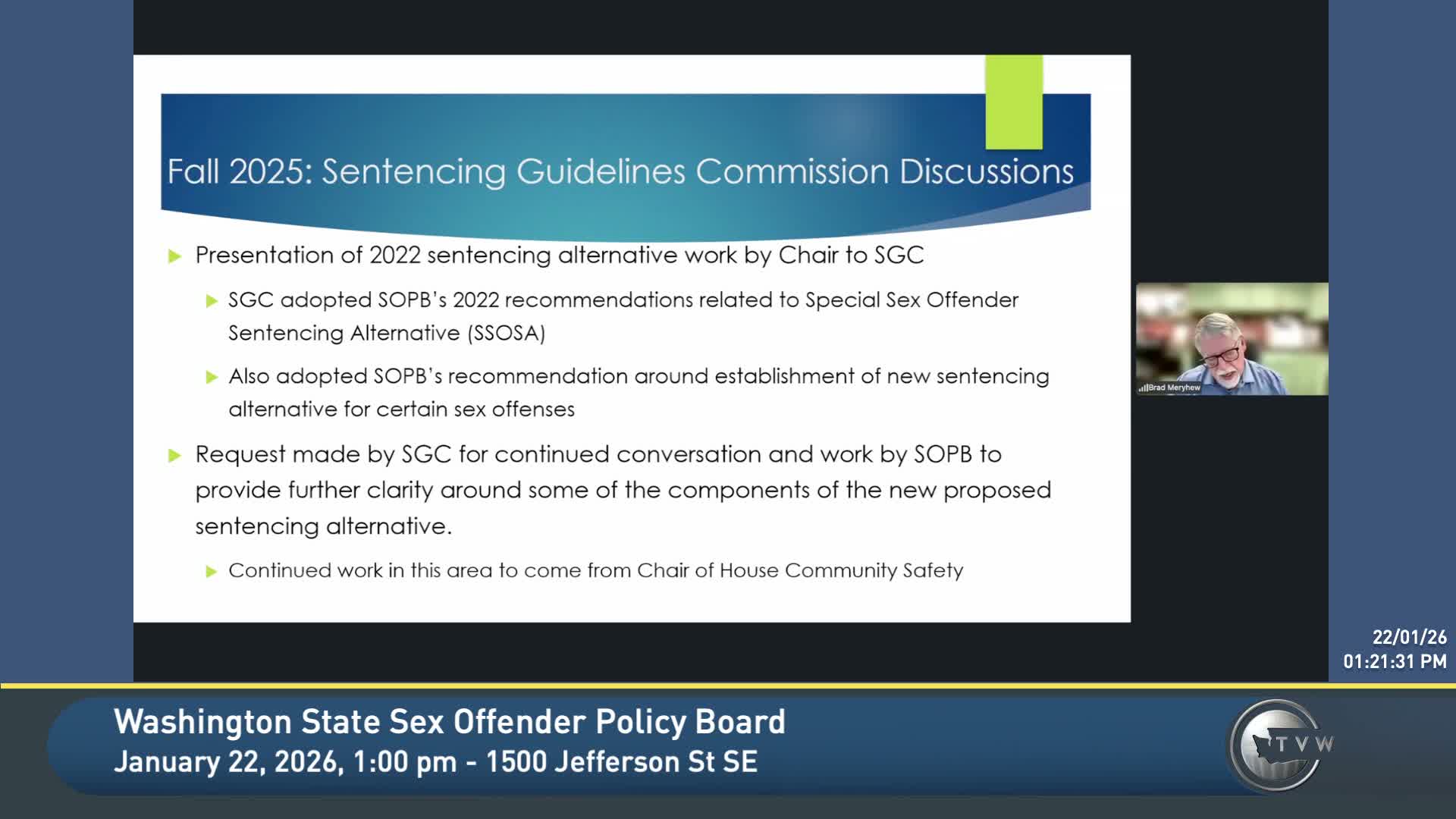
The Sentencing Guidelines Commission (SGC) has reviewed work from the Washington *** Offender Policy Board and moved several recommendations forward, according to the board’s chair. The SGC showed particular support for recommendations addressing child sexual imagery cases and also asked the board to refine eligibility criteria for alternatives similar to the Special Offender Sentencing Alternative (SOSA) for certain internet 'sting' or other non-contact offenses.
“We appeared, remotely for that session, to talk to them about what those proposals were,” Chair Brad Maryhugh said when reporting the interaction with the SGC. He added the commission initially endorsed recommendations related to child sexual imagery and later endorsed the sting-offense proposal after additional conversation.
Staff from the Public Safety Policy and Research Center (PSPRC) presented a two-page handout that condenses the board’s 2021 report into a quick-reference document intended for legislators, practitioners and interested stakeholders. Whitney Hunt, PSPRC staff, said the handout is drawn largely from the 2021 report with minor updates and includes descriptive statistics on who receives SOTAs; she noted the handout is not a new policy recommendation but a summary for easier use.
Board members raised data concerns about a partial 2024 data point. Jimmy Hong said the 2024 counts “seem to jump out” and asked whether the year was complete. Hunt confirmed the 2024 figures represented partial data through June 30, 2024, and the board agreed to remove the incomplete 2024 counts from charts until full-year data are available and to revise the data-limitation text accordingly.
The chair also updated members on a legislative development: House Bill 1180 was introduced to address failure-to-register charges and was amended by the sponsor and stakeholders to change the offense ranking; the board noted that its recommendation differed from the amendment. Chair Maryhugh described sentencing ranges discussed in committee: for example, a level 2 offense’s high-end standard range was described as 43 to 57 months, while a level 1 high end was described as 17 to 22 months and an unranked felony was described as 0 to 12 months.
Staff said they will resend the draft handout to board members for comment and finalize it after the agreed edits and removal of partial-year data.