Get Full Government Meeting Transcripts, Videos, & Alerts Forever!
Get email alerts on the Pension Governance topic
No spam. Unsubscribe anytime.
Yale researchers say long‑run pension underperformance persists; urge standard benchmarks and independent oversight
Summary
Yale researchers presented an independent 50‑state comparison showing Connecticut’s pension performance lagged historically and recommended statutory oversight, consistent 50‑state benchmarks, limits on any single external manager, clearer exit criteria and dashboard reporting. They praised recent improvements while urging more durable governance changes.
Yale researchers Steven Tian and Professor Sonnenfeld told the Finance, Revenue and Bonding Committee that an independent 50‑state aggregation shows Connecticut’s pension returns were among the poorest in the nation through mid‑2022, even as the treasurer’s office has reported strong recent gains.
Sonnenfeld summarized the research approach and results, saying the team calibrated annual reports across states to produce an apples‑to‑apples comparison. "As of 06/30/2022, Connecticut had the second worst performance of any state in a 3 and 5 year basis," he said, and described how differences in peer sets and aggregation methods (for example, the InvestMetrics/Makita dataset used by the treasurer’s office versus a state‑by‑state aggregate) lead to markedly different rankings.
The Yale team recommended several statutory and operational changes to reduce the risk of future underperformance: regular independent oversight and audits reported to the legislature; consistent 50‑state benchmarking for each asset class; clear, published criteria for pruning underperforming external managers (including vintage‑year comparisons); limits on the state’s exposure to any single external manager; and a public dashboard that presents concise, comparable performance indicators.
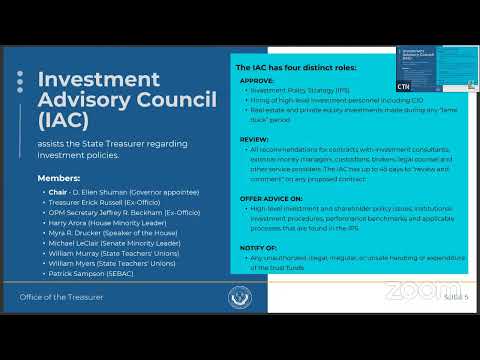
Sonnenfeld and Tian stressed that the recommendations are not a critique of current leadership alone but of long‑running governance and reporting practices. They credited Treasurer Russell and the IAC for recent reforms and improved short‑term results, but urged the legislature to consider statutory changes that codify key protections and make progress durable across administrations.
Committee members asked about concrete statutory language and whether other states have implemented these reforms; Yale responded they would provide comparative statutory examples and more detailed criteria for manager exit and benchmarking. Yale also gave a rough order‑of‑magnitude for fee inefficiencies: they noted that pension funds typically pay over $100 million annually in external manager fees and said reducing redundant fees and shifting appropriate allocations into low‑cost passive vehicles could materially improve net returns.