
Council hearing spotlights repairs, funding and staffing needs as city weighs grab-and-go and seven-day home delivery for older adults
Get AI-powered insights, summaries, and transcripts
Sign Up Free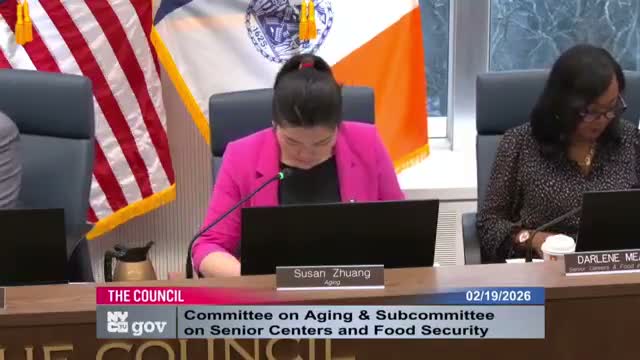
Summary
The City Council Committee on Aging heard testimony on Intro. 238 (grab-and-go meals at older adult centers) and Intro. 280 (seven-day home-delivered meals). NYC Aging supported the bills' intent but warned of federal funding limits, operational constraints and an estimated $27 million fiscal impact for seven-day home delivery.
Chair Susan Zhuang, chair of the New York City Council Committee on Aging, opened a hearing on conditions at older adult centers and two bills seeking to expand meal access for older New Yorkers: Intro. 238 to establish grab-and-go meal options at older adult centers and Intro. 280 to require home-delivered meals seven days a week.
The bills drew broad support from providers and advocates, but agency leaders and council members pressed for details on cost, operational capacity and building repairs. Ryan Murray, Executive Deputy Commissioner and Chief Program Officer at the New York City Department for the Aging (NYC Aging), said the agency "supports the intent of the bill" while flagging federal rules and contract realities that could affect implementation. "Nearly 2,000,000 New Yorkers are aged 60 or older," Murray told the committee, and NYC Aging currently reports serving more than 10,000,000 meals annually across the city through its older adult centers and home-delivered meal programs.
Why it matters: advocates said adding grab-and-go and expanding home delivery would help older adults who cannot attend congregate meals because of mobility, appointments or caregiving duties. Several witnesses and council members also pressed for clearer plans for capital repairs to aging center facilities — many of which operate in New York City Housing Authority (NYCHA) buildings and have outstanding code or inspection issues that block service and access.
Key details and agency cautions
- Fiscal estimate: NYC Aging referenced the fiscal impact statement already provided to the Council that estimated expanding home-delivered meals to seven days could cost about $27,000,000. Murray said operational design decisions during negotiations could change that estimate.
- Federal funding constraints: Murray noted a potential conflict with the Older Americans Act congregate-meal rules (cited in testimony as 3(c)(1)), which generally require congregate meals to be consumed on-site; introducing grab-and-go options without careful alignment could affect federal reimbursement for some meal funding.
- Program scale and capacity: The agency said it funds roughly 300 older adult centers citywide and that about 113 centers already offer grab-and-go options. NYC Aging also described a network of roughly 17 providers who deliver home meals across geographic areas and said home-delivery is used to serve people assessed as homebound.
- Capital needs: Multiple witnesses described widespread capital shortfalls at centers (broken HVAC, leaking roofs, malfunctioning elevators, outdated kitchens and transportation vans). Providers and advocacy groups urged ongoing council funding beyond last year's $5,000,000 allocation and recommended reforms to capital eligibility rules for NYCHA-based centers so state and other funds can be used more easily.
What advocates told the committee
- AARP New York, IBO, Legal Aid Society, City Meals on Wheels, LiveOnNY and other provider witnesses strongly backed both bills while urging adequate city funding and operational supports. Janine Kendall Jackson of the Legal Aid Society recommended expanding home-delivered meals eligibility and adding medically appropriate and culturally appropriate options. City Meals on Wheels said its cost-efficient pilots (a breakfast box and mobile groceries program) show ways to increase food for the most food insecure home-delivered meals recipients.
- LiveOnNY and other providers urged changes to capital rules, arguing that NYCHA site-control and administrative hurdles have in some cases blocked funding secured from state sources and stalled repairs for years.
Public comments and district issues
Council members raised examples from their districts: closures of centers for mold or HVAC repairs, long or unclear timelines for NYCHA remediation, and requests for more transparency about how the $5,000,000 capital pool is being allocated. Councilmember Amanda Farris described one center closure that has forced older adults to travel far for interim services, and providers urged better outreach to reach older adults who do not use centers.
Next steps
NYC Aging pledged written follow-ups on several items — a borough-by-borough breakdown of centers, the list of capital projects on the agency's radar, data on home-delivery volumes and Agent Connect call volumes — and said it will work with the Council on red lines and operational design for the two bills. Advocates asked the Council to pair any legislative expansion with commensurate budget increases and reforms to capital eligibility and interagency coordination for NYCHA buildings.
The committee took no vote at the hearing; public testimony and agency Q&A concluded and chairs accepted written testimony to the record.