
Middlesex College trustees hear student success presentation; five students describe supports that kept them enrolled
Get AI-powered insights, summaries, and transcripts
Subscribe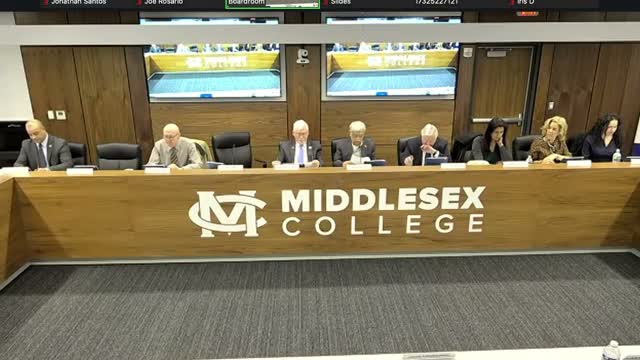
Summary
Five students spoke to the board about accessibility accommodations, veteran services, food and financial supports, and an adult-transitions program; college leaders said a Title 5 grant paid for a virtual orientation accessed by more than 1,900 students (67% completion).
A panel of five students told the Middlesex College Board of Trustees on Monday how campus programs helped them enroll, stay and succeed.
Dr. Alex Alexis Delgado, dean for student success, opened the presentation by describing the Student Success Office’s portfolio — advising and transfer services, counseling and wellness, a community resource and food pantry, the Center for Accessibility and Disability Resources, the Center for Adult Transitions, Educational Opportunity Fund (EOF), military and veteran services, and a developing TRIO program. He said the college’s new virtual orientation, purchased with a Title 5 grant and developed with Advantage Design, has been accessed by more than 1,900 students and that 67% of those users have completed the platform.
The board then heard first‑hand accounts. "My name is Jrelisa Yuceta, and it’s truly an honor to be here today," Jrelisa said, describing her experience as a student with a visual impairment and crediting the Center for Accessibility for accommodations including extra testing time, large‑print materials and math tutoring that allowed her to take challenging engineering courses.
Abraham Chavarria, a veteran and adult‑learner, said returning to school required "a different kind of courage" and praised staff members Stacy Garcia, Sharon Givarimasi and Michelle Rubio for practical supports — Chromebooks, assistance with GI Bill paperwork and help filing paperwork with the Veterans Administration. "Programs like Adult Scholars and Veteran Services have helped me make that transition possible," he said.
Mariela Flores, a second‑year psychology student who identified herself as first‑generation and low income, said the food pantry and EOF have been essential: she described carrying a bus pass and a $25 cafeteria card and said access to fresh food made it possible to stay on campus and focus on coursework. "EOF is my family," she said, crediting it with check‑ins and opportunity‑building experiences.
Nelson Baez, another veteran student, described finding community in a veterans lounge, receiving help replacing a broken laptop and assistance with VA reevaluation. Aya (first name only) spoke about the Center for Adult Transitions (students ages 18–24), saying the program taught computer, culinary and workplace skills and gave her confidence and independence.
Trustees responded with praise and questions about outreach. Trustee Anderson and others thanked the students for their “inspiring” testimonials. A board member asked whether the trustees could do more to make students aware of available services; Dr. Delgado and staff said institutional research was preparing pulse surveys and that results could be shared with the board to guide outreach and marketing.
The presentation closed with the board thanking the students and the college teams who run these programs. Dr. Delgado said the college is still hiring for a TRIO director and encouraged trustees to continue referrals and grant‑seeking to expand supports.
The board then moved on to committee reports and item votes.