MnDOT updates cost-participation policy, caps local share at 0.8% of ANTC; local governments applaud
Loading...
Summary
The Minnesota Department of Transportation proposed a revised cost-participation policy that caps a local unit's share on MnDOT-initiated trunk highway projects at 0.8% of its five-year average adjusted net tax capacity and proposes statutory authority to cover certain local utility relocation costs; local governments said the changes would substantially reduce local burdens.
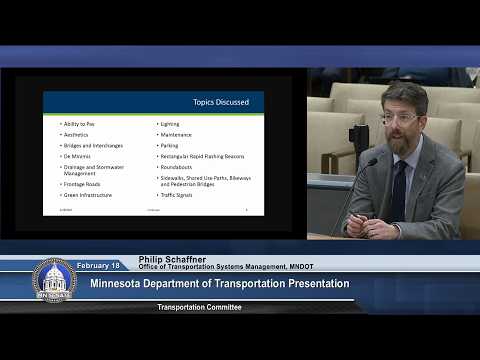
The Minnesota Department of Transportation (MnDOT) outlined a planned update to its cost-participation policy at a Minnesota Senate Transportation Committee hearing on Feb. 18, 2026, proposing an "individual project maximum" that would limit a local unit's responsibility for trunk-highway eligible costs to no more than 0.8% of its five-year average adjusted net tax capacity (ANTC).
Phil Schaffner, director of MnDOT's Office of Transportation System Management, told the committee the update is the product of nearly two years of work with local partners and a steering committee and will be implemented by July 1, 2027, for projects beginning in state fiscal year 2027. "We are establishing what we're calling an individual project maximum," Schaffner said, adding the cap is tied to a publicly published Department of Revenue data point and that non-trunk-eligible local additions to project scope would not count toward the maximum.
The update also includes proposed statutory language (an addition to Minnesota Statutes section 161.46, subdivision 2) that would enable MnDOT to cover the cost of relocating locally owned utilities with remaining service life when relocation is necessitated by a MnDOT construction project. MnDOT said it would work with local units on detailed guidance if the statutory change is enacted.
Local government representatives who participated in the steering committee and working groups praised the revisions. Jim Faldesi, Saint Louis County public works director and a steering committee member, called the ability-to-pay provision a "game changer," and offered a project example in which the local share would drop from roughly $630,000 under the old practice to about $35,000 under the new cap. "That's what we're talking about," Faldesi told the committee.
Deb Heizer, engineering director for the city of Saint Louis Park, said the utility relocation language includes commonly owned systems such as tribal and watershed district utilities and could prevent cities from prematurely replacing assets at their own cost. She described a Brooklyn Center example in which a $20 million estimated project that would have consumed more than a decade of that city's state aid would instead see a local cap in the mid-$300,000s under the new approach.
MnDOT cautioned the changes increase the department's responsibility and will have fiscal implications. Schaffner said a preliminary analysis of fiscal 2024-25 projects, focused on the ability-to-pay clause, estimated the cost shift to MnDOT at roughly $20 million per year, varying by year. MnDOT officials said districts are reviewing fiscal 2027-28 projects to refine that estimate and that the policy and manual will undergo final internal review and staff training.
Committee members asked whether the changes require statute or rulemaking. Schaffner and counsel explained the cost-participation framework has existed as an agency policy for decades and past session laws have directed MnDOT to maintain a policy without requiring rulemaking; the department said the proposed statutory language pertains specifically to utility relocation authority.
Representatives from city and county organizations including the League of Minnesota Cities, Metro Cities, the Minnesota Association of Townships, the Association of Minnesota Counties and the Minnesota Intercounty Association testified in support of the draft policy, saying it reduces potential fiscal strain on smaller local governments and improves predictability. Several witnesses and members urged clear implementation guidance and earlier coordination so local capital improvement plans are not disrupted.
The committee did not take a formal vote at the hearing. MnDOT said the policy and manual are expected to apply to projects starting in fiscal year 2027 and that the agency will provide training and further implementation guidance; the proposed statutory language would require legislative action to take effect.