
Consultants outline Temecula land‑use framework; community tables favor urban villages, mall reuse and equestrian sites
Get AI-powered insights, summaries, and transcripts
Subscribe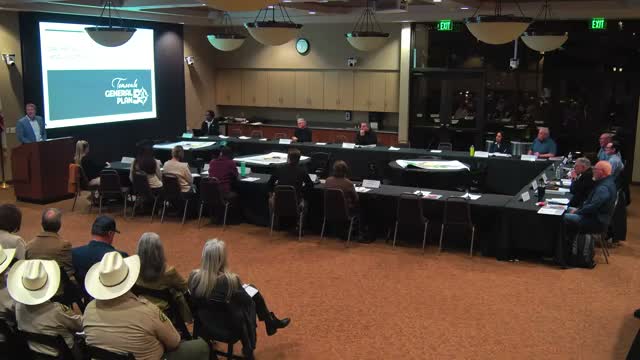
Summary
JZMK Partners presented a land‑use primer for Temecula—maps of five focus zones, development capacity vs. market demand, and next steps—while breakout tables recommended urban‑village concepts, adaptive reuse of the mall, innovation zoning and possible equestrian center sites.
Consultants from JZMK Partners presented a land‑use primer at the GPAC workshop, outlining Temecula's existing land‑use composition, focus zones for study and a preliminary assessment of development capacity versus projected market demand.
"Tonight's conversation is the start of a land use conversation," Amanda (consultant facilitator) told attendees, noting the meeting's purpose was to develop ideas for further study rather than reach final decisions. Drew Watkins of JZMK described the city's mapping approach and the five primary focus zones—Promenade/MSJC Temecula Valley campus, Uptown, Old Town, Temecula Parkway commercial strip and wine country—then summarized capacity figures and market demand for housing, office, industrial and hotel uses.
Watkins said Temecula's population is about "112,000 as of a year or so ago" and that the city's boundary is "just under 24,000 acres." He noted that residential uses make up roughly 45% of the city, open space and agriculture about 30%–40%, and that industrial and hotel categories present potential opportunities if the city elects to pursue them. He also told the committee that the RHNA allocation numbers are assigned regionally by SCAG and were not available for GPAC to set during this meeting.
During table exercises, groups proposed several focused ideas for study: an urban‑village overlay in and around Old Town and the MSJC campus; adaptive reuse concepts for the mall area (including housing and entertainment uses tied to the proposed MSJC campus); creation of an innovation/tech zoning district near freeway‑adjacent industrial parks; and identification of larger parcels suitable for a true equestrian center (rather than a small arena) north or west of the city.
Table 2 recommended revisiting the South Side specific plan for Old Town and considering a softer entertainment overlay to attract venues while managing noise. Several tables also suggested bringing youth voices into future visioning to capture preferences for 2030–2050 and emphasized multimodal connections between Old Town and Uptown.
Consultants said they will compile tonight's feedback into additional research and return to GPAC at a future meeting (no meeting in March; GPAC reconvenes in April).