
Administration proposes PTET, phased federal conformity and cuts to 'Better' reimbursement in supplemental budget
Get AI-powered insights, summaries, and transcripts
Sign Up Free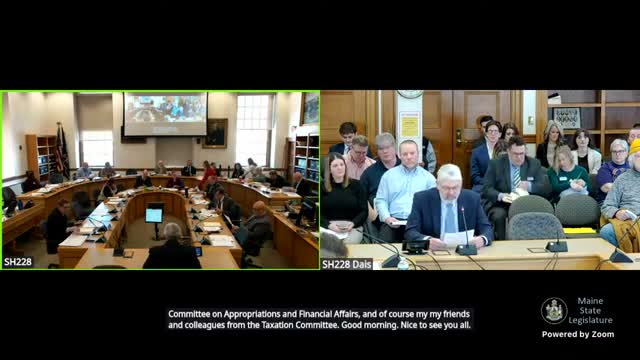
Summary
The governor's supplemental budget (LD 22/12) would broadly conform Maine tax law to recent federal changes while carving out exceptions, create an elective pass‑through entity tax (PTET) expected to net ~$17.5M ongoing, and phase out the long‑running business equipment reimbursement program commonly called "Better." The administration says the package balances taxpayer relief and fiscal sustainability; manufacturers and municipalities warn of retroactive costs and job risk.
The administration told lawmakers on the joint Appropriations and Taxation committees that the supplemental budget (LD 22/12) pairs a measured federal tax conformity with targeted state changes intended to modernize Maine's tax code and provide property tax relief. State Treasurer Joe Perry opened the hearing asking the legislature to allow municipal revenue sharing and the disproportionate tax burden fund to increase to match higher revenue forecasts.
DAS Commissioner Clark outlined the administration's taxation proposals in detail. On conformity the administration would adopt most of the income‑tax related provisions of the federal omnibus (referred to in testimony as "OB3") while carving out higher‑cost, above‑the‑line items such as bonus depreciation and certain qualified production property deductions. Clark said the administration opted for a phase‑in on expensive provisions (for example, a phased approach for R&D expensing for large businesses) to limit near‑term fiscal shock, noting full conformity to some direct items would cost substantially more than the proposal on the table.
A centerpiece of the budget language is a new elective pass‑through entity tax (PTET). Commissioner Clark described the design: an elective entity‑level tax on partnerships, S corporations and other pass‑throughs with a corresponding refundable individual credit set at 90% of the owner’s distributive share of the entity tax, plus an expanded credit for taxes paid to other jurisdictions. “The PTET would provide significant net federal tax savings to owners of certain pass‑through entities and generate approximately $17,500,000 annually for Maine,” Clark said, explaining the measure is a response to federal and state SALT limits and is intended to be voluntary for taxpayers.
The administration also proposed property‑tax changes packaged under Parts M and O: a consolidated, tiered homestead exemption that expands veterans’ and blind exemptions (the administration estimates roughly 24,000 additional veterans would gain some relief), and a phase‑out of the Better business equipment tax reimbursement. Commissioner Clark argued Better has largely been superseded by newer incentive programs and that sunsetting it would free resources for expanded homestead exemptions and other priorities. The budget document and testimony included fiscal tables and examples; the administration said they will provide a consolidated Office of Tax Policy report for committee work sessions.
Committee members pressed administration witnesses on fiscal estimates, timing, and distributional impacts. Staff said the PTET is likely to produce volatile receipts in the first years (a spike followed by refunds) before settling to an estimated ongoing net of roughly $17.4M in year three. Lawmakers also asked for lists of Better recipients, analyses of who benefits under Dirigo/BETI versus Better, and more granular examples of how the expanded homestead and charitable deduction phase‑ins will affect taxpayers at different incomes. The administration agreed to provide additional modeling and to supply numeric examples for the work sessions.
Public testimony at the hearing was dominated by businesses and trade groups opposing the proposed elimination or retroactive reduction of the Better reimbursement. Representatives of several paper mills, forest‑products businesses, and manufacturing employees — including union leaders and mill executives — said the Better program was essential to long‑term capital planning and that retroactive changes would harm investments and jobs. Sappi, ND Paper, Twin Rivers and other manufacturers described recent large capital projects built with the expectation of continued Better reimbursements; retail and lumber industry groups added that many smaller businesses rely on Better for equipment investments. Municipal associations urged the committee to preserve the municipal revenue sharing mechanism and to consider the local impacts of expanded exemptions.
The joint committees signaled they will take more evidence in work sessions. Lawmakers requested additional fiscal notes, lists of Better recipients, breakdowns of affected taxpayers, and comparative analysis of similar PTET implementations in other states. The committees also asked Maine Revenue Services staff and the Office of Tax Policy to provide a consolidated, line‑by‑line fiscal report before amendment votes.
Ending lines: Legislative work sessions were scheduled; no final committee votes occurred during the public hearing. Further numeric detail and legal language will be provided to members before any committee recommendations.