
LaPorte County leaders warn SEA 1 will shrink local revenue; consider taxes, cuts and efficiency
Get AI-powered insights, summaries, and transcripts
Subscribe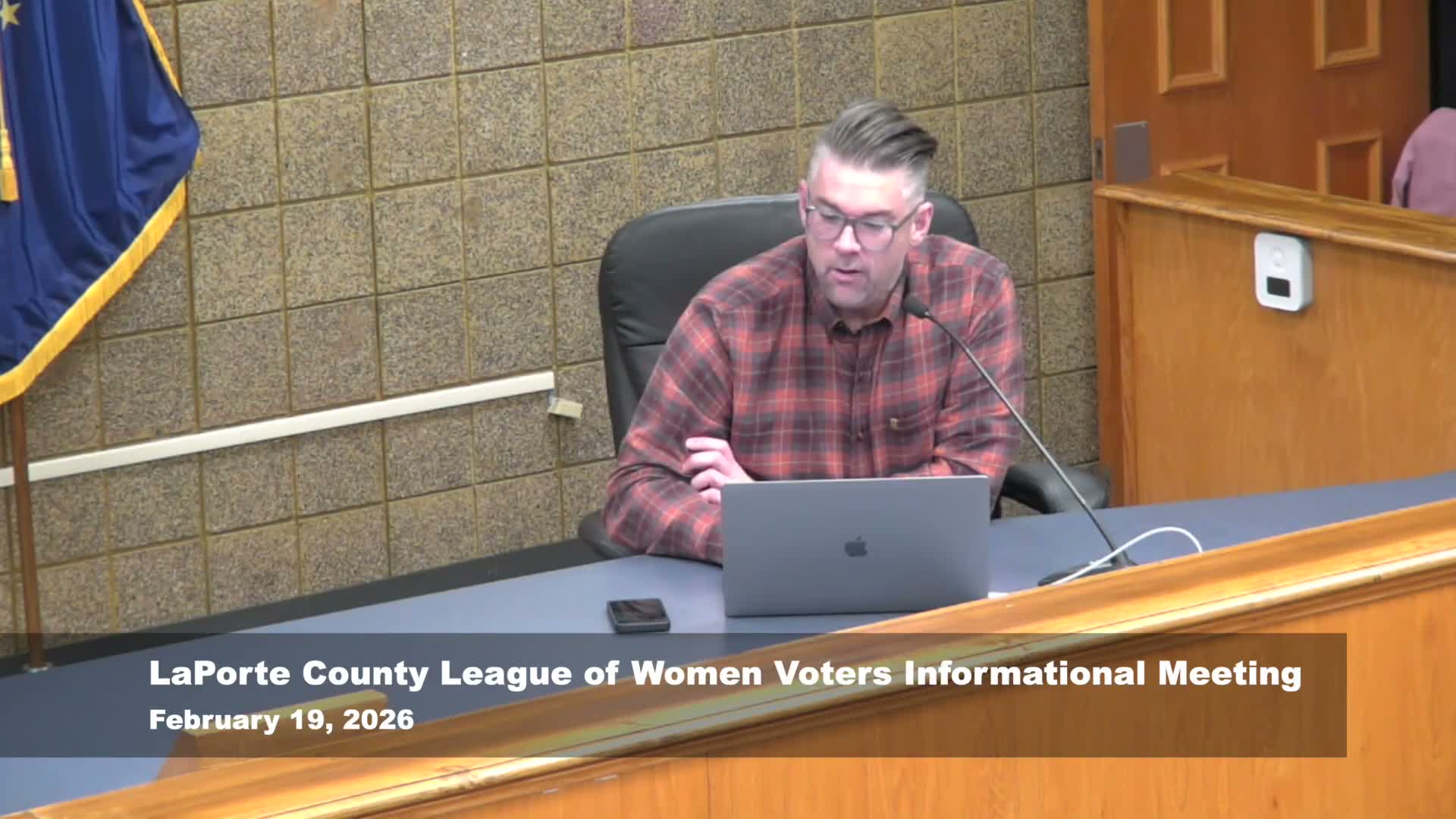
Summary
County leaders told a League of Women Voters forum that state property-tax reform (SEA 1) is creating a $2.3–$3.7 million projected shortfall and urged efficiency, targeted taxes and careful use of reserves to maintain services through 2028.
LaPorte County officials told residents at a League of Women Voters forum that a recent state property-tax reform known as Senate Enrolled Act 1 (SEA 1) has shifted revenue burdens to local governments and created a projected county shortfall of roughly $2.3 million to $3.7 million.
"The state is not funded by property taxes," Adam Kuronka, president of the LaPorte County Council, said, describing how SEA 1 reduced some homeowners' bills but transferred fiscal pressure to counties, townships, schools and libraries. Kuronka said the council must consider both cost reductions and potential local taxes to maintain operations through the 2028 budget cycle.
Commissioner Steve Holofield, president of the LaPorte County Board of Commissioners, said the county has been managing pressing infrastructure needs while remaining relatively low‑debt. He described an extended decision process that led to a temporary heating measure for the courthouse: "We took five bids that night," Holofield said, and vendors including LG and the original installer Ameresco have been involved in diagnosing and repairing systems.
Officials emphasized that some budget responses are constrained by state statute and accounting rules. Kuronka explained the role of local income taxes and special‑purpose LITs (local income taxes) as tools to fill gaps, but warned that many LITs will require annual renewal after 2028, complicating long‑term borrowing and capital planning.
The council also described a recent internal budget 'cleanup' that created a dedicated EMS fund and realigned payroll allocations. Kuronka said the reallocation was an accounting correction rather than a net increase in spending.
Panelists declined to promise layoffs but said they will pursue efficiency measures such as shared services and office co‑location to reduce overhead. "We're not looking to do any major layoff," Kuronka said, "but how can we do more with less because of systems, because of shared resources."
Next steps: leaders said they will continue budget meetings, consider targeted tax measures and discuss options with county attorneys and the state as statutes and deadlines evolve ahead of 2028.