Get Full Government Meeting Transcripts, Videos, & Alerts Forever!
Get email alerts on the Infrastructure School Safety topic
No spam. Unsubscribe anytime.
City asks school board to declare narrow Walnut Avenue strip surplus so it can buy land for sidewalk and safety improvements
Summary
City of Greenfield officials asked the Greenfield Union School District to declare a roughly 3,100-square-foot strip along Walnut Avenue at Mary Chapa Academy surplus so the city can buy it, build a sidewalk, add a push-button flashing crosswalk and widen the roadway to support future interchange work; board members pressed city staff on buffer zones, impacts to a curriculum storage building and choices such as fencing or landscaping.
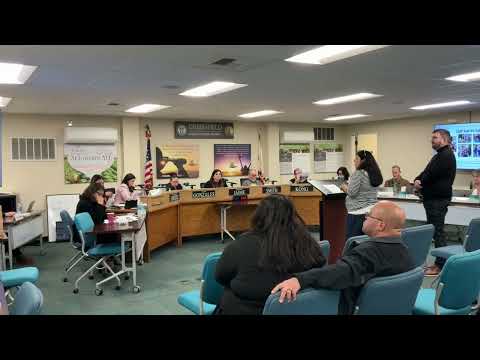
City of Greenfield officials told the Greenfield Union School District board on Jan. 8 that they want to purchase a narrow strip of district property along Walnut Avenue adjacent to Mary Chapa Academy to build a sidewalk, add a pedestrian-activated flashing crosswalk and widen Walnut to improve safety and to support a future interchange project.
Emily Rivera, president of the district's 7/11 committee reviewing the proposal, said the committee's recommendation "keeps the district whole while improving safety for our community." Jamie Tubel, the city's public works director, said the city has secured grant funding to plan and phase the work and that the improvements would be constructed in city right-of-way.
City engineer Doug Pike described the project as the "Mary Chapa School Pedestrian Safety and Traffic Improvement Project" and said the schematic plan calls for building a continuous ADA-compliant sidewalk on the school side of Walnut and a robust, signalized, push-button crosswalk to stop traffic when activated. Pike told the board the narrow strip the city seeks to acquire is typically about 5 feet in width (one spot potentially 6 feet) and that the total area being discussed is approximately 3,100 square feet.
Pike and Tubel said the city expects to use a mix of grant funding, including Community Development Block Grant (CDBG) funds, and that federal planning funds tied to a Reconnecting Communities grant (presented to the board as roughly $800,000 for interchange planning) would support subsequent design work. City staff said they do not expect the district to contribute construction funding because the work will be on city right-of-way.
Board members repeatedly asked how the proposed right-of-way would affect an older district building used for curriculum storage that sits in the potential acquisition area. Tubel and Pike said the exhibits were preliminary renderings and that design alternatives would be developed in consultation with district staff; they said options could include modifying, shortening or otherwise preserving most of the building and that any agreement would include provisions to preserve the district's needed storage and functions.
Trustees pressed the city on buffer-zone measurements and classroom proximity. Vice President Smith urged protections for classrooms and students, including the possibility of fencing or landscaping as a physical buffer. "We have enough room for us to do it—we are responsible for the buffer zone, not the city," one trustee said during questions; city staff responded that final dimensions and code compliance will be determined during design and with review by the Office of the State Architect.
City staff also acknowledged concerns about noise and vehicle intrusion; they said a full sound wall would likely be cost-prohibitive but that fencing with landscaping could be part of a mitigation strategy. Board members and city staff noted that final designs must comply with applicable design standards and that the district will be included in the final design and permitting process.
The board asked city staff to produce alternative designs that show how the district's functions would be preserved; Superintendent Cortez summarized the board's priorities as code compliance for buffers, alternatives such as fencing or landscaping, and additional study of the affected building before any final transfer.
The city presentation was informational; the board will consider an action item on declaring the strip surplus and negotiating terms at its next regular meeting.
What's next: The board is expected to see a formal action item on the proposed surplus designation and sale at the next meeting, after the city and district complete additional design and negotiation work.