
Middlesex County introduces $683.2 million 2026 operating budget, highlights $88.6 million in capital projects
Get AI-powered insights, summaries, and transcripts
Sign Up Free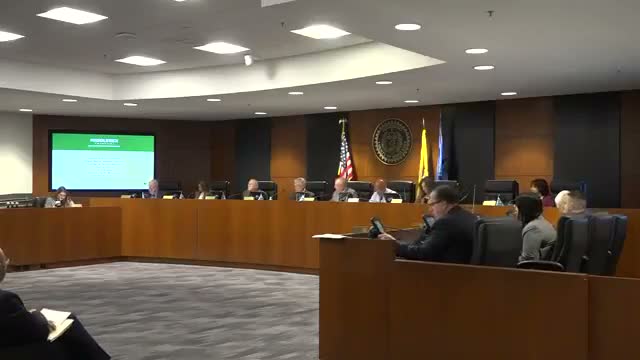
Summary
County officials introduced a $683.2 million 2026 operating budget that keeps the county purpose tax rate at 0.302 while planning $88.6 million in capital spending, citing federal policy shifts, higher construction and medical costs and an anticipated SNAP administrative cost-share increase.
Unidentified Speaker (the county director) opened the meeting and introduced Middlesex County's proposed 2026 operating budget, saying it is designed "to support local community and foster business growth." The board was told the introduced total general appropriations are $683,209,000 for 2026, up from $661,666,577 in 2025.
Nick Chukwinski, identified in the meeting as the county's chief financial officer, gave a detailed overview of the introduced figures and assumptions. Chukwinski said the county expects increases of $6.5 million for contracted wage commitments and $22.3 million for other mandated or contractual expenses; grants shown in the introduced budget increase roughly $35.4 million but are subject to timing. After accounting for anticipated offsets, the net year-over-year increase in expenditures was described as about $28.8 million. He said operating revenues include an anticipated $5 million surplus and cited a net amount to be raised by taxation of approximately $527.2 million, which corresponds with the county's presented county purpose tax rate of 0.302.
Chukwinski and the director framed several external drivers for 2026 costs. They cited federal policy changes, including shifts in renewable energy tax credits, new tariffs and changes to Medicare and Medicaid financing, as producing material uncertainty. Chukwinski listed specific pressure points: $8.5 million in funding the county could not incorporate because of state budget law timing, a projected $7.5 million increase tied to higher construction material costs, and a $6.0 million increase reflected in the county's 2026 medical insurance assessment. He also noted a SNAP administrative cost-share shift that may raise Middlesex County's share from 50% to 75% beginning Oct. 1, 2026, which he estimated could increase county responsibility by roughly $6—$8 million annually when fully realized.
On capital spending, officials said Middlesex will budget more than $88.6 million in 2026 for critical capital projects funded through the county's capital improvement fund. The presentation described the capital improvement fund as a mechanism the county uses to avoid issuing bonds for routine capital needs and cited a decade of reductions in funded debt, from about $400 million in 2014 to under $150 million in 2025. Chukwinski said the 2026 appropriation for debt service is budgeted at $43 million and that the county will seek to reduce that annual debt service toward a target under $40 million.
The presentation compared Middlesex's fiscal ratios to peer counties, cited a surplus ratio the presenters said exceeds bond-rating guidance, and noted an anticipated $36.8 million in local capital aid for 2026.
The director invited additional review of the introduced materials in the coming weeks. No formal vote on the budget was recorded in the provided transcript; the consent agenda was presented and the budget totals were recited to the board.
Key figures presented by county staff: total general appropriations $683,209,000 (2026), 2025 total $661,666,577; less anticipated revenues $155,951,693; amount to be raised by taxation approximately $527,200,000; capital investment budgeted at more than $88,600,000; anticipated local capital aid $36,800,000. Several figures in the transcript contained transcription errors or formatting anomalies and are reported here using the presenters' numeric claims from the meeting.