Get Full Government Meeting Transcripts, Videos, & Alerts Forever!
Get email alerts on the Fafsa Outreach topic
No spam. Unsubscribe anytime.
Advisory board outlines winter–spring FAFSA priorities after early data show equity gaps
Summary
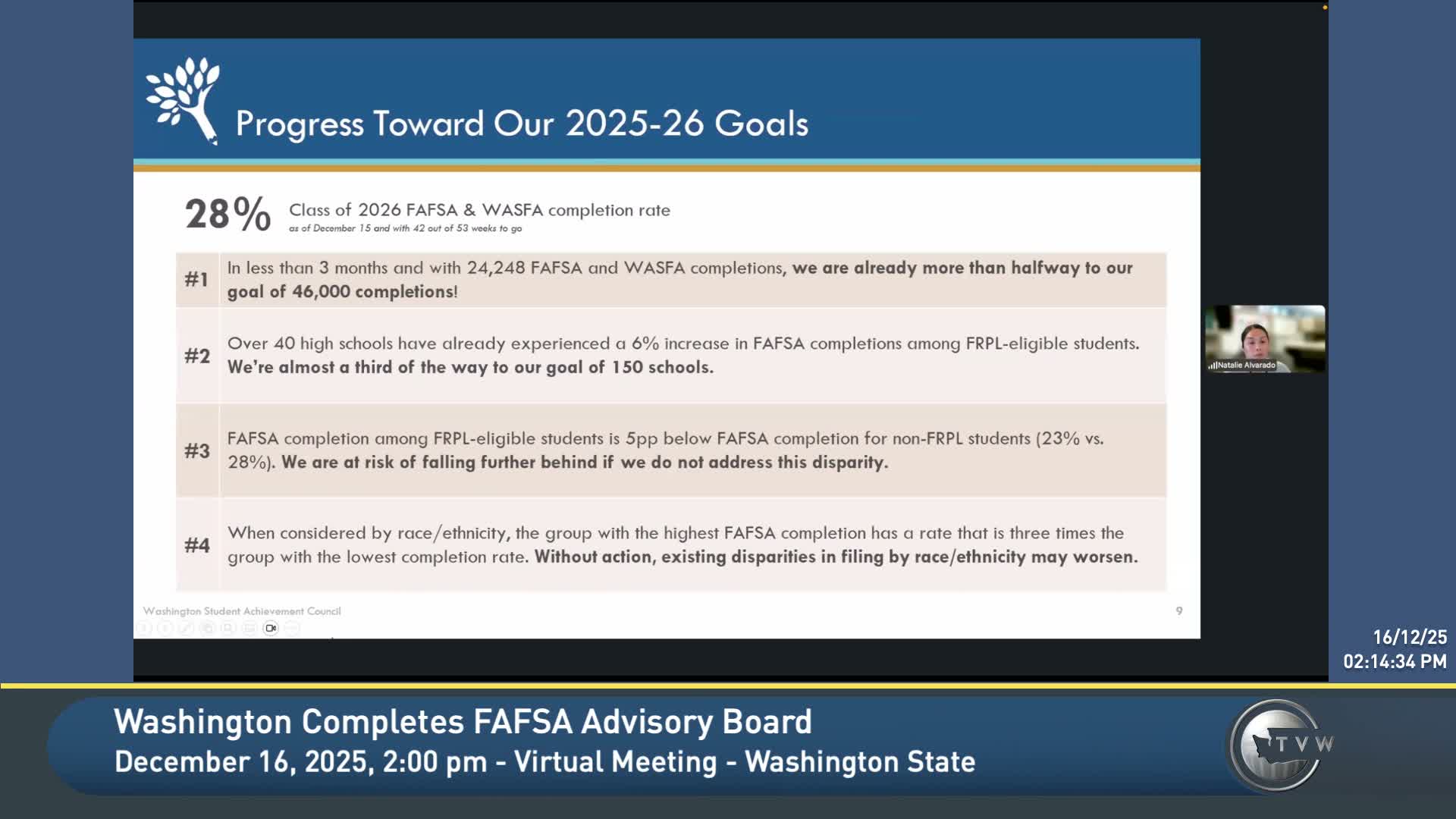
At a December advisory meeting, Washington Complete's FAFSA advisory board reviewed early-class-of-2026 data showing a 28% FAFSA/WASFA completion rate and discussed near-term actions — a challenge week, school‑day integration, parent outreach via OtterBot, and OSPI coordination — to close completion gaps for low-income and underrepresented students.
Sarah Weiss, director of college access initiatives for the Washington Complete FAFSA campaign, opened the advisory board’s December meeting and asked members to turn data and earlier commitments into concrete winter and spring actions.
“We launched together on November 7 to set roles and expectations,” Natalie Alvarado of WASAC told members as she reviewed campaign goals. “As of December 15, the class of 2026 FAFSA and WASFA completion rate is 28 percent, and we’ve seen 24,248 completions so far for both FAFSA and WASFA.”
Alvarado said the campaign is aiming for 46,000 total completions for the class of 2026 and a 6-point boost in completion among students eligible for free and reduced-price lunch. She flagged an equity gap: eligible students are completing at about 23% versus 28% overall and racial and ethnic disparities in filing could widen without targeted steps.
Board members and students offered a range of outreach and implementation ideas during a roundtable discussion. Proposals included integrating FAFSA/WASFA work into the school day (advisory or English classes), short in-class "FAFSA lab" sessions, competitive "challenge weeks" with leaderboards and local incentives, on-site admissions linked to financial-aid counseling, and classroom visits by current college students to make filing more tangible.
“I couldn’t find a single thing on my high school website about FAFSA in a 10–15 minute session,” one student said, urging clearer school website pages. Another student recommended producing short, platform-appropriate videos for TikTok, Instagram or YouTube to reach peers.
WASAC staff described operational enablers now in use: 25 priority schools showing gains (two tribal schools are being onboarded), a FAFSA portal with active users at many schools but 230 schools with no logged-in user so far this year, OtterBot outreach to roughly 3,870 seniors and about 40,000 parents, and regional partnership wins through GEAR UP.
Sean Moran, a data lead working with the portal, said many schools without a current portal login are small, rural or alternative programs that support students one-on-one and may not have an active portal login this year. “The 230 schools with no portal user means they have no portal user who has logged in so far this year,” he said.
In a public comment, Ben Mitchell of the Foundation for Tacoma Students urged the board to adopt a bold statewide goal and to consider incentives, integration of FAFSA completion data into the state high-school "beyond" plan, and consolidation of online tools. “We propose that by 2030, Washington be in the top 10 states in the nation in financial aid application completion,” Mitchell said.
At the meeting’s close, staff summarized five near-term actions WASAC will pursue before the January 20 meeting: coordinate with OSPI on migrant-program outreach and inserting Washington College Grant content in high-school planning pages; design a FAFSA/WASFA challenge week and leaderboard; engage additional partner organizations to amplify web and school‑link updates; produce short messaging that emphasizes how quick it is to create a studentaid.gov account and start the form; and work with college partners to pair on-site admissions with financial-aid assistance.
WASAC staff said they will circulate slides and an action-item summary to the board in the coming days. The next virtual advisory meeting is scheduled for January 20 from 2 to 4 p.m.