Get Full Government Meeting Transcripts, Videos, & Alerts Forever!
Get email alerts on the Wdfw Guidelines topic
No spam. Unsubscribe anytime.
Washington Fish and Wildlife unveils updated wind and solar guidelines, including mitigation ratios up to 5:1
Summary
The Washington Department of Fish and Wildlife presented updated wind and solar guidance to FSEC on Dec. 17, 2025: a consolidated document with a seven-step planning framework, appendices on survey protocols and mitigation, new operational monitoring guidance, and mitigation ratios (up to 5:1) tailored to species and habitat type.
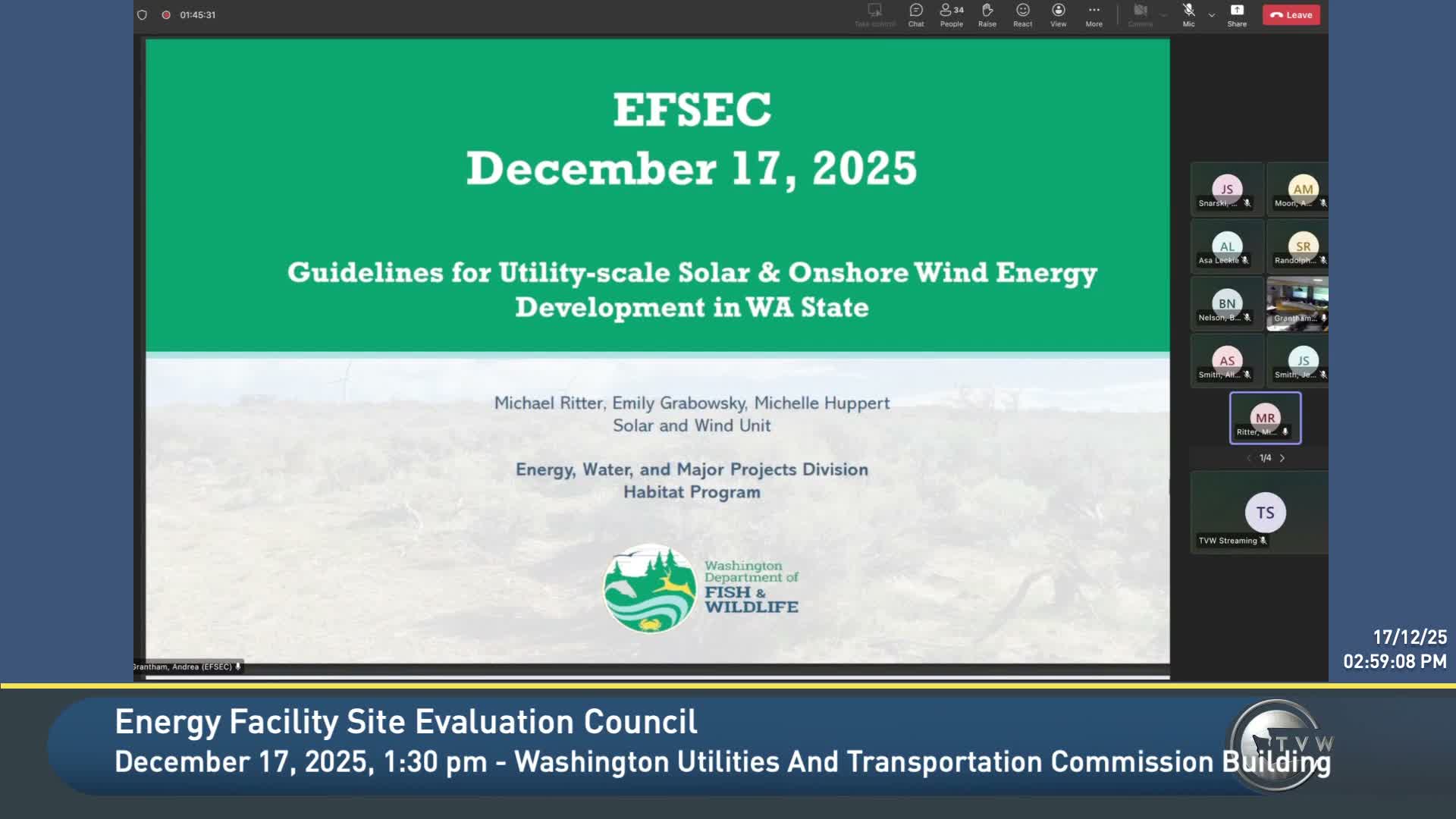
The Washington Department of Fish and Wildlife (WDFW) presented updated wind and solar guidelines to the Energy Facility Site Evaluation Council on Dec. 17, 2025, outlining technical recommendations for developers, permitting authorities and tribes.
Mike Ritter, lead planner for solar and wind energy development, said the agency prepared a single guidance document with separate call-outs for wind and solar and undertook extensive outreach (tribal forums, stakeholder workshops, public surveys and technical meetings) during a roughly 20-month drafting process. He told the council the document follows a seven-step structure: exploratory planning, preliminary project planning, assessing wildlife and habitat, minimization, mitigation, buffers for construction and operation, and operational monitoring and adaptive management.
Ritter said the guidance adds operational monitoring and adaptive management recognizing projects are permitted for decades and wildlife populations change over time. He also described appendices with best management practices, survey protocols, buffers and cumulative impacts assessment. On mitigation he described ratios "that go up to 5 to 1," tailored by species and habitat and based on best available science, and said the approach reduced emphasis on in-lieu fees in favor of acquisition and restoration strategies.
In Q&A, council members asked about cumulative impacts and coordination; WDFW and FSEC staff said they coordinate with major projects teams and with agencies including Ecology and DNR, and that cumulative-impact analyses consider other land-use changes as well as additional renewable development.
Ritter said WDFW also launched a dedicated web page and expects continued engagement with developers and permitting authorities to encourage early consultation. "We have chosen to work with permitting authorities on all of these projects," he said, noting about 95 solar and 58 wind projects are in some stage of review and that roughly 3 solar and 28 wind projects are operational.