
Milwaukee residents press Fire and Police Commission to ban facial recognition and demand transparency over chief’s Israel training trip
Get AI-powered insights, summaries, and transcripts
Subscribe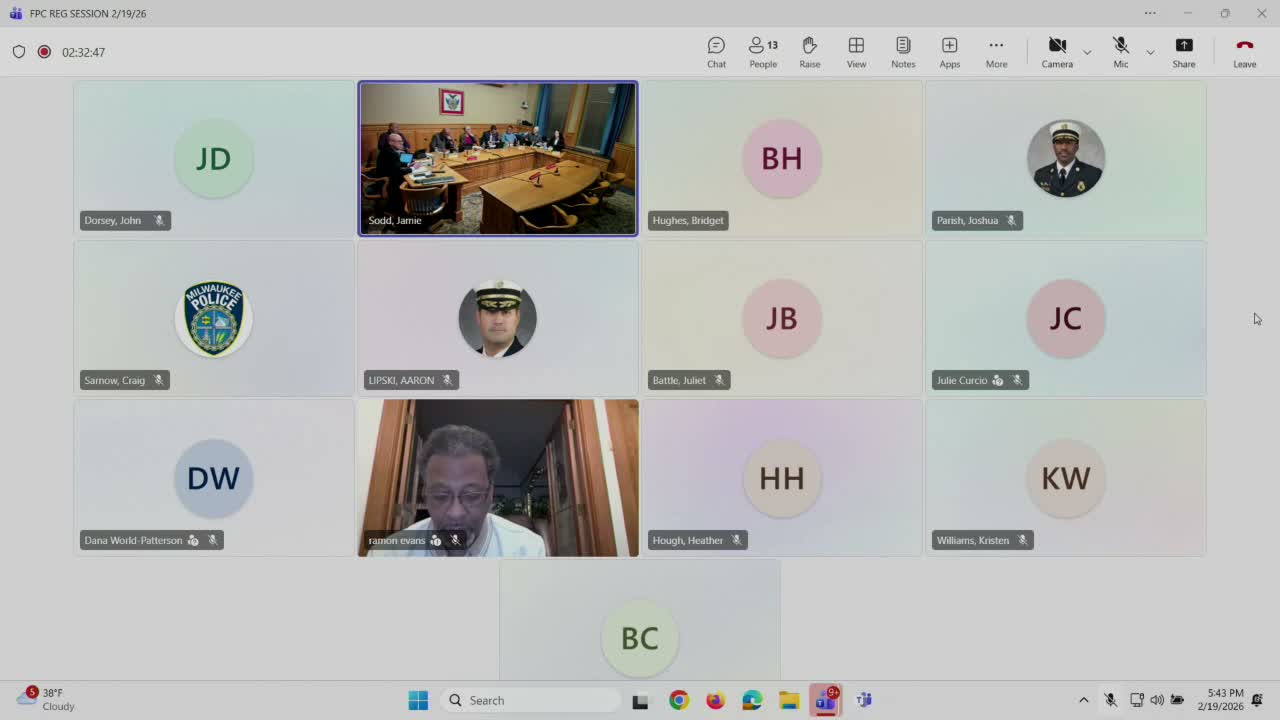
Summary
At the Feb. 19 Fire and Police Commission meeting, multiple residents urged a permanent ban on facial recognition technology and pressed the board for more oversight and public disclosure about Chief Norman’s training trip to Israel, while family members of Sam Sharp Jr. called for codified use-of-force safeguards they call 'Sam’s laws.'
Residents and community groups used the public-comment period at the Fire and Police Commission’s Feb. 19 meeting to call for tighter controls on police technology and more transparency about the police chief’s out-of-city training.
Connor Grossnickle opened the public-comment docket with concerns about SOP 6-82, the city’s proposed policy on generative artificial intelligence. He asked the commission to add a clear audit cadence and defined disciplinary thresholds so officers know when software-generated material could trigger discipline. “There needs to be a threshold measurement to even permit any software,” Grossnickle said, urging bias ratings and accuracy metrics in any approval process.
Several speakers focused on facial recognition technology (FRT). Chad Velez asked whether the commission would recommend a policy to stop the Milwaukee Police Department from borrowing FRT from the sheriff’s office and urged a permanent ban, saying community testimony has repeatedly called for one. “The moratorium is good, but what the people have clearly stated … is that we want a permanent ban on FRT,” Velez said.
Multiple attendees also raised concerns about Chief Norman’s recent trip to Israel. Julie Curcio and other commenters said the chief’s itinerary is a public record but asked for details about what training he attended and what practices, if any, he implemented after returning. Curcio described the trip’s timing and manner as “outrageous” given community concerns and said she would pursue public records for the training information.
Family members of Sam Sharp Jr. addressed the commission with a sustained personal plea for new, enforceable policies. Speaking at length, an attendee who identified themself as Angelique (and later referenced Edrick) Sharp described Sharp’s July 2024 death and urged the board to enact what they called “Sam’s laws”: codified safeguards for identification, independent investigations, immediate transparency, use-of-force limits and enforceable consequences. “Sam’s laws must be established. They must be enforceable, independent investigations, immediate transparency, real use of force limits, real consequences,” the speaker said.
The commission did not take immediate formal action on these public requests at the meeting. Executive Director Leon Todd said he would review the statutory complaint referenced by commenters and examine requests submitted about SOP 7-35 (automated license-plate readers). He also said the chief provided required notice per FPC rules for his trip, and that the itinerary is a public record.
What’s next: Commissioners and staff said some related items—such as broader policy and SOP reviews—are already on their queue for future meetings. Members of the public asked that the commission place FRT and training oversight items on an upcoming agenda for fuller consideration.