Lifetime Citizen Portal Access — AI Briefings, Alerts & Unlimited Follows
OHA trustees approve investment policy updates and adopt hybrid spending methodology for trust fund
Loading...
Summary
Trustees took a first reading and approved amendments to the Native Hawaiian Trust Fund investment and spending policies, clarifying direct‑investment allocation ranges and adopting a hybrid spending method that distinguishes financial assets from income from Hawaiian investment lands.
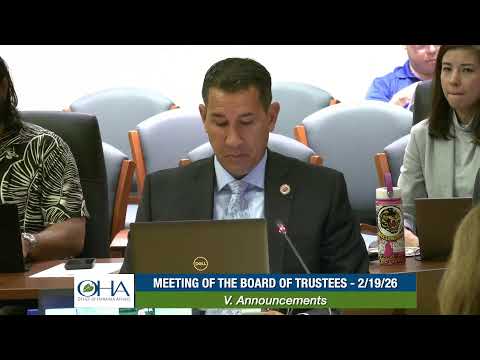
The Office of Hawaiian Affairs Board of Trustees considered two related items Feb. 19: a first reading to update the Native Hawaiian Trust Fund investment policy (including the allocation range for Hawaii investment lands) and proposed amendments to implement a hybrid spending methodology in the trust fund spending policy.
On the investment policy, trustees asked whether changes to the target percentage for direct investments could fluctuate as asset values changed. Staff explained the calculation mechanics, noted the trust currently exceeded the prior 20% limit (at about 26%), and said the proposed policy provides reporting, acquisition restraints and a buffer to manage concentration risk.
On spending policy, the board adopted a hybrid approach: financial assets continue to use the existing 20‑quarter rolling average spending rule (capped at 5%); income from Hawaiian investment lands will be spent on the basis of distributed income (owner distributions), not on market‑value appreciation. Staff explained that spending from land income will be subject to capital reserve and debt covenant needs and that spending would not occur if there is no distributed income.
Trustees voted and recorded seven affirmative votes on the items; staff will report quarterly on allocation metrics and the implementation of the hybrid spending methodology.