
Missouri House passes bill to criminalize illegal gaming machines and create regulated VLT option
Get AI-powered insights, summaries, and transcripts
Subscribe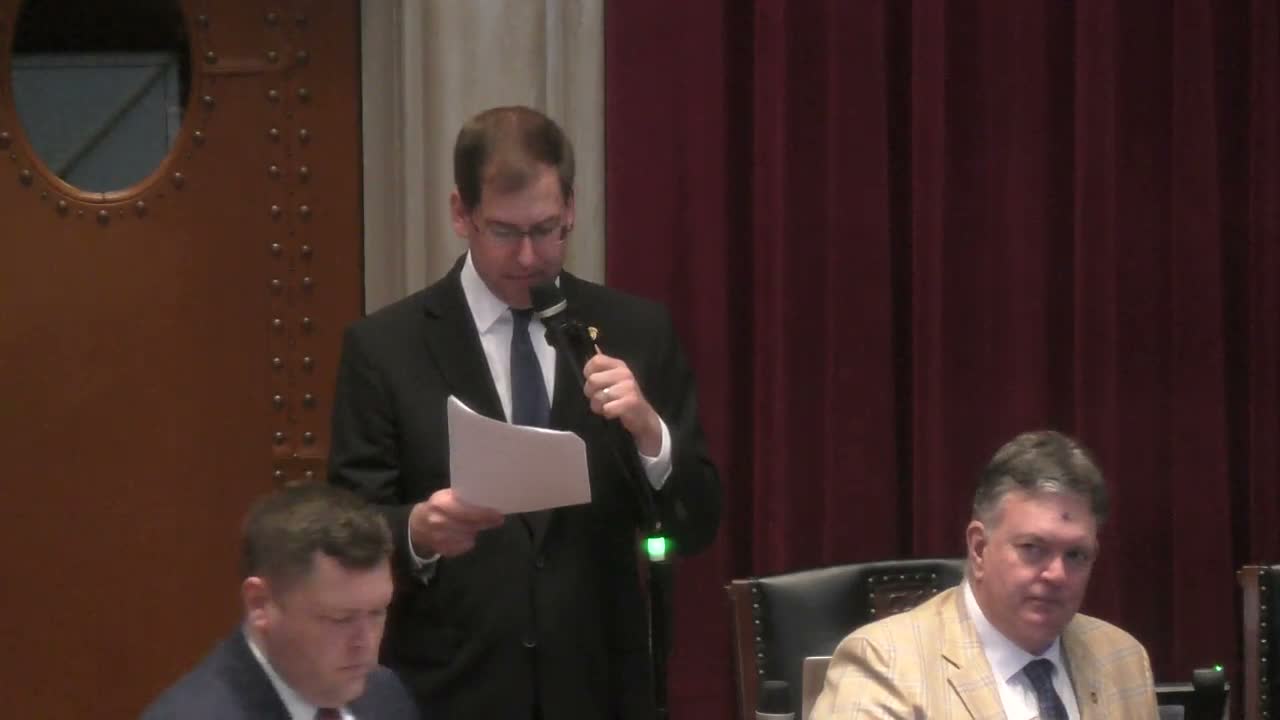
Summary
The House on Feb. 17 passed a committee substitute for House Bill 2989 that criminalizes unlicensed "gray" gaming machines, gives prosecutors and the attorney general enforcement authority, and establishes a licensed, taxed video lottery terminal option that local jurisdictions may opt into. A motion to send the bill to fiscal review failed; the final vote was 83-66-1.
The House of Representatives passed a committee substitute for House Bill 2989 on Feb. 17 after several hours of floor debate over enforcement, consumer protection and local control.
The bill handler, identified in debate as the gentleman from Pulaski, described the measure as criminalizing illegal or “gray” gaming machines and providing the attorney general and local prosecutors with the authority to enforce criminal penalties against operators of unlawful devices. He told colleagues the bill also creates a licensed, regulated video lottery terminal (VLT) pathway that local jurisdictions may choose to adopt; communities that opt out would not host the authorized games.
Supporters argued the bill is the fastest way to remove currently unlawful devices from storefronts and to create a regulated framework so any licensed games are taxed and subject to consumer protections. “This bill gives the attorney general enforcement authority,” the gentleman from Pulaski said on the floor.
Opponents urged caution. The Lady from Green moved to refer the committee substitute to the committee on fiscal review, citing a complex fiscal note that, she said, included multiple in-and-out funding lines and new FTEs and therefore warranted further committee examination. The motion to refer failed on a roll call, 69 nays and 44 yeas, after members debated whether the bill met the chamber’s fiscal-review rules.
Several members raised problems of addiction and consumer protection and questioned whether the bill’s regulatory apparatus would equip retail staff to identify problem gamblers. One member with prior industry experience said the bill does not require the level of training used by casino operators for spotting and assisting problem gamblers.
Proponents emphasized local control and the ability for communities to bar the authorized VLTs; other members stressed that creating a regulated system would let the state and localities capture tax revenue currently diverted by unregulated machines. The clerk announced the final vote on third reading as 83 yeas, 66 nays and 1 present, and the measure was recorded as passed.