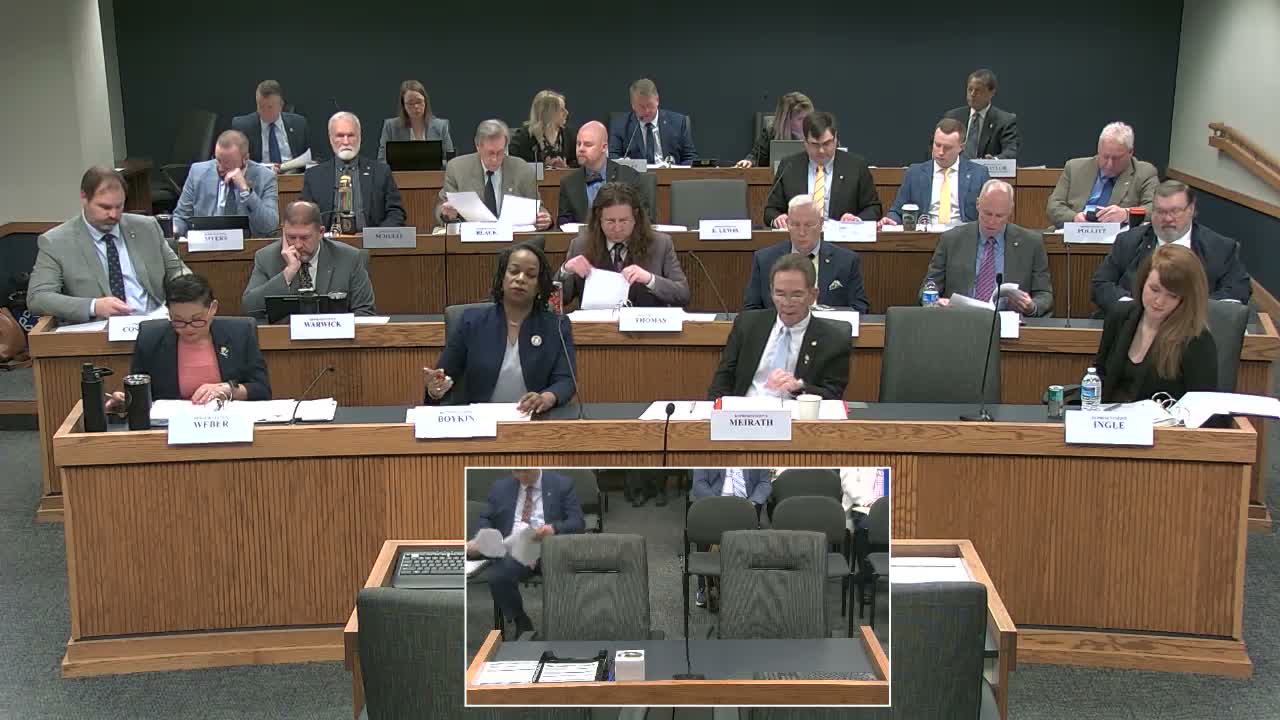
Committee hears bills to allow utilities to recover nuclear construction costs; members press for safeguards
Loading...
Summary
The Missouri House Committee on Utilities heard House Bills 1626 and 2122 to allow utilities to use construction work in progress (QIP/CWIP) for nuclear projects up to 600 megawatts. Sponsors and utility, business and education witnesses argued it lowers long‑term costs and supports SMRs; members pressed for stronger clawback and PSC oversight to protect ratepayers.
Representatives John Black and Willard Haley presented House Bills 2122 and 1626 to the House Committee on Utilities on the bill to allow utilities to include construction work in progress — often called QIP or CWIP — in the rate base for certain nuclear generation projects.
"The bill is really pretty simple," Representative John Black told the committee, saying an old statutory prohibition prevents use of construction work in progress and that allowing it reduces the interest that accumulates during long construction projects. Black and Haley said similar language was adopted for natural‑gas plants last year in Senate Bill 4 and that this legislation would extend like treatment to nuclear plants, targeted at small modular reactors (SMRs).
Sponsors described the bill as limited to projects of 600 megawatts or less and said it includes a callback (clawback) provision so the Public Service Commission (PSC) can require refunds with interest if construction costs are later found to be imprudently incurred or a project is not placed in service. Representative Haley said the measure is intended to "create a louder voice and more education" about the technology and to keep Missouri competitive for jobs and economic development.
Committee members repeatedly raised concerns about ratepayer exposure during long projects. Representative Engel noted that the barrier this bill would remove originated from a voter‑approved statute about 50 years ago and said she had "a lot of heartburn about adding something else for the rate payers of the state to pay for." Members asked whether the legislature should send the matter back to voters; sponsors responded that the original restriction is statutory and can be amended by the General Assembly.
Several members pressed for stronger scheduling discipline and clearer clawback language to protect consumers if projects slip schedule or exceed costs. Sponsors and proponents pointed to SB4's clawback language as the model to be copied for nuclear projects and emphasized that the PSC has authority to determine imprudence and require refunds.
Supporters from the private and public sectors testified in favor. Ray McCarty, president of Associated Industries of Missouri, said modular designs can shorten construction time and that the bill should include the same clawback language that applied to the gas‑plant changes. Jared Hankinson of the Missouri Chamber argued the measure will help reliability and economic development. Zach Monroe of Ameren Missouri said the utility is considering nuclear in its long‑range plan and is updating its IRP accordingly.
Kurt Schafer, director of the Missouri Department of Natural Resources, testified for informational purposes about federal engagement and permitting. He told the committee that NRC permitting can take around eight years and that overlapping permitting and construction often results in roughly a 12‑year timeline; he also described ongoing federal discussions about long‑term disposal of nuclear byproducts. Witnesses flagged permitting and major component lead‑time risks and said permitting and pre‑construction studies can run to hundreds of millions of dollars.
Moe Degani, chancellor of Missouri S&T, urged attention to workforce development, noting applications to nuclear engineering programs have risen and that the university is studying SMR feasibility for training and local power applications.
The hearing record included repeated sponsor assurances that PSC oversight and clawback provisions would be used to protect ratepayers but also sustained member requests for clearer, possibly strengthened consumer protections before the committee reports the bills. The committee closed the hearing after approximately one hour of public testimony and will consider amendments and next steps in committee before any vote.