
Committee advances change to property assessment law, narrows compliance range to 70–100%
Get AI-powered insights, summaries, and transcripts
Subscribe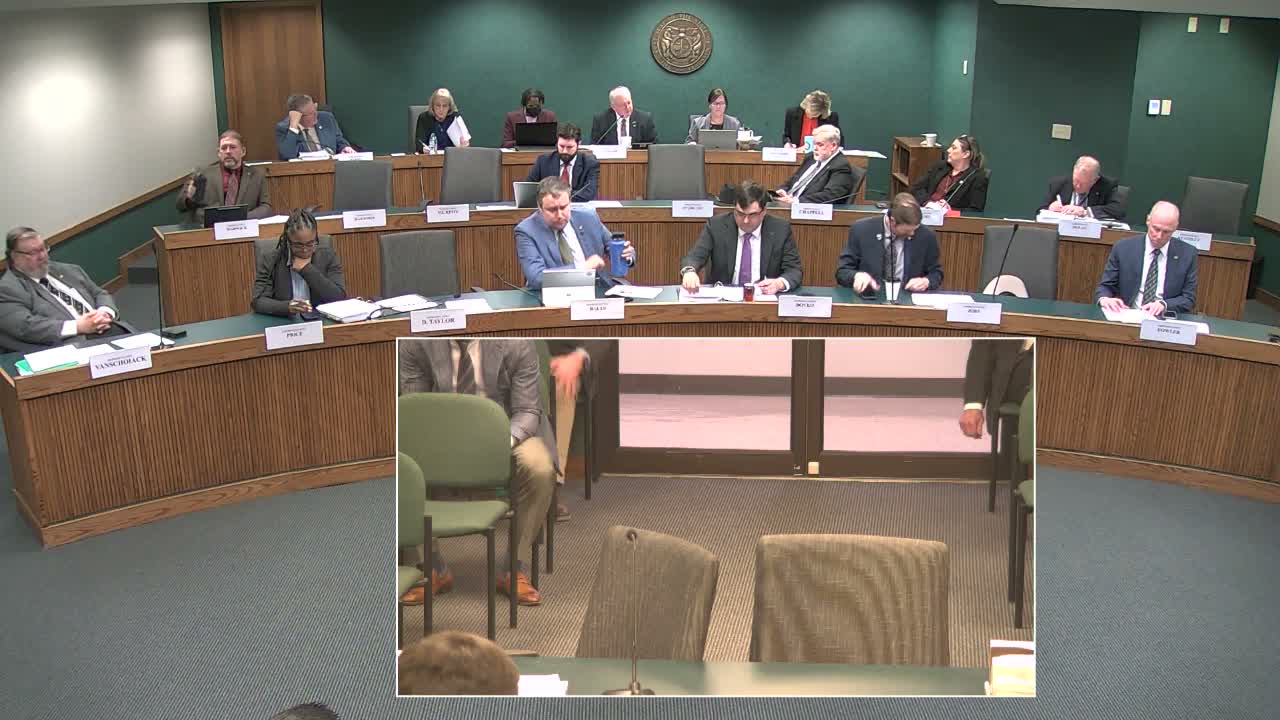
Summary
The committee adopted an amendment to House Bill 2,415 requiring assessors to reconcile replacement-cost and other applicable valuation approaches and narrowed the compliance range from 90–110% to 70–100%; the substitute passed 14–2.
The Special Committee on Property Tax Reform on Monday adopted an amendment to House Bill 2,415 that changes statutory language governing how assessors determine real property value and narrows a compliance range used in statistical testing.
An amendment maker explained the amendment removes the word 'value' from the title, specifies that assessors should use a replacement-cost approach reconciled with other applicable approaches to real property valuation, removes a confusing subparagraph, and changes the compliance range for statistical testing from '90 to 110%' down to '70 to 100%.' The amendment maker said, "That is what our assessors do. They look at all approaches that are applicable to that particular property and reconcile those approaches." The committee adopted the amendment, rolled it into a substitute and voted the substitute due pass by a roll call of 14 yeses and 2 noes.
Representative Steinhoff and others pressed for clarity about whether the amendment simply codifies current practice or changes it. Representative Steinhoff asked whether income approaches would be included; the amendment maker said assessors should use every applicable approach and reconcile them, including the income approach where appropriate. Representative Joby said he agreed with the principle behind the amendment and stressed fairness in assessments: "I mean, I think I agree with most people that you shouldn't be taxed at more than the true value of your house." Representative Reedy provided a technical explanation of the coefficient of dispersion used in statistical studies, saying, "The higher that coefficient of dispersion, that means you have a wider range," and acknowledged it is harder to compute in rural areas with few sales but that measurements can still be made.
Supporters argued putting the standard in statute prevents departments from adopting regulations that may conflict with legislative intent; Representative Chappell said a statutory cap is appropriate to prevent assessments above actual value. Opponents expressed concern that enshrining technical thresholds in statute could be premature if the commission's rulemaking could address them.
The committee did not record additional follow-up assignments in the transcript. With the 14–2 vote, the committee advanced the House Committee substitute for House Bill 2,415 to the next stage.
The bill and its substitute now proceed through the legislative process; staff and committees may produce further drafts or amendments before floor consideration.