
Rep. Lewis Riggs proposes state coordinator to find and recover unspent federal funds for broadband
Get AI-powered insights, summaries, and transcripts
Subscribe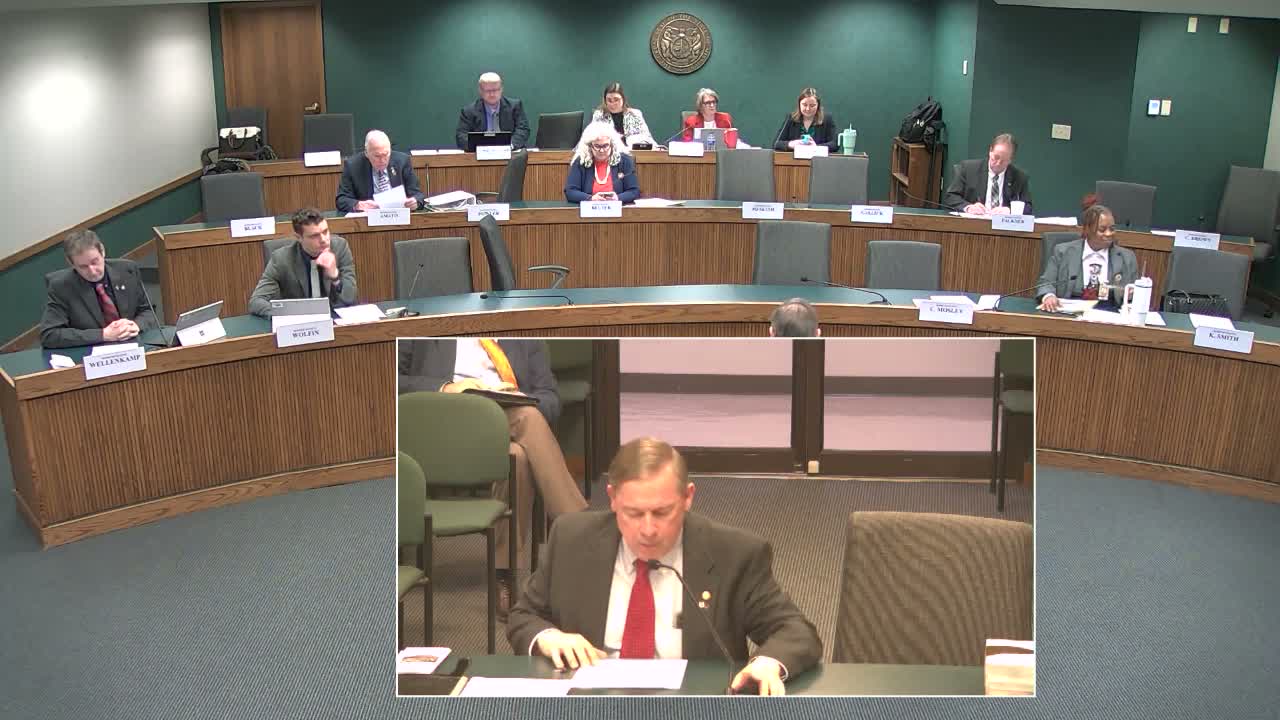
Summary
Representative Lewis Riggs told the House special committee he wants a dedicated state position to locate and recover federal funds Missouri did not receive, citing failures of programs such as the Rural Digital Opportunity Fund; committee members pressed him on legal authority, scope and cost.
Representative Lewis Riggs, R-5, told the Missouri House Special Committee on Intergovernmental Affairs that he is proposing a bill to create a state coordinator whose job would be to locate and recover federal funds the state was allocated but did not receive, with an emphasis on expanding broadband access.
"This bill is a result of years pursuing funding that will bring about universal access to broadband internet across Missouri," Riggs said in the hearing, and he cited federal programs that he said promised much but delivered little, including the Rural Digital Opportunity Fund (RDOF). Riggs asserted a roughly 50% default rate in that program and said that, to date, about $177,200,000 in federal funds allocated to Missouri have not been deployed.
Why it matters: Riggs argued the coordinator would give Missouri standing and a year-round process to locate funds and, when appropriate, pursue them — including by litigation if necessary — so money intended for state programs can be used in Missouri. He and other lawmakers framed the proposal as particularly relevant to broadband deserts in rural and some suburban counties.
Committee questions focused on two practical limits: cost and legal authority. A committee member asked whether the fiscal note reflected a single full-time position; the member read the estimate as about $118,000 in ongoing costs, and Riggs confirmed the fiscal note anticipates one position. When asked whether anticipated recoveries would exceed that cost, Riggs said yes and estimated recoveries could be "literally by a factor of 100." The committee did not receive a written estimate of net recoveries in the hearing record.
On legal authority, committee members asked how the coordinator would interact with the attorney general and whether the position could independently sue the federal government. Riggs said litigation would typically be handled through the attorney general’s office and that the bill is intended to give the state a process and standing to identify and pursue funds, not to bypass established legal channels.
Members also pressed on scope. Lawmakers raised hypothetical cases in which a federal program was canceled or funds were intended to flow through the state to individual recipients (for example, FEMA pass-throughs or Farm Service CRP payments). Riggs said the proposal as described is meant to pursue funds that were intended for Missouri as a state rather than individual payments to citizens; he invited limiting language to clarify that distinction.
The hearing record does not show any public testimony for or against the measure. Representative Reuter thanked Riggs for filing the bill and described pursuing federal money as a good use of state resources. The chair closed the public hearing and the committee moved into executive session to take unrelated votes.
What comes next: The committee did not take a recorded committee vote on the specific coordinator bill during the public hearing portion. The transcript shows the committee later moved in executive session on other bills and then adjourned. Formal steps to amend, advance, or refer the coordinator proposal would appear in subsequent committee or chamber actions not recorded in this hearing.
Representative Lewis Riggs is the only witness on this item in the hearing record; committee members who asked questions are recorded but not always named in the transcript.