Get Full Government Meeting Transcripts, Videos, & Alerts Forever!
Get email alerts on the Labor Negotiations topic
No spam. Unsubscribe anytime.
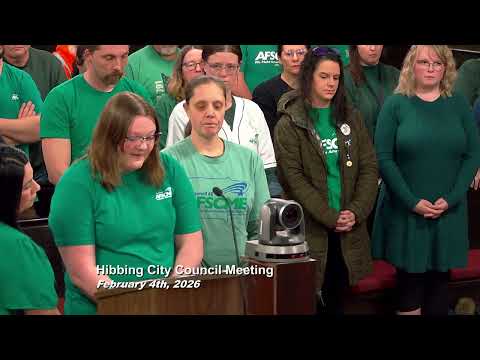
AFSCME members urge Hibbing council to uphold tentative agreement; chair cites state labor law
Summary
Two AFSCME Local 791 members urged the Hibbing City Council to honor a tentative Jan. 12 agreement and warned a strike would disrupt essential services. The mayor repeatedly cut off negotiation details, citing Minnesota labor-law restrictions, and the council proceeded to closed session on negotiation strategy earlier in the meeting.
Cassie Tomasetti, an accountant in the finance office and an AFSCME Local 791 member, told the Hibbing City Council on Feb. 4 that after lengthy negotiations on Jan. 12 the union and the city had reached a tentative agreement and asked the council to "uphold the tentative agreement, as it was understood and approved by both parties." She described city employees as the people who plow streets, collect garbage and staff essential services and warned a strike would affect every resident who depends on those services.
The mayor repeatedly interrupted Cassie and the next speaker, Christie Fairchild, who identified herself as AFSCME Local 791 president. The mayor said statements about ongoing labor negotiations were "out of order" because they could contravene provisions of the Public Employment Labor Relations Act and other state statutes and instructed speakers to avoid negotiation details. Christie told the council that "what was on the table is not what we were sent back with" and submitted a petition alleging concerns about the city's conduct in recent contract negotiations.
The exchange did not produce a public ruling on the substance of the union's claims; rather, the council chair limited what speakers could say in open session and the agenda included a separately approved closed session for "labor negotiation strategy" under Minnesota Statute 13D.03 subdivision 1(b). There were no public votes on the contract itself during the meeting.
The dispute highlighted competing obligations for the council: members must follow state laws limiting public discussion of active bargaining while union representatives pressed for public acknowledgment and action. The council took no public action to confirm or reject the union’s request during the open forum; the meeting earlier authorized a closed session to discuss negotiation strategy.
The matter may return to a public agenda in redacted form or as an informational update once legal and procedural constraints allow.