
Statewide housing plan: at least 115,000 homes needed now; scenario targets raise need to 222,000–262,000 units
Get AI-powered insights, summaries, and transcripts
Subscribe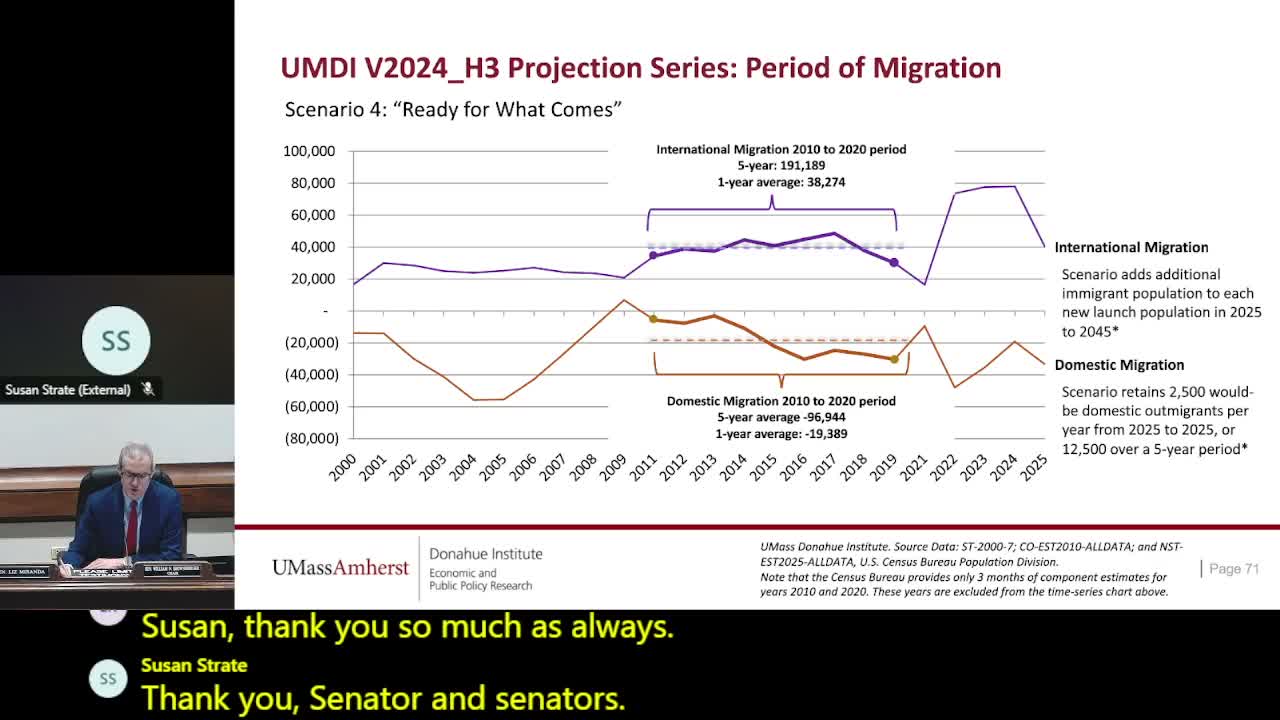
Summary
MAPC and the Executive Office of Housing and Livable Communities told the Senate Committee on the Census that addressing Massachusetts’ existing shortage requires roughly 115,000 homes and that combined short‑ and longer‑term demand under low to high population scenarios adds between ~75,000 and ~145,000 more units, producing state targets from roughly 222,000 to 262,000 units.
Jesse Partridge Guerrero of the Metropolitan Area Planning Council explained how MAPC transforms population projections into household and housing demand allocations using ACS PUMS headship rates, UrbanSim allocation models and development inputs such as the 'mass builds' dataset and zoning capacity. MAPC’s LRTP (vintage 2023) workflow translates regional population scenarios to municipal household and unit projections.
Tim Reardon of the Executive Office of Housing and Livable Communities summarized the 'Home for Everyone' needs assessment. He identified four components of current demand: pent‑up household formation (~50,000 units for doubled‑up or overcrowded households), families in emergency shelter (6,800 families), units needed to reach healthy vacancy rates (~51,000), and losses to seasonal conversion (about 10,000 in some regions). Combined, those elements account for roughly 115,000 homes that the Commonwealth needs to address existing shortages.
Reardon explained additional demographic demand even under low population growth: changes in household formation and generational cohort sizes will require roughly 73,000 more households over the next decade even if total population is flat or slightly down. When that demographic demand is combined with the existing shortage and scenario‑driven population changes, the statewide production target in the plan is about 222,000 homes (combined baseline); under the high scenario it could be as much as about 262,000 units.
Committee members asked about program performance (HomeBASE, RAFT, Section 8) and whether the plan understates current hardship. Senator Liz Miranda recounted constituent experience with homelessness and doubled‑up households; Reardon and MAPC emphasized the plan pairs supply expansion with rental assistance, preservation and targeted technical assistance (MBTA Catalyst Fund, Housing Works) and highlighted accessory dwelling units (ADUs) and zoning changes as strategies to deliver smaller units and increase supply.
MAPC and HLC noted that scenario vintages were developed in 2024, that assumptions about international migration materially affect the high and medium scenarios, and that if international immigration remains depressed through the late 2020s the lower scenario would shrink somewhat. MAPC will allocate the middle scenario to the local level with UrbanSim as part of the 2028 LRTP process (work to begin in FY2027).
The presentation and committee discussion framed supply expansion as a central policy lever: speakers argued supply constraints drive affordability pressures and domestic out‑migration, while additional programmatic measures are needed to address immediate hardship and preserve existing stock.