Get Full Government Meeting Transcripts, Videos, & Alerts Forever!
Get email alerts on the Open Public Meetings Act topic
No spam. Unsubscribe anytime.
Attorney General's office briefs ESD advisory committee on Open Public Meetings Act
Summary
Lisa Peterson of the Washington Attorney General's Licensing and Administrative Law Division gave required OPMA training, covering who OPMA covers, meeting types, executive sessions, public-comment rules, minutes, penalties and MRSC resources for local governments and state agencies.
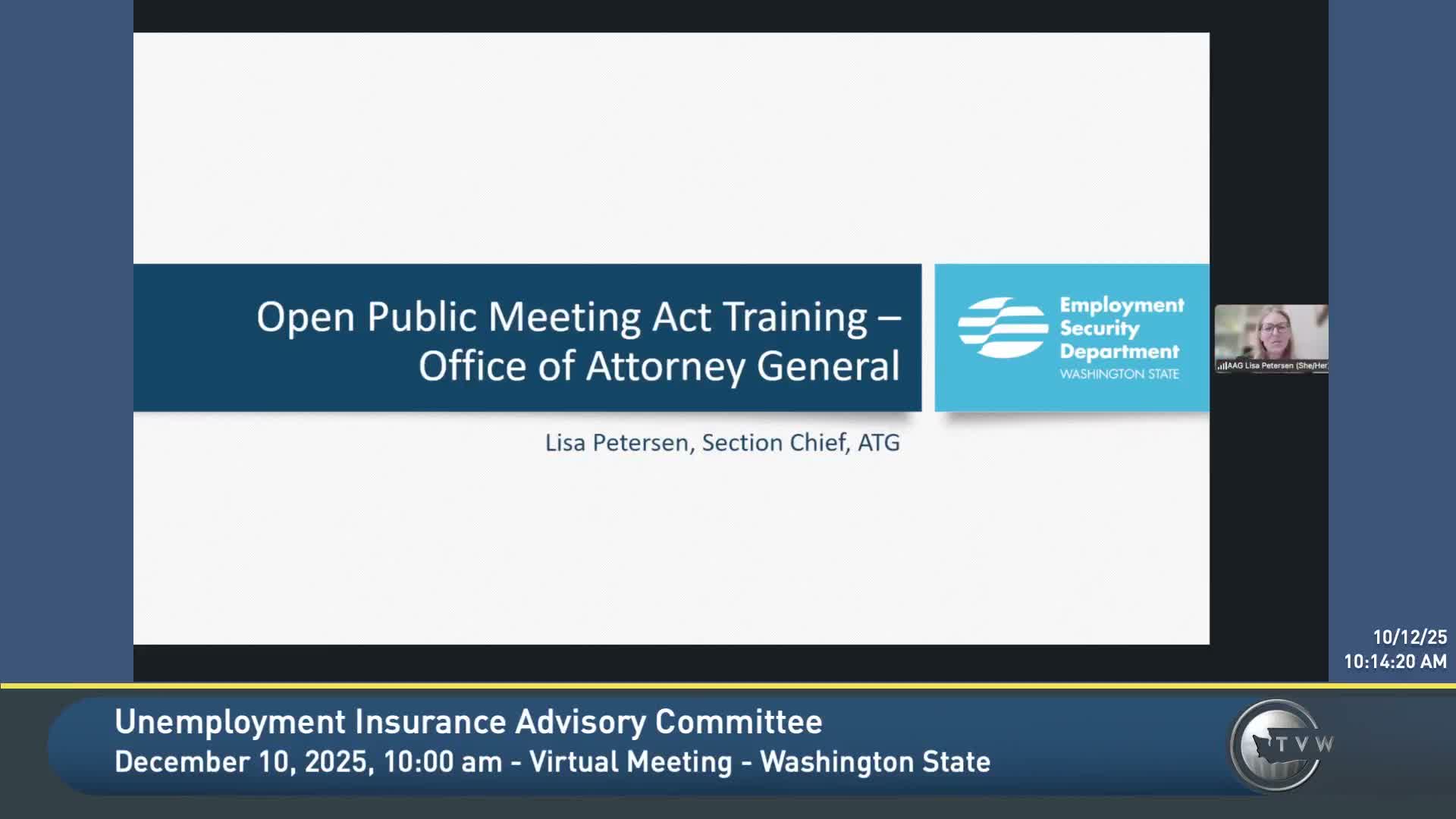
Lisa Peterson of the Washington Attorney General's Licensing and Administrative Law Division provided a 20-minute Open Public Meetings Act training to the Employment Security Department advisory committee on Dec. 10, reviewing the law's purpose, scope, meeting types, executive-session requirements, minutes and remedies for violations.
Peterson described OPMA as a 1971 transparency statute that requires governing bodies of public agencies to conduct business in open meetings "from gavel to gavel," with narrow exceptions. She emphasized that a meeting occurs whenever a majority gathers with the collective intent to transact official business and warned about "serial" or rolling meetings that can violate the statute.
On executive sessions, Peterson said allowable topics are narrow (real estate, personnel evaluations, litigation strategy) and the presiding officer must announce the session's purpose and expected end time. She also said the public must be permitted to attend regular meetings and comment when final action is to be taken; bodies may adopt reasonable time limits for individual speakers.
Peterson noted possible remedies for OPMA violations include court actions that can void decisions taken in improper closed meetings and award costs and attorney fees to prevailing plaintiffs; rare, knowing violations can carry civil penalties.
Committee members had no substantive questions; JR thanked Peterson and said the training would be repeated periodically.