Get Full Government Meeting Transcripts, Videos, & Alerts Forever!
Get email alerts on the Public Safety Funding topic
No spam. Unsubscribe anytime.
CJTC outlines rules, timeline for new public-safety sales tax and $100M grant program
Summary
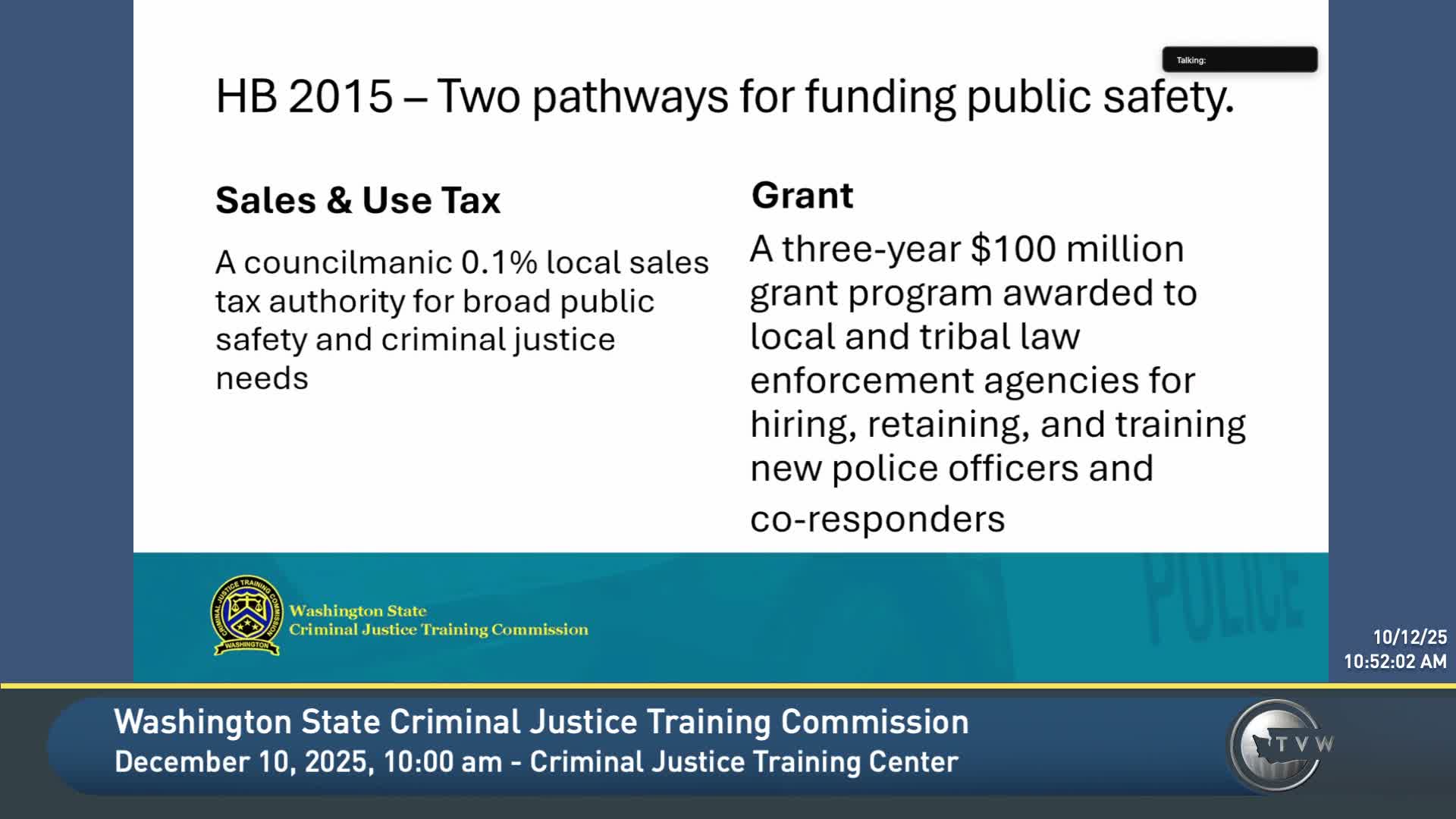
At its December meeting, CJTC staff reviewed the implementation steps for the recently enacted public-safety funding package: a permanent local sales-and-use tax and a three-year, $100 million grant program. CJTC will verify jurisdictions' compliance with training, use-of-force and firearms policies before collections begin.
The Criminal Justice Training Commission explained how it will implement a new public-safety funding package that gives jurisdictions two paths to pay for law-enforcement needs: a permanent local sales-and-use tax and a three-year, $100 million grant program.
A CJTC presenter said the program includes a statutory certification process that agencies must meet before they may collect the tax or draw grant funds. "Part of the statutory process allows us to give jurisdictions conditional approval so that they can, in fact, start collecting the tax," the presenter said. The presenter told the commission that conditional approval carries a 180-day window to reach full compliance.
CJTC described the grant as aimed primarily at funding new law-enforcement positions and law-enforcement-related activities such as training, emergency-management planning and community outreach. The presenter said the grant is intended to be broadly accessible and that, in the first round, CJTC does not expect to impose strict per-agency caps. "Our goal with the grant process is anybody who wants this funding gets it," the presenter said.
Staff emphasized the difference between the two funding streams: the sales-and-use tax is permanent and tied to ongoing compliance, while the grant is temporary and expires after three years, creating a sustainability challenge for jurisdictions relying on the one-time money. CJTC advised jurisdictions to build a sustainability plan for positions funded with grant money.
Commissioners asked practical questions about timing and compliance. CJTC said it hoped to post grant application materials in December and open applications for one to two months, with final eligibility contingent on meeting the statutory criteria. The presenter also recommended jurisdictions sign up for CJTC'issued weekly newsletters and review the publicly available FAQ materials on CJTC'maintained web pages.
Why it matters: The funding program creates a new, potentially large revenue source for local public safety, but it makes local collection and ongoing policy compliance contingent on meeting CJTC'administered criteria, including training thresholds, use-of-force policy provisions and firearms-relief rules. Jurisdictions that fail to remain in compliance could lose authorization to collect the tax, CJTC said.
What comes next: CJTC staff said they will continue statewide outreach, post application materials and, as applications are received, provide conditional approvals and technical assistance to help jurisdictions meet the criteria.