Get Full Government Meeting Transcripts, Videos, & Alerts Forever!
Get email alerts on the Stormwater Treatment Bioretention topic
No spam. Unsubscribe anytime.
Field and lab tests show high‑performance bioretention media can reduce 6PPD quinone below Washington criteria
Summary
Multiple laboratory and field studies presented at the forum show high‑performance bioretention media and some floating treatment wetland designs reduce 6PPD quinone concentrations substantially; treated effluents often fell below Washingtons acute aquatic life criterion (12 ng/L) and did not cause acute coho mortality in lab exposures.
Researchers and practitioners reported consistent lab and field evidence that high‑performance bioretention media can reduce 6PPD quinone concentrations in stormwater to levels below Washington States acute aquatic life criterion and substantially reduce acute mortality risk to coho salmon.
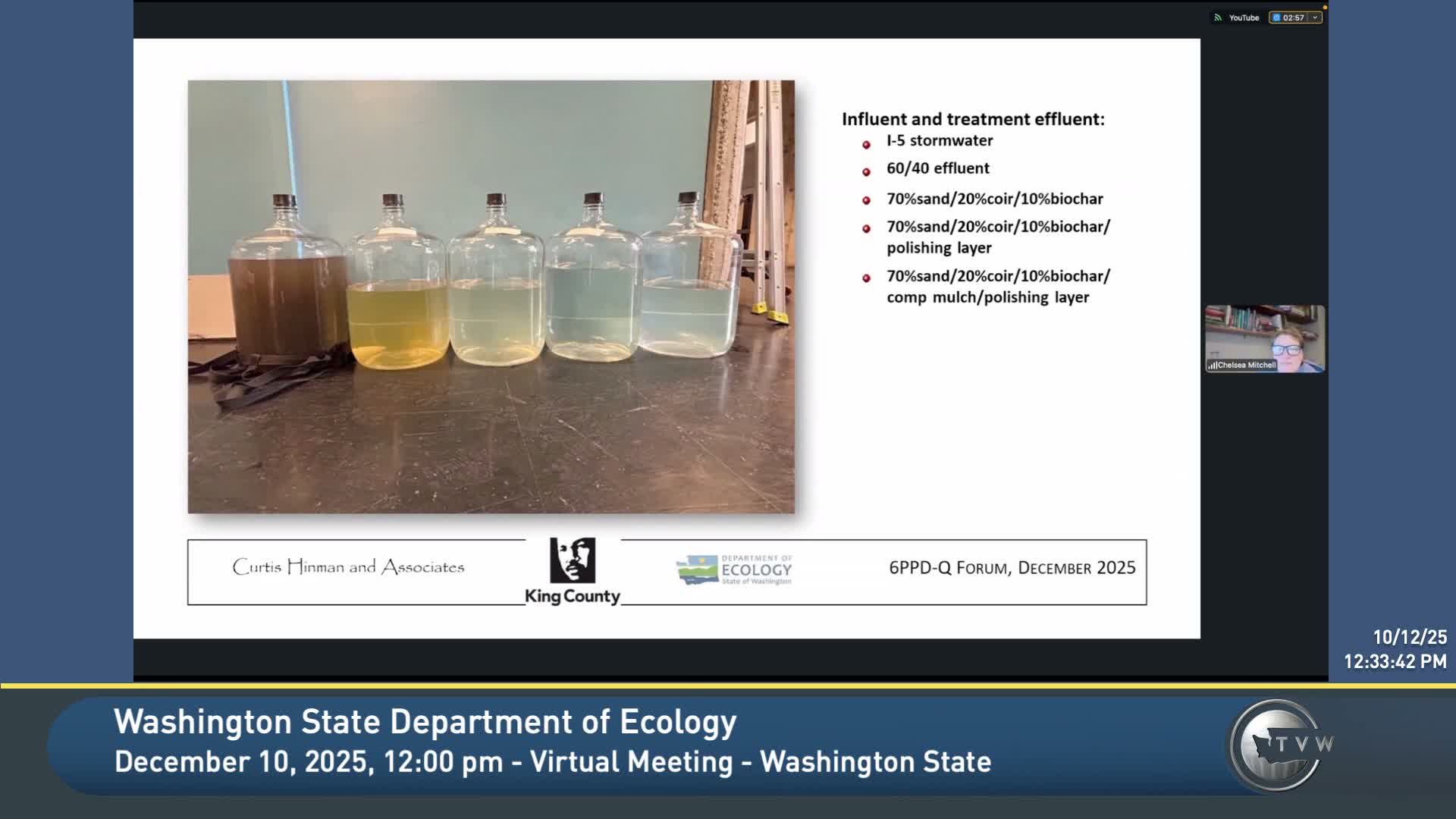
In laboratory column tests led by King County and Washington State University partners, influent concentrations from heavily contaminated I‑5 Ship Canal stormwater (about 200to800 ng/L) were treated through three different high‑performance soil media blends. Chelsea Mitchell of King County said effluent concentrations from the high‑performance media ranged from below detection to about 5 ng/L and "always met" Washington's 12 ng/L acute criterion; conventional 60/40 (sand/compost) media produced more variable effluents (2.8to22.5 ng/L in the tests shown).
The laboratory treatments were evaluated with acute coho exposures. Mitchell reported that untreated stormwater killed nearly all test fish, while water treated through the high‑performance bioretention media did not cause acute mortality in the laboratory exposures presented.
Field studies from Spokane (Gonzaga University site) and an Eastern Washington dual‑cell installation reported similar reductions. Amy Nabickas Brausch (Evergreen Stormwater), presenting Spokane results, said the site has produced consistent removal efficiencies (~97–98%) across sampled storms, with median effluent concentrations remaining low. Lizbeth Seabacher (University of Washington) reported floating treatment wetland (FTW) trials and modular biomedia deployments that produced reductions between ~61% and 76% in sampled events at two field sites; she emphasized that contact time and biomedia ratio affected performance.
Why it matters: Washington's Department of Ecology adopted an acute aquatic life criterion of 12 ng/L for 6PPD quinone; modelled mortality for coho at that concentration can be non‑zero for sensitive populations. Presenters framed robust treatment at the stormwater interface as an important mitigation tool where source reduction is not yet complete.
Limits and next steps: Presenters cautioned that (1) many field datasets remain limited in sample count and seasonality; (2) analytical capacity for 6PPD quinone is still concentrated in a handful of labs, creating sampling and shipping constraints; and (3) most field results reflect high hydraulic loading lab tests or pilot deployments, requiring further monitoring across seasons, storm types, and scales. Several teams plan multi‑season monitoring and replication before scaling treatment guidance; King County and partners will continue testing and publish final reports on procedures and design guidance.
Sources: Presentations by Chelsea Mitchell (King County), Curtis Hinman (study design), Amy Nabickas Brausch (Spokane field trials), and Lizbeth Seabacher (UW FTW work) at the 6PPD State of the Science Forum Day 2. The Department of Ecology acute criterion (12 ng/L) was cited repeatedly in discussions.
The research community recommended continued paired field monitoring, more fish bioassays under field‑realistic exposures, and comparative testing of scale‑appropriate designs before broad implementation.