Get Full Government Meeting Transcripts, Videos, & Alerts Forever!
Get email alerts on the Wa Cares Finance topic
No spam. Unsubscribe anytime.
State actuary and WA Cares staff report premium collections, reserves and investment approach
Summary
Office of the State Actuary and WA Cares staff reviewed two fiscal years of premium assessments, investment results and near‑term projections: actual premiums have exceeded base expectations, the fund holds about $2.9 billion in reserves, Q1 FY26 premium receipts were $379 million, and return projections may change once the State Investment Board updates policy under SJR 80.
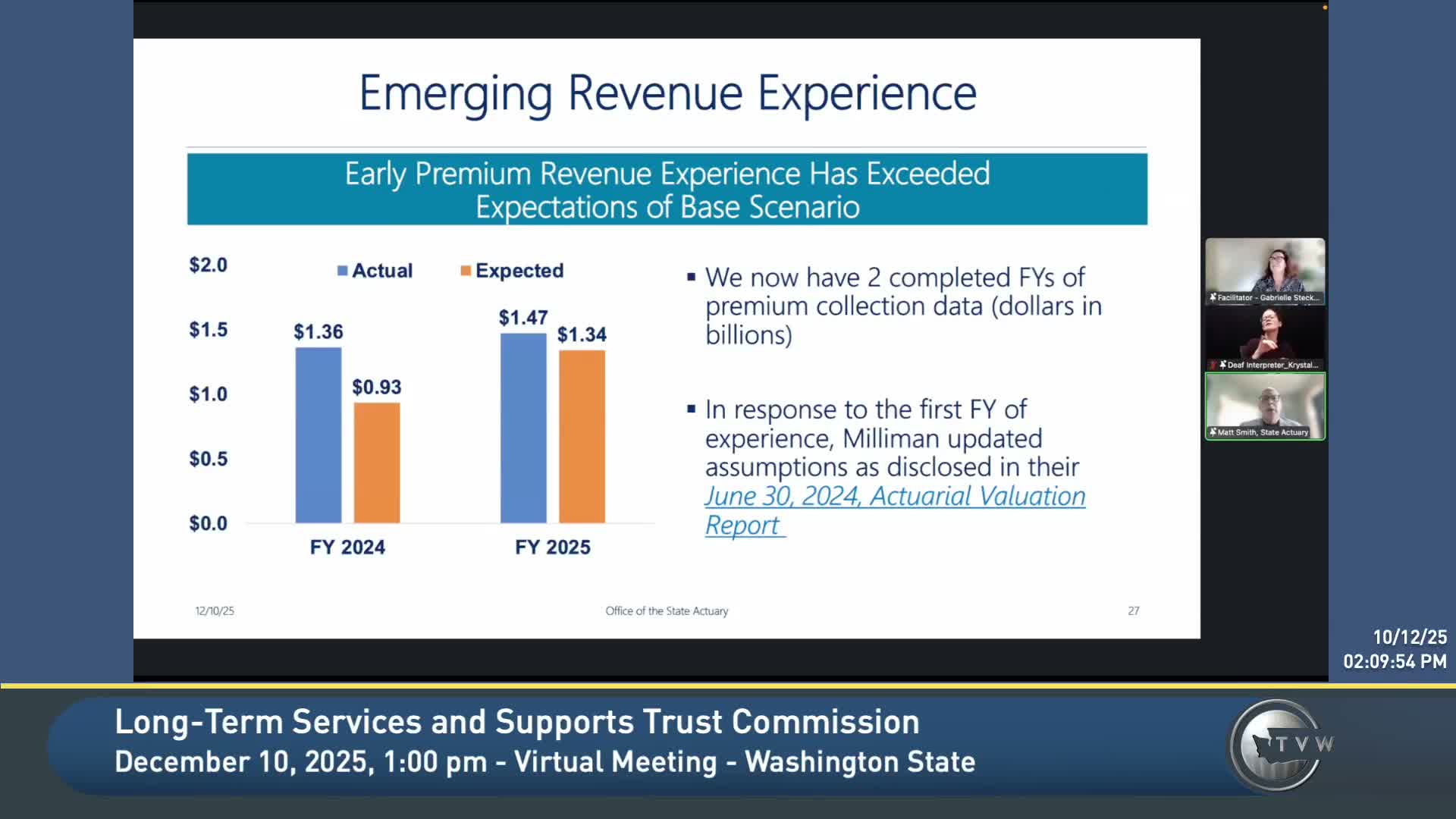
Matt Smith of the Office of the State Actuary told the commission that the program is in phase 1 of its risk management framework and that Milliman updated assumptions after seeing higher‑than‑expected premium assessment experience. Smith said actual premiums in fiscal year 2024 exceeded the base scenario by about 46%, and in fiscal year 2025 exceeded it by about 10%. He cautioned that short‑term investment returns are volatile and that Milliman's expected long‑term annual return assumptions are around the 4% range.
Smith reported that program investments dating to 11/20/2023 through 09/30/2025 totaled about $2.9 billion in invested assets, which roughly aligns with assessed premiums collected during the first two fiscal years. He noted the State Investment Board's benchmark comparisons and that, pending voter approval of Senate Joint Resolution 80, SAB will review and may adopt a new investment policy for the fund; that process could take up to a year and would be reflected in Milliman's next actuarial evaluation.
Ben Bekhti provided a quarterly update: Q1 FY26 premium revenue was $379,000,000; Q1 administrative expenses in FY26 were $13,700,000; and the fund's reserves are about $2,900,000,000. Bekhti reiterated that startup IT and staffing drove higher administrative percentages in early years and that Milliman's long‑range benchmark for administrative cost was roughly 3.5% of revenues plus 3.5% of benefit expenditures. He said preliminary administrative expense ratios were about 2.3% of premiums in FY24 and about 4% in FY25 while IT systems were being built.
Commissioners asked why the investment‑policy update could take up to a year; Smith explained the State Investment Board's due diligence process, public meetings and updated projections required to feed actuarial analysis. The commission plans to revisit investment performance and actuarial results as more benefit payment experience emerges and once updated SAB policy and Milliman evaluations are available.