Get Full Government Meeting Transcripts, Videos, & Alerts Forever!
Get email alerts on the Cybersecurity topic
No spam. Unsubscribe anytime.
WATECH security panel spotlights lessons from Nevada breach; state cybersecurity grants show fast deployment
Summary
The TSB heard a security subcommittee report that analyzed a high‑impact Nevada ransomware incident and recommended defensive steps; staff also reported that the state’s SLCGP has pushed $6.6 million to local projects, completed 80% of first‑round projects and funded 108 projects in the latest round pending federal approval.
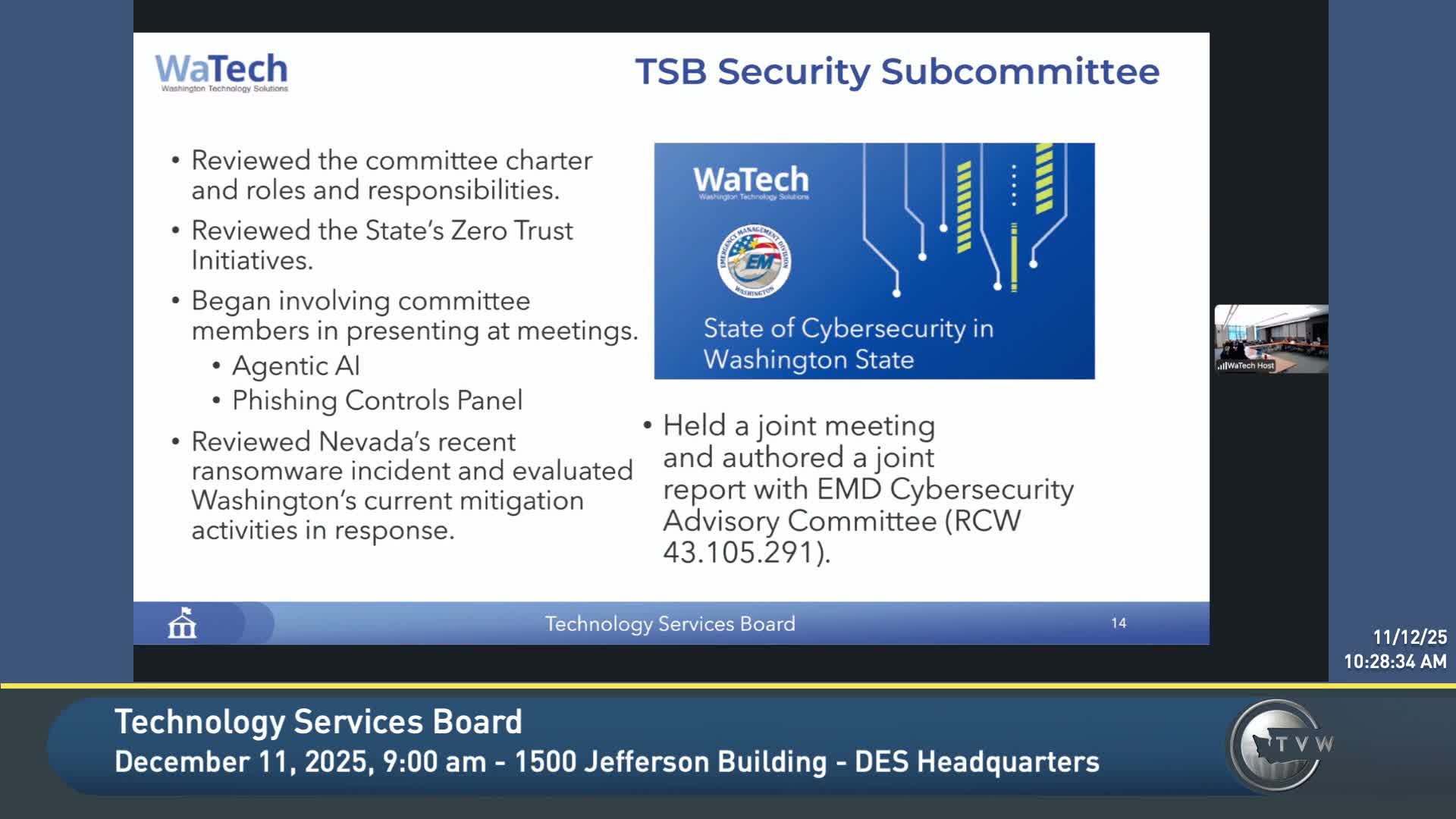
Ralph Johnson, the chair of the security subcommittee, briefed the board on the group’s work this year, including a joint meeting with the Emergency Management Division’s cybersecurity advisory committee and a confidential after‑action review of a major ransomware incident in Nevada that shut systems for weeks.
Johnson said the subcommittee reviewed the Nevada after‑action report to identify gaps the state should address and recommended maintaining some material as nonpublic because it contains sensitive infrastructure details. He described subcommittee activities including a phishing controls panel, charter review, and a presentation on zero‑trust adoption.
Separately, Zach Hudgins presented the state and local cybersecurity grant program (SLCGP) update: the program reported roughly 80% of first‑round projects closed and 51% of second‑round projects closed; the state awarded 108 projects this round across 76 entities and disbursed $6,600,000 while reallocating $1,900,000 into a fourth round. Hudgins said the project list has been submitted to FEMA and CISA for federal approval.
Board members stressed that grant success depends on ongoing executive and legislative support; presenters said the program’s legislative match helped accelerate federal reimbursements and local adoption.
What’s next: Federal review of the current project list, continued subcommittee work to shore up statewide defensive controls and further outreach to local governments and critical infrastructure partners.