Get Full Government Meeting Transcripts, Videos, & Alerts Forever!
Get email alerts on the Plan Certification topic
No spam. Unsubscribe anytime.
Exchange proposes authority to require carriers to serve underserved counties; San Juan singled out for 2027
Summary
Exchange staff presented draft legislation to let the board add targeted plan-certification criteria to address access and affordability. For plan year 2027 staff proposes requiring carriers filing in certain oversaturated rating areas to also file in an identified underserved county (San Juan), with a waiver process and interagency coordination with OIC and HCA.
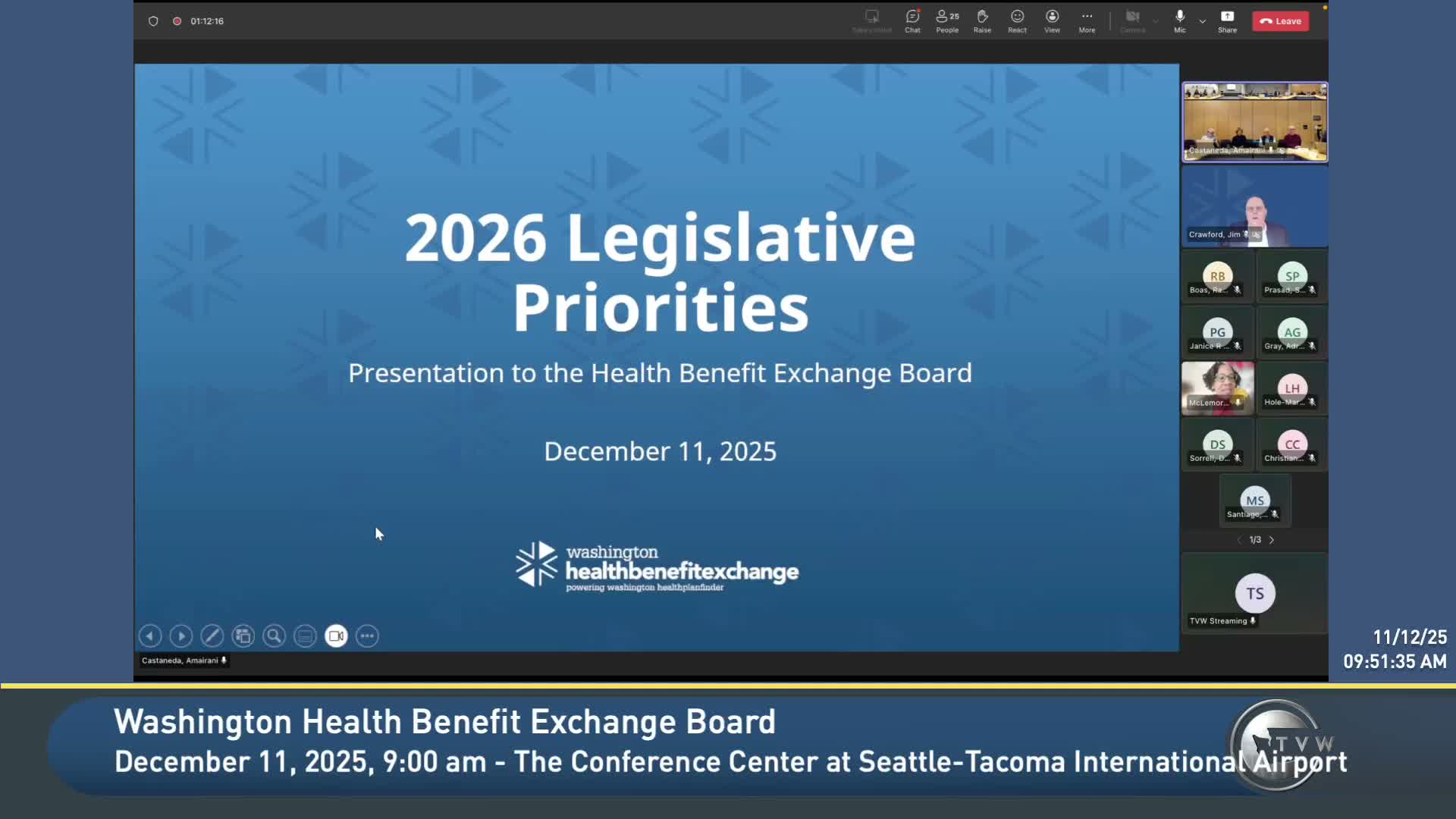
Exchange legislative staff outlined a bill concept on Dec. 11 that would expand the Washington Health Benefits Exchange's ability to use the plan-certification process to address county-level gaps in carrier participation.
Shirley Posada, legislative lead, said the draft bill would let the Exchange add specific criteria during plan certification to ensure carriers address "access and affordability" problems the board identifies. Laura Kate Zajken, director of market competition and affordability, described an incremental approach for plan year 2027 focused on two priorities: (1) ensuring underserved counties have multiple carriers and (2) preserving a range of metal levels (bronze, silver, gold) in those counties.
Under the proposed guidance, staff would define an "underserved county" each year; for plan year 2027 staff identified San Juan County as meeting the criteria because it had only a single carrier in 2026. The draft would require carriers that file plans in a rating area that includes that underserved county to file a plan for San Juan, across multiple metal levels. Staff said a formal waiver process would let carriers request exceptions where network or affordability constraints exist and that the waiver review would ask for data to evaluate the net effect on consumer access.
Several board members and delegates raised operational and legal questions. Delegates from the Office of the Insurance Commissioner and the Health Care Authority thanked staff for early consultation but warned about potential unintended consequences, including impacts to actuarial justification and rate filings if participation rules change after carriers have made filing decisions. Staff emphasized a reconciliation and negotiation process with carriers, and said other levers (including conversations with OIC and HCA's authorities) would be deployed if a county remains underserved.
Proponents said the policy is intended to protect rural and other high-risk counties where market dynamics can leave consumers with little or no choice; one board member suggested options such as capping the number of carriers in oversaturated counties in future years, but staff said such limits are not recommended for 2027 in this incremental proposal.
Staff said the bill language is intended to be targeted rather than "unfettered authority," with annual guidance and public comment built into the process. They asked the board for directional alignment so staff can continue stakeholder outreach and finalize decision packages for the governor's budget process.
Board members were asked to prioritize attendance at upcoming Hill Day and legislative engagements to support the Exchange's funding requests and statutory proposals.