Senate committee moves bill to remove one-sided ballot sentence for school referenda
Loading...
Summary
The Senate Elections Committee recommended passage of Senate File 1310, which would remove or rebalance the standard ballot sentence stating that a "yes" vote increases property taxes; supporters said the sentence misleads voters, while opponents warned the change could reduce transparency. The committee voted 6–5 to send the bill to education policy.
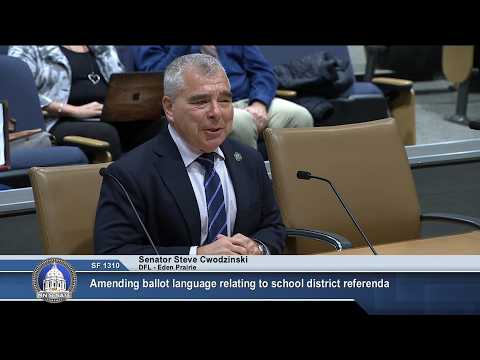
Senator Swadzinski moved Senate File 1310 on Feb. 21, arguing the long-standing ballot sentence that begins "by voting yes on this ballot question, you are voting for a property tax increase" unfairly biases voters against school referenda.
Swadzinski said the wording can mislead voters because ballots also show per-pupil dollars that are not the same as an individual homeowner’s tax change. "It seems almost undemocratic ... you're being told what to think," he said, urging removal or rebalancing of the sentence so the ballot does not "tip the scales." He offered the bill with an author's 8-2 amendment to update dates, which the committee adopted by voice vote.
Superintendent Christine Tucci Osorio of ISD 622 (North St. Paul–Maplewood–Oakdale) testified that Minnesota’s reliance on local property taxes creates inequitable funding across districts and that the current ballot sentence exacerbates confusion. She told the committee her district is "very high poverty" and that 68% of students qualify for free and reduced-price lunch. After a failed referendum last fall, residents told her they believed their taxes would go up by large, misleading figures.
Sam Rosemark, a school board member for ISD 622, said voters saw per-pupil amounts such as "$1,152 per pupil" and mistakenly assumed their personal tax bill would rise by that whole dollar figure. He said, "Once I explained ... what the tax increase could be for them, which would be about on average 8% increase for the average $300,000 home," many voters better understood the measure.
Kim McLaughlin, treasurer of ISD 701 (Hibbing), testified by Zoom that two levy questions failed in her district and that the district faces a roughly $2.6 million shortfall and the elimination of 34 positions. She said the blanket sentence on the ballot "oversimplifies something that is far more complex" and can undermine voters’ understanding at the point of decision.
Committee members pressed the author and testifiers on whether removing the sentence would reduce transparency. Senator Matthews proposed an amendment to require symmetric language telling voters "what yes means" and "what no means" on the ballot notice rather than striking the existing sentence outright. Matthews argued the current sentence exists to warn voters that a referendum may increase taxes and to preserve clear expectations at the ballot box.
Swadzinski opposed the amendment and said it should be workshopped; he asked members to vote no so he could "further process it." After debate, the committee held a roll call on Matthews’ amendment; the chair announced, "There being 6 ayes and 7 nays, the motion does not prevail." Later a separate amendment offered by Senator Lucero (an a5 amendment related to judicial incumbency language on ballots) also failed on roll call.
After further discussion about property classes, per-pupil figures, and options for clearer ballot language, the committee voted on Senate File 1310 as amended. The chair announced, "There being 6 ayes and 5 nays." The bill was recommended to pass and was re-referred to the education policy committee for additional work on the detailed ballot wording.
The committee record shows the debate centered on trade-offs between clarity at the ballot and the risk of a single sentence oversimplifying complex levy mechanics. Supporters pressed that districts already provide individualized tax calculators and notices, and that the one-sentence notice can nonetheless steer voters toward a default "no." Opponents said the ballot is one of the few places to give a succinct warning and that striking the sentence risks less transparency at the point of voting.
The next procedural step is for the bill to be considered by the education policy committee, where members said the per-pupil and notice language could be further refined.